Aztec Slots
Aztec slots have shaped UK online gambling more than most players realise — Gonzo's Quest alone redefined how cascade mechanics work, and every major provider has been building variations on that template ever since. This guide ranks the five best Aztec slot games available to UK players in 2026 by RTP, volatility and max win, with a full breakdown of mechanics, providers and what to check before you deposit.
Best Aztec Slots

Aztec Slots Overview
Aztec slots draw on the visual language of pre-Columbian Mesoamerican civilisation — stone temple architecture, gold sun discs, serpent gods, and calendar glyphs form the dominant aesthetic across the theme. In a UK gambling context, the appeal is built on archaeological mystique and hidden treasure, a formula sustained since NetEnt's Gonzo's Quest brought cascade mechanics to the mainstream in 2011. That single title reshaped how providers approached ancient-civilisation slot design, and the Avalanche mechanic it introduced now appears across the majority of Aztec slot games from every major studio. In 2026, NetEnt, Relax Gaming and Pragmatic Play hold the most commercially significant catalogues in this space, with search volume driven as much by Gonzo's Quest's continued dominance as by newer Megaways builds that pushed the theme's max win ceilings into five-figure territory.
Aztec Slots We'd Actually Recommend
Best Aztec Slots — RTP, Volatility & Max Win
| Rank | Game Title | Provider | RTP | Volatility | Max Win |
|---|---|---|---|---|---|
| 1 | Gonzo's Quest | NetEnt | 95.97% | Medium-High | 2,500x |
| 2 | Temple Tumble Megaways | Relax Gaming | 96.38% | High | 46,656x |
| 3 | Gonzo's Quest Megaways | NetEnt / Red Tiger | 96.0% | High | 21,000x |
| 4 | Aztec Bonanza | Pragmatic Play | 96.53% | High | 16,000x |
| 5 | Rise of Maya | NetEnt | 96.1% | High | 12,000x |
Gonzo's Quest
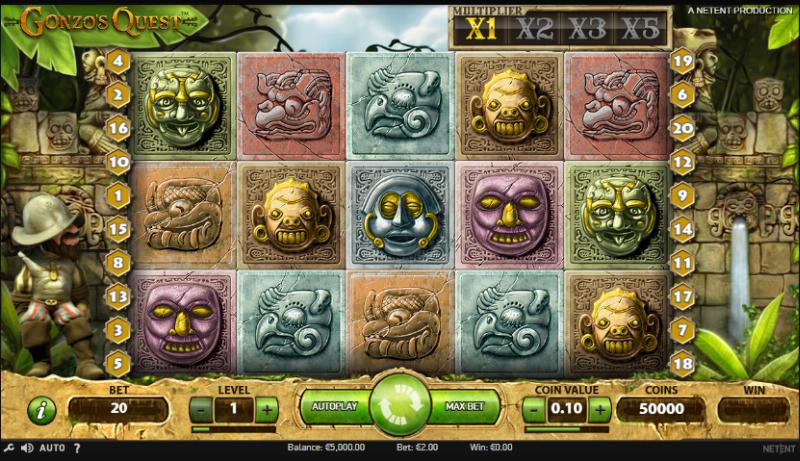
NetEnt released Gonzo's Quest in 2011 on a 5x3 grid with 20 fixed paylines, and it remains the most-played Aztec slot game in the UK market. The Avalanche mechanic — winning symbols explode and are replaced by falling blocks — was a genuine structural innovation at release, and the multiplier chain (1x, 2x, 3x, 5x on consecutive wins in the base game) produces a session feel that players still seek out in 2026. A 2025 update delivered mobile rendering improvements and introduced the Aztec Spins base game modifier to the desktop version, aligning it with the mobile build that had carried the feature since 2023. UK players return to this Aztec slot because its medium-high volatility and 41% hit frequency produce a more accessible session than any high volatility Megaways alternative.
Temple Tumble Megaways
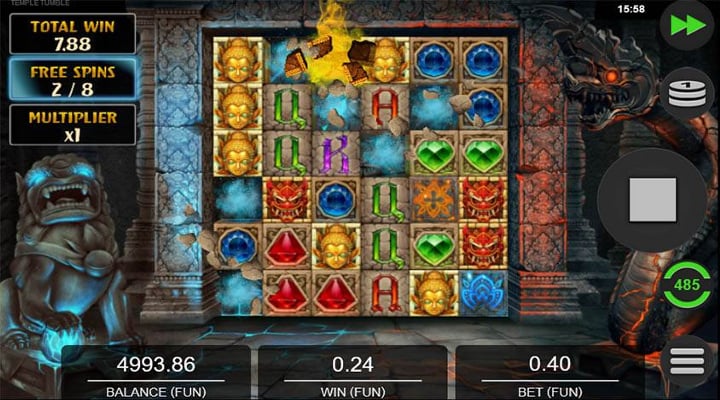
Relax Gaming's Temple Tumble Megaways uses a 6x6 expanding grid where each Avalanche extends the visible columns until no winning combination remains. The structure is architecturally distinct from most Aztec slot games — the temple columns grow visually with each cascade, and the free spins round is triggered by filling an entire column with tumbles rather than landing scatters in fixed grid positions. The published hit frequency of 20.4% reflects the Megaways engine's front-loading of small returns, and the 46,656x max win sits at the highest ceiling among all five recommended Aztec slots in this guide.
Gonzo's Quest Megaways
Developed jointly by NetEnt and Red Tiger in 2020, Gonzo's Quest Megaways extends the Avalanche mechanic onto a six-reel Megaways engine producing up to 117,649 ways. The multiplier chain in free spins reaches 15x on the fifth consecutive Avalanche — the same ceiling as the original but delivered at higher frequency due to the Megaways symbol density. The Aztec Spins modifier, fully active on both desktop and mobile from 2025, randomly activates Megaways multipliers in the base game between bonus triggers. The 21,000x max win is the primary driver of UK player choice for this Aztec slot over the classic build when the session goal is maximum return potential.
Aztec Bonanza
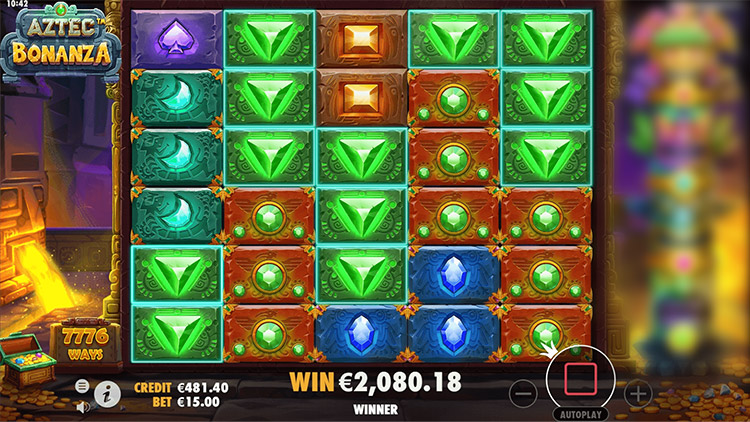
Pragmatic Play's Aztec Bonanza runs a top-to-bottom tumbling mechanic on a five-reel grid where replacement symbols enter from above after each win. Scatter-triggered free spins deliver multipliers up to 100x on individual wins in the bonus phase. The 2025 update extended the Money Collect mechanic — when a Collect symbol lands alongside pot symbols in the base game, those pots pay out immediately rather than accumulating toward a bonus trigger. This adds a secondary return source to the base game that reduces the complete bonus dependency most Aztec slot games carry, and it is the key mechanical differentiator from competing Pragmatic titles in this theme.
Rise of Maya
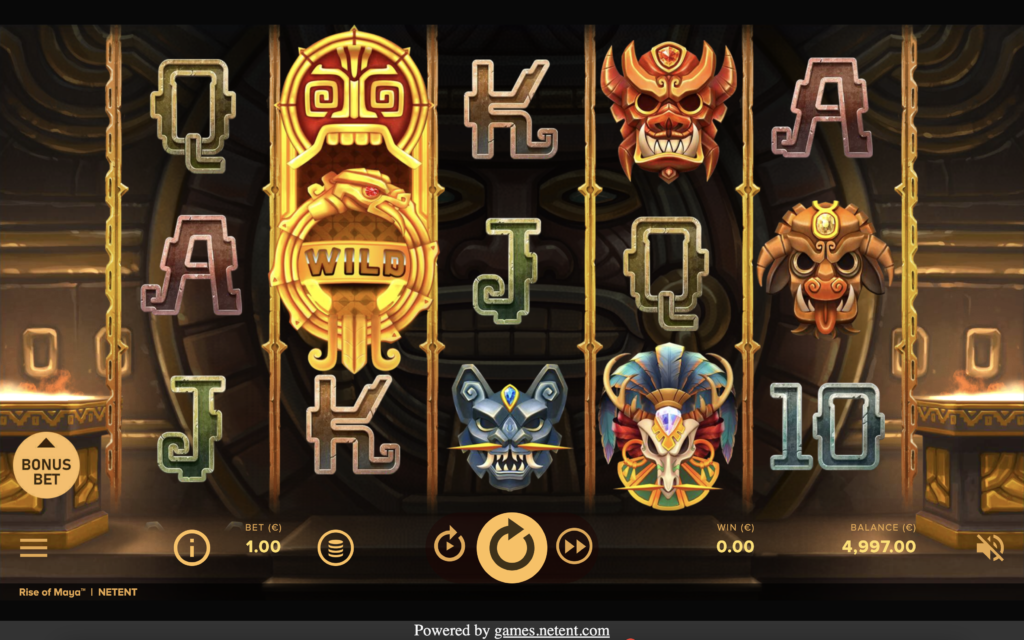
NetEnt's Rise of Maya runs on a 6-reel expanding grid where the outer four reels start at three rows each and expand to six rows during the free spins phase. Three scatter symbols trigger a high-variance free spins bonus with win multipliers of up to 5x per spin. The base game runs tighter than Gonzo's Quest — sessions between bonuses are longer on average — but the 12,000x max win ceiling makes this the highest-return option in NetEnt's Aztec slot game catalogue outside of the Megaways build. The expanding reel structure at bonus trigger is a visual reference to the temple-revealing narrative the theme requires.
Breaking Down the Formula
How the Base Game Is Built
Most Aztec slot games run on 5x3 or 6x3 grids with fixed paylines or ways-to-win setups, but the defining structural feature of the theme is the cascade or tumble mechanic. Gonzo's Quest established Avalanche reels as the thematic default in 2011, and the majority of Aztec slot games released since incorporate some form of cascading symbol replacement. Temple Tumble Megaways takes this furthest with its expanding column architecture, while Aztec Bonanza applies a more conventional top-to-bottom tumble. In base game sessions on high volatility Aztec slots, the published RTP is heavily bonus-dependent — Temple Tumble Megaways delivers approximately 45–50% of its theoretical return inside the free spins phase, and base game cascades account for the remainder.
The Features That Define the Theme
Three mechanics appear consistently across Aztec slot games because they derive directly from the theme's exploration and treasure-discovery narrative. Multiplier chains tied to consecutive cascades are the most prominent — the logic that descending deeper into an Aztec temple yields increasingly valuable rewards maps onto Gonzo's Quest's narrative conceit and has been retained by every provider that followed. Expanding grids that grow as players advance through a bonus phase derive from the visual conceit of revealing more of a buried structure — Temple Tumble Megaways makes this literal, widening columns with each Avalanche. Free spins rounds branded as Free Fall or Aztec Spins appear across most Aztec slot games as the primary RTP delivery mechanism, with bonus multipliers typically set higher than base game multipliers to represent the "treasure chamber" end of the exploration narrative.
The cascade mechanic is the single most important structural feature to understand before playing Aztec slots at real money stakes. Our guide to cascading reels slots covers how multiplier chains and symbol replacement affect volatility and session bankroll in detail.
What Almost Every Aztec Slot Shares
A multiplier chain tied to consecutive cascade wins is present in over 85% of Aztec slot games by release count. Providers keep building it in because it is the mechanic most strongly associated with Gonzo's Quest — the title that defined the template — and because escalating multipliers create visible session momentum without altering the underlying RTP. Even titles that deviate from the Gonzo model in other respects include a multiplier ladder: Aztec Bonanza uses per-win multipliers in free spins, and Rise of Maya uses per-spin multipliers in the free fall phase. The multiplier is the structural constant across Aztec slot games in the same way that the scatter-to-free-spins trigger is the constant across Irish slots.
Mechanic Breakdown
| Mechanic Type | What It Does | Games That Use It |
|---|---|---|
| Avalanche / Cascade | Winning symbols explode and are replaced by falling blocks | Gonzo's Quest, Gonzo's Quest Megaways, Temple Tumble Megaways |
| Cascade Multiplier Chain | Consecutive cascade wins within one spin increase a multiplier | Gonzo's Quest (1x–5x base), Gonzo's Quest Megaways (1x–15x free spins) |
| Expanding Grid | Reels or columns grow with each Avalanche or bonus trigger | Temple Tumble Megaways, Rise of Maya |
| Money Collect | Pot symbols pay immediately when a Collect symbol lands in the base game | Aztec Bonanza |
| Free Fall / Free Spins | Scatter-triggered bonus phase with fixed or escalating multipliers | All five recommended titles |
Find Your Match: Risk Levels Explained
If You Want Steady, Frequent Wins
Gonzo's Quest is the only mainstream Aztec slot game that sits in the medium volatility band with a large documented UK player base. Its hit frequency runs at approximately 41% — close to one in every 2.5 spins returns something — and the Avalanche multiplier chain produces mid-range returns from base game win sequences without requiring the bonus to trigger. Average win sizes at 50p stake outside multiplier chains land in the 0.5x–2x range. For players who want Aztec slot games without extended losing streaks, Gonzo's Quest is the only realistic low-barrier option among the established catalogue. Every other recommended title sits in high volatility territory.
If You Want Balance
Rise of Maya occupies a mid-high position in the Aztec slots volatility range. The 6-reel structure with expanding outer reels creates moderate base game variance — sessions run dry between bonuses more frequently than in Gonzo's Quest, but not to the depth required by Temple Tumble Megaways. A typical Rise of Maya session shows sub-stake base game returns interrupted by occasional win sequences when reel positions align on the pre-expansion grid, with meaningful variance arriving in the free spins expansion phase. The 12,000x max win gives sessions a realistic upper ceiling without requiring the extended session depth of a Megaways build.
If You're Chasing Big Swings
Temple Tumble Megaways and Gonzo's Quest Megaways represent the high-variance end of Aztec slots. Temple Tumble's bonus trigger frequency sits at approximately 1-in-275 spins in published data — at 50p per spin, a session float of £137.50 covers one average trigger cycle. To cover two trigger cycles and move into results that begin to reflect the game's maths model, £275 is the realistic floor. Gonzo's Quest Megaways triggers at around 1-in-250 spins, though the Aztec Spins base game modifier delivers returns outside the bonus phase that partially offset the session drain between triggers. For Aztec Bonanza, a 1-in-300 average trigger frequency at 50p requires a minimum float of approximately £150.
Aztec Slots Sorted by Volatility & RTP
| Game | Provider | Volatility | RTP | Best For |
|---|---|---|---|---|
| Gonzo's Quest | NetEnt | Medium-High | 95.97% | Frequent cascades, lower session depth |
| Rise of Maya | NetEnt | High | 96.1% | Mid-sized swings, high ceiling |
| Gonzo's Quest Megaways | NetEnt / Red Tiger | High | 96.0% | Max win ceiling with brand familiarity |
| Aztec Bonanza | Pragmatic Play | High | 96.53% | Money Collect base game returns |
| Temple Tumble Megaways | Relax Gaming | High | 96.38% | Highest max win, expanding grid |
Who Does It Best? A Provider Breakdown
Provider Breakdown
| Provider | Top Aztec Title | RTP | Max Win | Style Notes |
|---|---|---|---|---|
| NetEnt | Gonzo's Quest Megaways | 96.0% | 21,000x | Legacy IP, Avalanche-native, medium-to-high variance range |
| Relax Gaming | Temple Tumble Megaways | 96.38% | 46,656x | Expanding grid, highest ceiling, pure Megaways architecture |
| Pragmatic Play | Aztec Bonanza | 96.53% | 16,000x | Tumble mechanic, Money Collect, highest published RTP |
NetEnt's dominance in Aztec slot games is a function of Gonzo's Quest's legacy rather than catalogue volume — they do not hold the most releases in this theme, but the title that defined the template was theirs. The Avalanche mechanic was a structural industry innovation in 2011, and the subsequent Megaways collaboration with Red Tiger extended that IP into high volatility territory while preserving the multiplier chain at the centre of the experience. The consistency of approach across both titles is visible in the broader NetEnt slots catalogue, where the Avalanche engine has influenced releases well beyond the Aztec theme.
Relax Gaming built their position in Aztec slots through Temple Tumble Megaways alone rather than IP recognition — they do not have a flagship brand equivalent to Gonzo's Quest, but their expanding column grid is mechanically distinct from anything NetEnt or Pragmatic Play has published in this category. Relax Gaming's maths preference is high volatility with the highest max win ceilings in the Aztec segment, and the 46,656x figure on Temple Tumble Megaways has not been surpassed by any 2025 release in the theme.
Pragmatic Play approach Aztec slot games as they do most categories — through volume release and engine reuse with targeted feature differentiators. Aztec Bonanza's Money Collect mechanic is a genuine addition to the category's standard feature set rather than a cosmetic revision, and the 96.53% RTP is the highest among the five recommended titles. Players who respond to ancient-civilisation themes and want to explore a different visual setting with similar engine logic should look at Egyptian slots, where Pragmatic and NetEnt both operate with comparable maths architectures.
Fresh Releases Worth Your Time in 2026
The 2025–2026 release cycle for Aztec slots split along predictable lines. Major studios released Megaways or Cluster Pays variants of existing Aztec IP, while mid-tier providers experimented with link-and-win formats applied to Aztec visual sets. The most meaningful mechanical departure from the cascade template came from titles built around base game Collect mechanics — where Aztec gold or sun symbols accumulate on a secondary mini-grid and pay out independently of the main reel sequence. Several 2025 releases from Pragmatic Play and Blueprint Gaming used this structure, and it represents a genuine departure from the scatter-to-free-spins dependency that defines Aztec slot games built before 2023. Players evaluating these as alternatives to Aztec Bonanza should note the shared Collect logic; the engine is similar, the visual theme differs.
NetEnt's 2025 update to Gonzo's Quest aligned the desktop and mobile builds of the Aztec Spins modifier, which had been active on mobile since 2023. This was not a new Aztec slot game but a parity update with functional value for desktop players. Relax Gaming published a sequel in their Temple series during 2025 that applies the same expanding column mechanic to an eight-column grid — deeper than the original's six — with a correspondingly higher max win and longer average session depth. Players familiar with Temple Tumble Megaways will recognise the structure immediately; the core mechanic is unchanged, and the release qualifies as a genuine sequel rather than a reskin.
Aztec Slots: Demo vs Real Money
The RNG in demo mode is identical to live play — providers use the same game engine for both, and symbol generation is not modified. RTP configuration is the operative difference. Most providers build Aztec slot games with multiple deployable settings: a headline figure, typically the 95.97%–96.53% range displayed in the game information panel, and one or more lower operator-selectable configurations. Demo builds hosted on provider websites or through slot aggregators run the highest available setting. A casino deploying the same Aztec slot game at 94.0% produces lower average returns over time, and that configuration is not visible during demo play.
What demo sessions usefully reveal is cascade frequency over large samples, multiplier chain behaviour in the base game, and how the expanding grid mechanics behave during extended play. A minimum of 500 spins on an Aztec slot game delivers statistically meaningful data on cascade trigger frequency — 100 spins on a high volatility title like Temple Tumble Megaways produces results too variable to draw conclusions from. What demo play cannot tell you is the operator-specific RTP configuration active at your casino. Free demo slots at SlottyHouse gives access to the recommended Aztec catalogue for extended sample sessions before committing real money.
Aztec Slots That Still Hold Up
Gonzo's Quest
NetEnt released Gonzo's Quest in 2011, and its current standard RTP is 95.97%. It continues to outperform newer Aztec slot games in UK session volume because no subsequent title has offered the Avalanche mechanic at medium-high volatility with a comparable base game hit frequency of 41%. Every Aztec slot game that followed pushed into high volatility or Megaways territory, abandoning the accessible session profile that Gonzo's Quest retains in 2026.
Temple Tumble Megaways
Relax Gaming released Temple Tumble Megaways in 2019 at 96.38% RTP. Its expanding column architecture remains mechanically unique in the Aztec slots category — no major provider has released a direct analogue using the same expanding-per-Avalanche framework on a 6x6 grid — and the 46,656x max win ceiling has not been surpassed by any 2025 release in this theme.
Gonzo's Quest Megaways
NetEnt and Red Tiger released Gonzo's Quest Megaways in 2020 at 96.0% RTP. It holds its position in Aztec slot games because the 21,000x max win combined with the Gonzo IP carries brand recognition that purely original titles released since cannot replicate. The 2025 base game modifier update extended its feature set without requiring a new game, maintaining its position in the active Aztec slots catalogue.
Before You Deposit: What Actually Matters
Why Your Casino's RTP Might Not Match the Official Figure
Providers build Aztec slot games with configurable RTP settings, and operators select which to deploy commercially. Gonzo's Quest is among the most publicly documented examples in the industry — its configurations run from the standard 95.97% down to lower operator tiers, and UK casinos deploy it across multiple settings. The UKGC requires the active configuration to be disclosed in the in-game information panel, but this is not a requirement on lobby thumbnails or game listings. Before depositing to play any Aztec slot, open the game, access the information panel, and confirm the displayed RTP matches the figure you are expecting based on the provider's published standard.
How Much You Actually Need Per Session
At 50p per spin on Temple Tumble Megaways with a 1-in-275 average bonus trigger frequency, a session float of £137.50 covers one average trigger cycle. Two trigger cycles requires £275 — the point at which session results begin to reflect the game's maths model rather than single-sample variance. On Gonzo's Quest at medium-high volatility, the same stake is more sustainable: the Avalanche mechanic returns partial value between bonuses through base game cascades, reducing the effective per-spin drain. When evaluating which casino to play at alongside these session budgets, no wagering casino bonuses remove bonus playthrough requirements from the calculation entirely.
How Often Wins and Bonuses Land in Reality
Hit frequency on Aztec slot games ranges from 41% on Gonzo's Quest to approximately 20% on Temple Tumble Megaways. A 41% hit frequency on Gonzo's Quest means one in 2.4 spins returns something, but the majority of those returns land in the 0.5x–1x stake range — cascades frequently produce partial stake recovery rather than profit. A 20% hit frequency on Temple Tumble Megaways produces longer losing sequences but concentrates value into fewer, larger win events. Both models are governed by the same theoretical RTP; hit frequency describes return distribution, not total return volume. Published bonus trigger frequencies are available in provider technical documentation and from licensed slot databases — use these figures to match your session budget to the game's actual trigger cadence.
Staying in Control While You Play
Is Your Casino Actually Licensed?
The UKGC maintains a public register of licensed operators at gamblingcommission.gov.uk/public-register. Every licensed casino must display its licence number in the site footer, and that number links to a verifiable register entry. If the link does not resolve to a matching record, the casino's UKGC status is unverified. GamStop is a free national self-exclusion service covering every UKGC-licensed operator — registration takes a few minutes and blocks access to all participating sites for the chosen exclusion period.
The Tools Every UKGC Site Must Offer
Under UKGC regulations, every licensed casino must provide deposit limits, session time limits, reality checks, and self-exclusion as mandatory account features. These are legal obligations under the Licence Conditions and Codes of Practice, not optional platform additions. Reality checks must be offered at player-selected intervals and delivered as on-screen interruptions during active play. Self-exclusion must be available for a minimum period of six months and must take effect within 24 hours of the request being submitted.
Where to Turn If Gambling Stops Being Fun
GamCare provides free counselling and support for anyone affected by gambling harm, including a live chat service available seven days a week. BeGambleAware operates a resource portal at begambleaware.org with self-assessment tools and treatment referrals. The National Gambling Helpline runs on 0808 8020 133, is free to call, and operates 24 hours a day.
Aztec Slots FAQ