Pragmatic Play Slots
Best Pragmatic Play Slots







Pragmatic Play at a glance
Start with The Dog House for fixed paylines, Gates of Olympus for pay-anywhere tumbles, or Big Bass Bonanza for a collector bonus. Those are comparisons by documented mechanics, not recommendations based on which game is most likely to pay during your session.
Our selection includes Pragmatic Play games and officially distributed partner titles, with the studio identified where relevant. The focus is on contrasting features, not casino popularity or a claim to cover the entire catalogue.
| Question | Answer |
|---|---|
| What does the business supply? | Casino software and games, including slots; the casino operator manages the player account. |
| Where is its headquarters? | Gibraltar, according to the current corporate description. |
| Who owns it? | A private investor group led by Veridian (Gibraltar) Limited. |
| Which partner studios matter here? | Reel Kingdom and Fat Panda; distribution does not erase studio attribution. |
| What distinguishes the slot range? | Pay-anywhere tumbles, cluster multipliers, collector bonuses, sticky wilds and licensed Megaways games. |
| Does the provider name establish casino safety? | No. Check the operator and its exact website separately. |
Selected Pragmatic Play games
These eight choices demonstrate contrasting features rather than an overall winner. The table is a navigation aid: use the game analysis below to understand what the feature actually does. Where two games belong to the same family, they are listed separately because a familiar name or character does not make their rules interchangeable.
| Game | What it illustrates | Important distinction |
|---|---|---|
| Gates of Olympus | Pay-anywhere tumbles and an accumulating bonus multiplier | The original, not Gates of Olympus 1000 or POP |
| Sweet Bonanza | Tumbles and bonus multiplier bombs | Matching symbols need not form an adjacent cluster |
| The Dog House | Fixed paylines and sticky multiplier wilds | The original has 20 paylines, not Megaways |
| Sugar Rush | Cluster wins and position-based multipliers | Marked grid positions matter, not just the symbols currently occupying them |
| Big Bass Bonanza | Money-symbol collection and bonus progression | A Reel Kingdom partnership title; money symbols need the relevant collector |
| Wolf Gold | Money Respins and a fixed jackpot award | A jackpot label does not automatically mean a growing network pool |
| The Dog House Megaways | Changing reel heights and two free-spin modes | Sticky Wilds and Raining Wilds develop differently |
| Sweet Bonanza 1000 | A later edition with larger multiplier possibilities | Its maximum total win is different from an individual multiplier value |
Gates of Olympus: follow the multiplier calculation
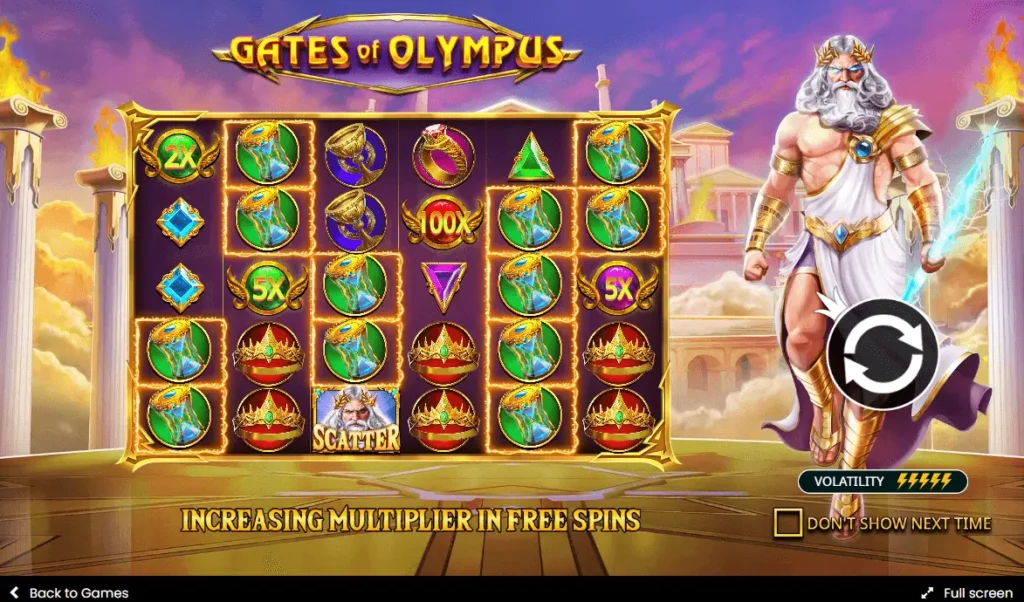
The original Gates of Olympus counts matching symbols across six reels instead of asking you to trace a payline. A win clears the relevant symbols and allows replacements to fall into the gaps. The feature to watch is how a multiplier applies to that winning sequence, rather than treating every falling symbol as a separate paid spin.
During free spins, qualifying multiplier symbols contribute to a running multiplier total. That changes the role of an otherwise familiar tumble: the bonus can develop across its sequence rather than starting from the same position each time. It also makes the final summary more informative than a dramatic individual animation. This is a useful example for readers who enjoy following a changing calculation, but it is less direct than a game that shows a winning line and immediately settles it.
The scatter trigger is separate from an ordinary symbol win: four or more scatters award 15 free spins. This matters when reading the screen because a successful tumble and a bonus trigger are not the same event. The base game can award multiplier-assisted wins without that event also starting the free-spin feature.
Sweet Bonanza: fruit symbols without traditional fruit-machine rules
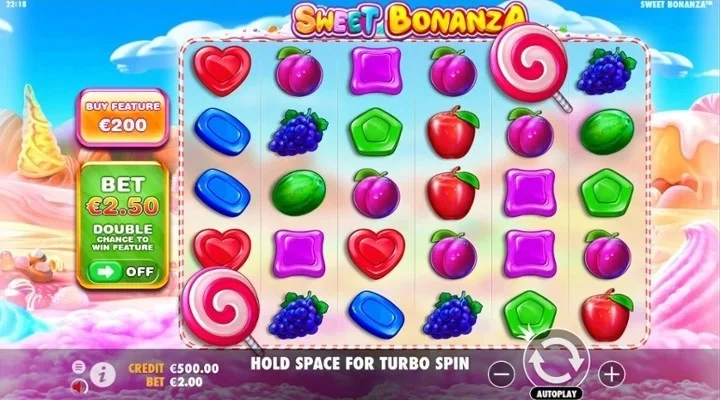
Sweet Bonanza’s original game also counts matches anywhere on the screen, with at least eight matching symbols needed for an ordinary symbol win. The sweets do not have to touch. Confusing that rule with cluster pays makes it harder to understand why one scattered arrangement pays while an attractive smaller group does not.
The bonus bombs provide the main multiplier distinction. Their values are combined at the end of a qualifying tumble sequence. Sweet Bonanza is the comparison to use for a multiplier calculated within that sequence; Gates is the comparison for a multiplier total that can develop across the free-spin bonus. The cheerful artwork does not make either system low-risk.
The Dog House: a clearer line-based contrast
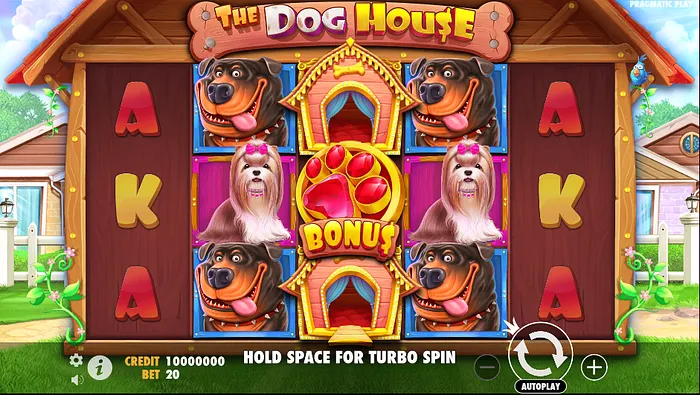
The original Dog House uses five reels, three rows and 20 fixed paylines. Multiplier wilds can appear on the middle reels, while its free-spin feature allows wilds to stay in place. It is a useful counterpoint to pay-anywhere games because symbol position along a paying line remains central to reading an outcome.
A persistent wild changes the next spin’s available combinations without guaranteeing a win. To compare it with random wilds, check whether new wilds appear independently on each spin or earlier ones remain. A screenshot can make these features look alike; the difference becomes clear across successive spins.
For a further comparison within the portfolio, our Hand Of Midas 2 review covers sticky multiplier wilds combined with a developing bonus multiplier. It is another distinct sequel, not the original Hand of Midas. Compare what remains on the reels with what accumulates in the bonus calculation; those are related but separate effects.
Sugar Rush: the grid remembers where wins happened
Sugar Rush uses cluster wins and leaves marks on winning positions. When later wins revisit marked spaces, multipliers can develop there. During the free-spin feature, those positions and their multipliers persist across the bonus. That makes the geography of the grid part of the game’s logic, not simply a background for the next set of sweets.
The practical distinction from Sweet Bonanza is therefore larger than a different candy design. One asks you to count a sufficient number of matching symbols across the screen; the other builds around winning clusters and the places they occupy. Sugar Rush is the more useful example when you want to understand how a bonus can develop through persistent positions.
For the original game’s progression and reset rules, see the Sugar Rush slot review. On marked positions, repeated qualifying wins develop multipliers from 2x through successive doublings, up to 128x. Their location is crucial: a strong multiplier in one part of the grid is not a multiplier on every award anywhere else.
Big Bass Bonanza: collection, not an automatic award
Big Bass Bonanza was released through Pragmatic Play’s partnership with Reel Kingdom. Its free spins pair money symbols with fisherman wilds that collect their values. A screen containing fish is not necessarily a completed collection: the relationship between the money symbols and the fisherman is what matters.
Every fourth fisherman retriggers 10 free spins. Successive retriggers increase the collection multiplier to 2x, 3x and then 10x. That gives the progress display a concrete job: it tracks fishermen towards the next stage, not a cash balance. The original is a useful starting point for understanding collection mechanics before comparing the different rules of Big Bass Bonanza Megaways or another fishing sequel.
For the fishing series in particular, our Reel Kingdom guide explains the studio behind the supplier logo. That credit matters when comparing related titles: an official distribution partnership is a sound reason to include a game here, whereas a casino grid that happens to mix suppliers is not.
Wolf Gold: a jackpot with a stated bet multiple
Wolf Gold provides a different kind of feature sequence through Money Respins. Qualifying money symbols remain while the remaining positions respin, and new money symbols reset the respin counter. Filling all 15 positions awards the Mega Jackpot of 1,000 times the bet under the published rules.
That is a fixed bet-multiple award, not evidence of a prize growing from contributions across an operator network. The distinction matters when comparing jackpot advertising. A board with one empty position can be visually compelling, but the missing symbol is still an uncertain future outcome. Read the awarded total when the feature finishes instead of treating an almost-full board as an unpaid balance that the game must eventually deliver.
A contrasting money-themed game appears in our Wild Cash review. That title is made by BGaming, not Pragmatic Play, and its bonus uses a separate reel machine to select a multiplier. Compare that multiplier-selection mechanism with Wolf Gold’s retained money symbols; the shared banknote imagery tells you little about how the award is calculated.
The Dog House Megaways: choose between different bonus structures
This edition replaces the original’s fixed lines with changing reel heights and up to 117,649 ways. The bonus offers Sticky Wilds or Raining Wilds. In the sticky mode, wilds remain and adjust to the changing reels; in the raining mode, random wilds are added on individual free spins.
The choice is therefore about persistence versus renewed placement, not simply picking whichever opening screen displays more free spins. A longer allocation does not independently establish a better expected return, because the rest of the feature’s mathematics also matters. This is an example of a sequel that merits its own explanation: using the original Dog House screenshot or rules as a complete guide would conceal a substantial part of the decision.
The published allocations make the contrast concrete: Sticky Wilds awards between seven and 20 free spins, while Raining Wilds awards between 15 and 30, depending on the scatter trigger. Comparing those counts without the corresponding wild behaviour would compare only part of each feature. More starting spins and more persistent positions are different benefits within their respective rules.
Sweet Bonanza 1000: distinguish a multiplier from the win cap
Sweet Bonanza 1000 retains the pay-anywhere and tumble idea but publishes bonus multipliers reaching 1,000x and a maximum total win of 25,000x the bet. Those numbers describe different limits. The presence of the larger bomb does not mean that every triggered bonus approaches the overall ceiling.
For comparison, the original Sweet Bonanza’s published bonus bomb values reach 100x. The later edition’s larger headline is a reason to examine a different ruleset, not a shortcut to judging value. The same caution applies when moving from the original Gates of Olympus to Gates of Olympus 1000: the name identifies an edition, not a personal target, a likelihood or a guarantee that a longer session will encounter its headline feature.
How the main feature systems differ
Some games combine several systems rather than relying on one signature bonus. The Great Chicken Escape slot review covers a Pragmatic title with random symbol features, expanding wilds and several bonus games. It is a useful next comparison after a single-feature example: identify the active bonus first, then check which symbol rules apply to that particular sequence.
Several labels can apply to the same game because they describe different parts of the calculation. Pay-anywhere describes where matching symbols may count. Tumbles describe what happens after a win. A multiplier describes how an eligible award is scaled. Keeping these jobs separate is more useful than treating every animated grid as the same kind of slot.
Persistence is another important dividing line. A wild can remain for a respin, for the rest of a bonus, or only for the current evaluation. A multiplier can belong to a symbol, a grid position or a running bonus total. The question to ask is what carries forward, and exactly when it resets. Similar animations can conceal different answers.
There are also collection features with a finite counter rather than an open-ended sequence of ordinary spins. The mechanics described in hold and spin slots provide useful context for Wolf Gold’s retained money symbols. Compare what resets the counter, which positions remain occupied and when the final award is paid. A reset extends the feature; it does not retrospectively improve every earlier paid spin.
The original Great Rhino offers another instructive persistence example: rhinos can remain during Super Respins and newly added rhinos can extend that feature. The explanation of how Great Rhino pays separates it from the Megaways sequel. That is a better comparison than grouping both games under an animal theme and assuming their bonuses work alike.
Published RTP: compare versions, not a provider average
Return to player describes a mathematical long-run proportion of stakes returned as prizes. It is not the fraction of your deposit that must remain after a session. The following figures are those shown on the current official product pages. They are useful for comparing the named listings, but they do not establish the active configuration at a particular casino.
| Exact game | Supplier-published RTP | Scope of the figure |
|---|---|---|
| Gates of Olympus | 96.50% | Original game listing |
| Sweet Bonanza | 96.48% | Current original-game listing |
| The Dog House | 96.51% | Original fixed-payline game |
| Sugar Rush | 96.50% | Original game listing |
| Big Bass Bonanza | 96.71% | Original Reel Kingdom partnership title |
| Wolf Gold | 96.01% | Original game listing |
| The Dog House Megaways | 96.55% | Megaways edition, not the original |
| Sweet Bonanza 1000 | 96.53% | The 1000 edition |
Open the information or help panel in the actual game before committing a stake. Check the full title, its return information and any rules explaining different modes. If that version displays a different figure from a review, do not substitute the review’s number into your decision. The information supplied for the offered game is the relevant starting point for an operator query.
To illustrate the arithmetic, £100 of turnover at 96.50% RTP has a theoretical expected loss of £3.50. At Wolf Gold’s listed 96.01%, the equivalent is £3.99. The difference is £0.49 for that amount of turnover. These are mathematical expectations over repeated outcomes, not predictions that either individual session will end close to those amounts.
Turnover means the total staked, including any winnings staked again. A purely illustrative 500 paid spins at £0.20 would total £100 of turnover; this is not a recommended session or a promise that a deposit will fund that many spins. Confusing deposits with turnover can make repeated wagering seem less costly than it is, especially when small returned amounts are repeatedly recycled.
There is no useful provider-wide average in this comparison. It would depend on the selected games, their configurations and how they were weighted. Equally, Big Bass Bonanza having the highest listed figure among these eight does not establish that it tops the full catalogue. The table is intentionally a set of named examples rather than a league table for every Pragmatic Play release.
Volatility, maximum wins and the cost of waiting
RTP and volatility answer different questions. RTP concerns the long-run return proportion; volatility concerns how unevenly outcomes are distributed. Two games can publish the same RTP while placing very different emphasis on intermittent bonuses, smaller base-game awards or rare large outcomes. Neither a colourful theme nor a high return figure removes the possibility of substantial losses.
The distinction between slot volatility and return is particularly useful with sequels. Gates of Olympus and Gates of Olympus 1000 both currently list 96.50%, yet their multiplier limits differ. That shared percentage alone cannot tell you that bonus frequencies, prize distributions or short-session behaviour are identical. A maximum-win figure supplies none of the missing probabilities.
A progress meter can create a second misunderstanding. When a collector approaches a retrigger, or a retained-symbol board is nearly full, the display describes the current feature state. It does not create a debt to the player. British technical standards prohibit secretly adjusting random results to compensate for earlier outcomes. A previous losing session does not make a future bonus due.
Even an expanding symbol can serve a different purpose. In Book Of Dead, Play’n GO selects an ordinary symbol to expand during free spins. It is not the same as a wild remaining on screen or a multiplier developing on a Sugar Rush position. Similar-looking screen coverage does not establish a comparable risk profile.
Decide what you are willing to spend and when to stop before a feature encourages you to extend a session. Treat a losing limit as a limit, not a target to recover. If the only appealing outcome is an exceptionally large advertised award, the ordinary cost of waiting for uncertain events deserves more attention than the headline. Not playing remains a valid conclusion.
Who makes Pragmatic Play slots?
The current corporate description places Pragmatic Play’s headquarters in Gibraltar and identifies a private investor group led by Veridian (Gibraltar) Limited. It supplies businesses with gaming products. The operator displaying those products is still the business responsible for the player account, payment arrangements and customer support.
The official Pragmatic Play portfolio also includes studio partnerships. Reel Kingdom’s relationship was publicly announced in June 2020, and the original Big Bass Bonanza launch later that year explicitly credited the partnership. The more recent Fat Panda studio debut was announced in March 2025. Including these distributed titles can be appropriate, provided the individual studio credit is not lost.
The wider business also supplies live casino products. For that separate part of its range, our Live Fortune Baccarat guide covers Pragmatic Play’s Fortune 6 Baccarat. Its main wagers and side bets require their own rules and return figures; the slot RTP table above does not apply. A shared supplier name is not a reason to merge these product categories.
New Pragmatic Play slots: September 2026
A new release is useful when it introduces a meaningful difference, not simply because it has a later date. As of September 2026, Gates of Olympus POP is a clear example. Launched on 31 August 2026 as the first POP sub-brand title, it reworks the familiar Zeus presentation into a portrait layout with three reels and five rows.
That narrower arrangement changes how the screen is organised compared with the wider original. It retains a pay-anywhere and tumble approach, with wins starting at five matching symbols rather than the original’s eight. It should be assessed as a separate game, not presented as a mobile display setting that transforms the original Gates into an identical experience.
Lucky Drums 88 also appears in the current supplier catalogue. It combines a wider base grid with collection features that can lead into one or two smaller Hold and Spin grids. The useful point of comparison with Wolf Gold is how the feature space changes and how separate grids are resolved, rather than assuming that every retained-money-symbol bonus is one standard design.
The base game uses a five-by-five grid, while the Hold and Spin feature uses five-by-three grids. Drums can also lead to instant collection awards rather than that feature. A drum appearing is therefore a prompt to read the resulting event, not a guarantee that the same bonus layout follows on every occasion.
A supplier launch announcement does not establish simultaneous release at every British casino. Check the exact available title and information panel, especially when a casino lobby abbreviates a family name. Upcoming catalogue entries, demonstration pages and an operator’s playable real-money list are different surfaces; seeing a promotional thumbnail is not enough to treat them as interchangeable.
Jackpots and Drops & Wins are different things
An in-game jackpot belongs to the game’s rules. Wolf Gold’s full-board award is one example, expressed as a fixed multiple of the stake. A network jackpot would need its own explanation of eligibility, funding and how the shared prize is awarded. Neither model should be inferred simply because a game displays coins, a jackpot label or a large number.
Drops & Wins sits in a different category: it is a promotional programme running alongside eligible games. The announced season spans 4 March 2026 to 3 March 2027 and includes Daily Tournaments and Weekly Wheel Drops. A tournament position or wheel component is not the same thing as a winning combination evaluated by the underlying slot.
The tournament format uses accumulated win multipliers, while the wheel format involves collecting pieces towards a wheel award. Before relying on either, read the actual operator’s promotion terms for eligible titles, participation conditions, territorial access, timing and prize restrictions. The supplier’s global programme page does not prove that a particular British account can participate.
Keep the ordinary game result separate from any promotional result when judging a session. A leaderboard position can move as other people participate; a wheel component is not a cash balance. Additional staking to pursue a rank or complete a collection introduces further spending even when the promotional graphics make progress look nearly finished.
Licensing, testing and British game rules
The current register identifies PragmaticPlay (Gibraltar) Limited under Gambling Commission account 56015, with active remote gambling software and game-host casino permissions. That establishes the supplier’s regulatory position; it does not licence every website that displays its logo. Check the business accepting your money and its exact domain in the regulator’s public register.
Keep that check separate from customer-service questions. The casino’s terms should identify how account complaints are handled and how payments and withdrawals work. A problem with a balance or an offer is not resolved merely by finding the game supplier’s contact page. Record the exact game edition and the relevant account information when raising a query with the operator.
Pragmatic Play names Gaming Laboratories International, Quinel and Gaming Associates among its RNG testing bodies. This supplier disclosure should not be mistaken for a personal audit of every casino installation or a guarantee that an individual session will behave like a theoretical average. Testing and licensing are safeguards around systems and conduct, not promises of profitable play.
British online-slot limits also affect what you should expect in the actual client. The maximum stake per game cycle is £2 for adults aged 18–24 and £5 for those aged 25 and over. Both age-band limits have applied since 2025. They are legal ceilings, not recommended personal stakes, and a lower amount can still be more than someone can afford.
Licensed online gaming requires an individual commitment for each game cycle, so autoplay is not permitted. Slots must also leave at least 2.5 seconds between the starts of game cycles, with outcome-accelerating features such as turbo or quick spin restricted. The timing standard includes an exception for unstaked feature games; that does not permit a global paid-spin turbo button in a British licensed version.
International screenshots and supplier demonstrations may show bonus-buy menus or controls that are not offered in a British licensed version. The regulator has previously required operators to remove feature-buy functionality. Treat the illustrations here as illustrations of the named games, then use the local game’s rules and controls to establish what is actually available.
Casino bonuses: keep offer terms separate from slot rules
In-game free spins and a casino’s promotional free spins are different arrangements. The former are a feature triggered under the slot’s rules. The latter are an operator offer that may specify a title, stake value, expiry and conditions on resulting winnings. Finding a free-spin bonus in the paytable does not establish an entitlement to an operator promotion.
Before accepting an offer, check which games qualify, whether different editions are treated separately, what contributes to any wagering requirement and which balance is used first. Also read the conditions affecting withdrawal and any restrictions on bets while bonus funds are active. A familiar Pragmatic Play logo does not replace that offer-specific information.
Do not choose a game solely because a promotion makes the initial spin appear inexpensive. Extra wagering conditions can change the overall commitment, and a different eligible title may have different rules from the one you intended to assess. If the terms are unclear, ask the operator before accepting; choosing to use no promotion is also an option.
Mobile play and free demos
Pragmatic Play describes its games as supporting mobile and desktop use. That does not establish identical readability on every screen. In a tumble game, check whether you can distinguish the sequence total from an individual symbol award. In a collector game, check whether money values, progression and the remaining bonus spins remain readable together.
Orientation deserves particular attention with wide grids and portrait designs. A useful screen lets you open the rules, see the selected stake and recognise the end of a game cycle without obscuring essential information. Audio, animation and full-screen presentation are preferences, not evidence of better return.
A free demo can help explain controls and feature presentation without making its results a prediction. British operators must verify age before access to their free-to-play gambling games, including relevant affiliate arrangements. A simple declaration that the visitor is old enough is not a substitute for that verification. Still screenshots are different from an interactive demo.
Where a free version represents a corresponding paid game on the same facility, its rules and likelihood of winning must accurately represent that game. Supplier demonstrations designed to show features with different returns require disclosure. Notice which kind of demonstration you are viewing; a conveniently displayed bonus sequence is not evidence of how quickly that bonus will arrive during paid play.
Use any permitted demonstration to answer a bounded question: where the rules sit, how a collector is identified, or how the client reports a completed tumble. Those are observable presentation questions. A short run of virtual-credit outcomes cannot establish that a game is unusually generous, that a bonus is due, or that a different casino uses the same configuration.
Pragmatic Play compared with other studios
Compare individual systems instead of assigning every supplier a single personality. NetEnt’s Starburst uses expanding wilds and respins, providing a compact contrast with the running bonus calculations discussed here. Its gem symbols do not make it mechanically equivalent to another game with gemstones. The same visual category can contain straightforward line rules and much more elaborate feature sequences.
Megaways also crosses supplier boundaries. Pragmatic Play announced its licence from Big Time Gaming for the Great Rhino sequel in April 2020. Red Tiger’s Gonzo’s Quest Megaways uses the same named technology within a different studio’s game. Shared changing-reel mechanics do not make their bonus rules, published return settings or maximum awards interchangeable.
The most useful comparison is between two exact editions that answer the same question. If your interest is persistence, compare sticky wilds with renewed random wilds. If it is readability, compare how each client separates the stake, current win and bonus total. You do not need a provider-wide score to make those distinctions, and a studio logo cannot supply them on its own.
Distribution needs the same care as mechanics. For a separate supplier’s portfolio, our Evoplay guide provides another reference point: Evoplay identifies Gems of Ra: 3 Pots among its own production-ecosystem titles. A similar collection theme or a casino listing that mixes suppliers is not sufficient reason to reclassify that game as Pragmatic Play.
Our verdict
Pragmatic Play’s slot range is most useful to explore by mechanism. Gates of Olympus demonstrates a developing multiplier, Sugar Rush makes grid positions matter, and Big Bass Bonanza shows the difference between displayed money symbols and a completed collection. The original Dog House supplies a line-based alternative, while the later editions show why a family name is not a complete specification.
The strength here is a choice between genuinely different feature systems. Its limitation is that bigger edition numbers, animated progress and promotional layers can distract from the actual rules and cost of play. Choose an exact title you can explain, check the version offered by a properly licensed operator, and decide your limits independently of the next bonus or advertised maximum.
Pragmatic Play Slots FAQ
Choose by the mechanic you want to understand. Gates of Olympus demonstrates pay-anywhere tumbles and a developing multiplier; The Dog House offers fixed paylines and sticky wilds; Big Bass Bonanza uses money-symbol collection. None is a universal best choice, and the published rules do not guarantee a profitable session.
Yes, officially distributed partner games can belong in the portfolio while retaining Reel Kingdom’s studio credit. The original Big Bass Bonanza launch explicitly identifies that partnership. A supplier logo and a development-studio name describe different aspects of a game’s attribution.
Do not assume so. The table records figures published on the supplier’s current pages, not a verified configuration at every casino. Read the information for the exact game offered before staking. A familiar title, screenshot or edition name does not independently establish its active return setting.
No. It is a separate edition. Its official page lists bonus multipliers up to 1,000x and a maximum total win of 25,000x the bet. Those are limits, not probabilities or typical results. Use the rules and return information for the exact edition you are considering.
No. Drops & Wins is a promotional programme with its own eligible games and participation terms. A tournament result or wheel award is separate from the slot’s paytable. Wolf Gold’s fixed full-board jackpot, for example, belongs to that game’s rules rather than this promotional programme.
Do not treat an international screenshot as evidence of British functionality. Autoplay is not permitted in British licensed online gaming, and the regulator has required operators to remove feature-buy options. Use the actual local game’s rules and controls; a historical illustration is not an available-feature checklist.