NetEnt Slots
Best NetEnt Slots







NetEnt at a glance
NetEnt’s strongest starting point is its variety of clearly recognisable game mechanics. Starburst keeps attention on expanding wilds and respins; Aloha! Cluster Pays builds around retained clusters; Divine Fortune adds a separate jackpot feature. We would choose between those systems before choosing a theme. A familiar logo is useful for finding a game, but it tells you little about how its bonus works.
We compared the official NetEnt catalogue and published game rules to select eight titles with contrasting features. This is a documentary assessment, not a play test. The aim is to explain the differences that affect your choice, from the symbol arrangement to what persists during a bonus.
| Question | What matters |
|---|---|
| Who supplies the games? | NetEnt, an Evolution group brand with Swedish roots dating to 1996 |
| What does this guide compare? | Eight selected NetEnt titles, followed by distinct editions and newer releases |
| Does one RTP describe the studio? | No; return information belongs to an exact game and configuration |
| Who manages the casino account? | The casino operator, not the NetEnt brand |
| What is the first useful filter? | The pay system and the feature you actually want to understand |
Start with the pay system you prefer: fixed lines, linked reels or clusters. Then compare the bonus and its reset point. That order makes the differences between the games easier to assess than sorting them by a single return percentage.
Selected NetEnt slots: eight different starting points
These are editorial selections for their contrasting rules, not a ranking by player numbers, largest wins or casino availability. The table gives each game one clear reason to investigate. The sections below explain the practical differences; the RTP comparison comes later so that a percentage does not become the entire recommendation.
| Selected title | Feature to compare | Important distinction |
|---|---|---|
| Starburst | Expanding wilds and respins | A compact feature system rather than a choice of bonus modes |
| Gonzo’s Quest | Avalanches with rising multipliers | Winning symbols disappear and replacement symbols can continue the sequence |
| Dead or Alive 2 | Different free-spin modes | The selected mode changes the feature rules |
| Blood Suckers | Free spins and a separate coffin-picking bonus | Different bonus types should not be treated as one event |
| Twin Spin | Linked adjacent reels | Ways to win are not fixed paylines |
| Divine Fortune | Falling wilds and a jackpot bonus | The original and Megaways edition have different prize structures |
| Aloha! Cluster Pays | Sticky Win Respins | Winning clusters can remain while other symbols change |
| Butterfly Staxx | Butterflies moving across the screen during respins | Position and persistence matter more than a simple symbol count |
Starburst: the clearest introduction to expanding wilds
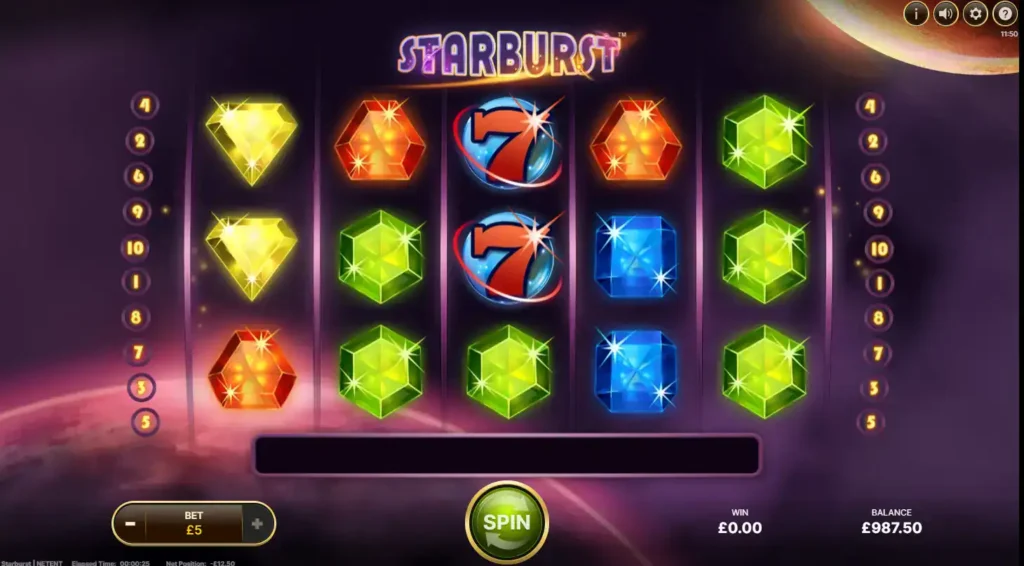
The original Starburst was released in January 2012. Its five-reel, three-row layout uses ten paylines, with expanding wilds and respins providing the main feature. That gives it a relatively small set of rules to learn compared with games that combine several meters, bonus choices and changing reel heights.
The useful question is what happens after a wild appears, not simply how colourful the gems look. Follow which reel expands, what remains for the respin and which symbols are evaluated for a payout. This makes Starburst a good example of a feature that visibly changes the reels without requiring a separate narrative bonus screen.
The appeal is that the feature remains attached to the reels: the star expands, the reel becomes wild and the respin supplies the next result. There is no choice between separate free-spin modes to explain. We favour this focused presentation for learning expanding wilds; readers seeking a more involved bonus progression may prefer another title.
Gonzo’s Quest: follow the whole Avalanche
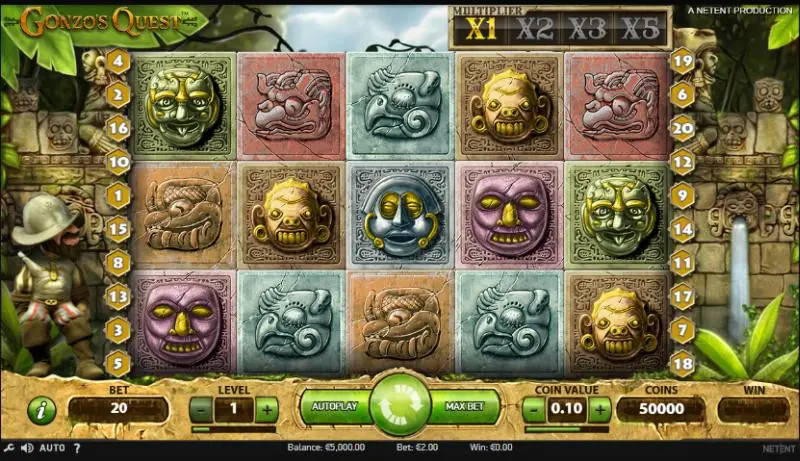
Gonzo’s Quest predates Starburst: the original launched in March 2010. It uses twenty paylines, but its defining feature is the Avalanche. Winning symbols disappear, new symbols fall into the spaces and further wins can continue the sequence. The multiplier rises as wins continue, reaching 5x in base play.
Free Falls changes the multiplier progression, with a ceiling of 15x. The original feature awards ten free spins. These figures belong to the original game; neither the Megaways adaptation nor Return to El Dorado should be read as a cosmetic replacement with identical rules.
Several winning drops can belong to the same paid game cycle. Follow the multiplier beside each drop, then distinguish the sequence total from the value of an individual combination. The sequence ends when the replacement symbols stop producing wins. This developing result is the main reason to compare Gonzo’s Quest with a conventional stop-and-settle slot.
Dead or Alive 2: the bonus choice is the main comparison
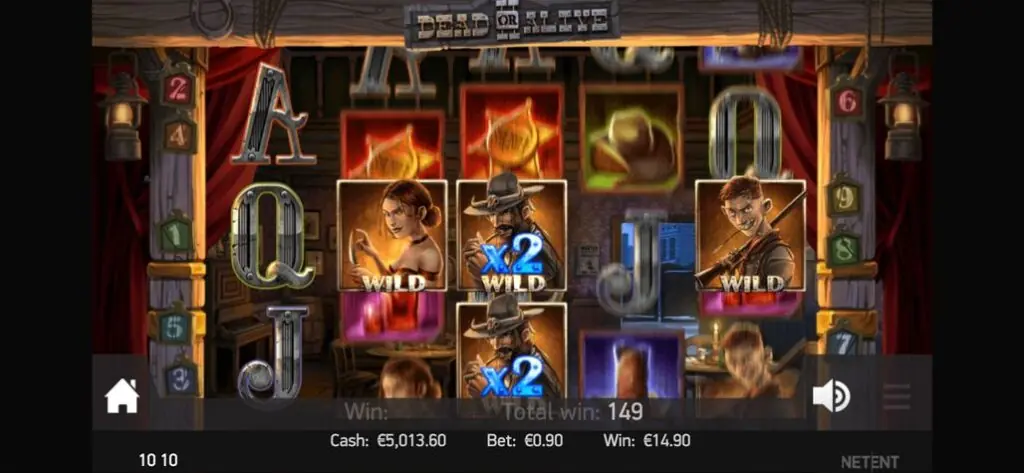
Dead or Alive 2, released in April 2019, has five reels, three rows and nine paylines. The bonus choice is its defining comparison: Train Heist, Old Saloon and High Noon Saloon develop wins in different ways.
Train Heist uses a multiplier meter. Each wild advances the meter and adds a free spin, so the value to follow is the developing multiplier rather than a collection of fixed wild positions. Old Saloon instead doubles wins and holds landed wilds for the remaining free spins. The central visual difference is progression on a meter versus accumulation on the reels.
High Noon Saloon also retains wilds, but additional wilds on an occupied reel can create multiplier wilds: two produce 2x, and three produce 3x. Multipliers combine multiplicatively when they contribute to a win. In Old Saloon and High Noon Saloon, collecting a sticky wild on every reel awards five extra free spins.
These mode descriptions follow NetEnt’s published game sheet. Old Saloon has the more straightforward retained-wild explanation; High Noon adds another calculation, while Train Heist shifts attention to its meter. That gives a reader a concrete choice of feature structure, without needing to turn a maximum-win headline into a recommendation.
Blood Suckers: separate the free spins from the coffin bonus
Blood Suckers combines a conventional line-based game with two distinct bonus ideas. Three or more scatters award ten free spins with tripled wins. The separate Vampire Slaying feature involves choosing coffins, with bats able to end the round. Keeping these events separate makes the rules easier to follow than describing everything as a single vampire bonus.
The two bonuses ask you to follow different information. Free spins apply a defined multiplier to wins on the reels; the coffin feature accumulates a separate coin award until it ends. The published return is the highest in our selected RTP table, but the division between ordinary wins and these bonus events still matters to the experience.
For a contrasting supernatural slot, our Immortal Romance review covers the original game’s Chamber of Spins. Stormcraft describes different free-spin features that unlock through repeated triggers, rather than Blood Suckers’ separate free-spin and coffin-picking arrangement. Compare that progression with what you want to follow on screen; a shared horror theme does not make the two games substitutes.
Twin Spin: linked reels, not hundreds of paylines
The original Twin Spin has 243 ways to win across five reels. Those ways are not 243 fixed paylines. Matching symbols on consecutive reels from the left form winning combinations, while adjacent twin reels begin with identical symbols and can expand into a larger linked group.
The reel relationship is the attraction. When linked reels match, the screen can contain several relevant symbol combinations, so the win calculation deserves more attention than the visual size of one symbol stack. A large matching area and a large payout are not interchangeable concepts: the symbols involved and the paytable still determine the result.
This is our more useful comparison for someone interested in synchronised reels than for someone primarily seeking an elaborate bonus narrative. It also provides a clean baseline for understanding Twin Spin Megaways. Learn the original’s linked-reel and ways rules first; the sequel changes how the reel layout and subsequent Avalanches behave.
Divine Fortune: wild movement and jackpot awards are different layers
Divine Fortune’s Falling Wilds shift down the reels through respins. A new wild landing on a position already occupied by a falling wild triggers Wild on Wild, expanding that reel. The interaction explains why the position of a new wild matters, not just the number visible on the screen.
The original’s jackpot feature includes Mini, Major and Mega awards. NetEnt describes the Mega as progressive. That wording should not be stretched into a claim that every displayed prize grows in the same way, or that a particular casino currently offers a specific pot. Read the jackpot explanation alongside the ordinary paytable, especially when a lobby thumbnail shows only the largest award.
The attraction is the combination of two different forms of progression: a wild moves through the reel game, while the jackpot feature builds its own outcome. Keep the ordinary win display and jackpot information separate when reading a result. The original-versus-Megaways table below explains why those prize descriptions need to stay attached to the correct edition.
Aloha! Cluster Pays: watch what stays on the grid
Aloha! Cluster Pays uses a six-reel, five-row layout and winning symbol clusters rather than fixed lines. Its Sticky Win Respins can trigger after a qualifying cluster win. Winning symbols remain while other positions respin, and new matching symbols can enlarge the retained cluster.
The respins continue while new matching symbols enlarge the cluster, ending when it stops growing or fills the screen. That is the opposite visual idea to Gonzo’s Quest’s removal of winning symbols. Aloha’s Sticky Win Respins do not activate during free spins; that separate mode uses Symbol Drop to remove lower-paying symbols instead.
The practical appeal is being able to follow a growing group rather than trace a line from reel to reel. The limitation is that a busy grid can make it harder to distinguish symbols contributing to the current win from those merely nearby. Focus on the highlighted winning cluster and the feature explanation, rather than treating every matching symbol on screen as part of one payout.
Butterfly Staxx: position changes the feature
Butterfly Staxx uses forty paylines on a five-reel, four-row screen. A full butterfly stack triggers respins. Visible butterflies move to the leftmost position in their row that is not already occupied by a butterfly, then remain for the rest of the feature.
The explanation of how Butterfly Staxx pays follows that movement in more detail. Newly landed visible butterflies add another respin. The feature ends when no additional visible butterflies land, even though the collected butterflies are still on the reels. Butterflies landing behind retained ones do not count as visible additions.
The separate Butterfly Spins mode fills the reels with cocoons. Visible active cocoons open into butterflies, which move left and remain for the feature. This is a useful slot for comparing occupied positions with newly arriving symbols: the screen can contain plenty of butterflies without extending the respin sequence.
Signature mechanics: ask what persists and what resets
The most useful way to compare these slots is to ask three questions: what triggers the feature, what remains on screen and when does it reset? That separates superficially similar animations. Starburst expands a wild for a respin sequence; Divine Fortune moves wilds down the reels; Dead or Alive 2 offers bonus modes with sticky wilds.
Apply the same questions to multipliers. Gonzo’s Quest develops its multiplier through a winning Avalanche sequence, whereas a newer title may retain a developing value across free spins. The word “multiplier” does not tell you which event increases it or which payout it affects. Those details determine how to interpret the result display.
Consider a retained symbol and a retained position separately. Aloha keeps the symbols in its growing cluster; Butterfly Staxx moves symbols into available positions; Divine Fortune shifts wilds down. Describing each as simply a “sticky feature” would hide the movement that determines where the next combination can form.
Branded bonuses still need their own rules
NetEnt’s Jumanji makes the film’s board-game idea part of its bonus: dice move a token around a board, where spaces lead to different features. That is a stronger connection between theme and mechanics than merely placing familiar characters on ordinary reel symbols. It also means there is more to understand than the base-game paytable.
For contrast, the 243-ways edition of Game Of Thrones uses a house choice to determine free spins, a multiplier and an additional stacked symbol. Compare that selectable bonus package with Jumanji’s board movement. Both draw on familiar screen stories, but the bonus rules determine how the awards are calculated.
The useful distinction is choice versus movement. Selecting a house establishes a bonus package; Jumanji’s board route leads into different feature spaces. A themed licence can therefore affect how a bonus is organised, not just the symbols on the reels.
Published RTP: compare the exact game edition
The figures below are the RTP listings on NetEnt’s official product pages checked on 9 September 2026. They are not a verified list of the configurations offered by every casino. Use the information in the actual game you are considering to establish its rules and return; a familiar title or screenshot is not enough.
| Exact title | Supplier-published RTP | Edition covered |
|---|---|---|
| Starburst | 96.08% | Original |
| Gonzo’s Quest | 95.97% | Original, not Megaways or Quest II |
| Dead or Alive 2 | 96.80% | Second game, not Dead or Alive 3 |
| Blood Suckers | 98.00% | Original |
| Twin Spin | 96.55% | Original, not Megaways |
| Divine Fortune | 96.59% | Original, not Megaways |
| Aloha! Cluster Pays | 96.42% | Original |
| Butterfly Staxx | 96.80% | Original |
RTP describes a long-run theoretical proportion returned across wagering, not a refund on your deposit. At 98.00%, the theoretical house edge is 2.00%; at 95.97%, it is 4.03%. On an illustrative £100 of total wagers, the corresponding expected losses are £2 and £4.03, a difference of £2.03. An individual session can finish very differently.
Turnover is the total staked, including any returns staked again. It is not the amount initially deposited. This distinction is important when comparing both games and bonus conditions: repeated wagering increases exposure even when you have not added another deposit. The example is arithmetic, not a recommended budget or a prediction of playing time.
We have not ranked Mega Joker or Jackpot 6000 alongside these games solely by their headline percentages. Their Supermeter arrangements involve decisions about banked winnings and continued play. A meaningful comparison needs the relevant mode and decision rules, rather than treating a prominent return number as an unconditional rate for every action.
There is also no sensible provider average to calculate from this small editorial selection. An equal-weight average would describe our chosen rows, not the mix of games, configurations or wagers at a casino. Blood Suckers leads this selected table on published RTP, not every possible comparison across the catalogue.
Volatility and maximum wins: what the numbers leave out
RTP and volatility answer different questions. RTP concerns the theoretical average return; volatility concerns how outcomes vary around that average. A game can offer a comparatively high return while still producing losses or uneven results over a short session. Artwork, release age and the number of bonus animations cannot establish that distribution by themselves.
Maximum win is another separate measure. It describes a ceiling under the relevant rules, not the chance of reaching it. Multiplying a stake by a spectacular headline can make a game seem easier to compare, but the result leaves out the probability that would make the comparison meaningful. We do not use a highest-possible payout as a score for player suitability.
The more actionable question is whether you understand the feature well enough to decide that it fits your preferences and limits. If you dislike waiting for a particular bonus, increasing stakes to make ordinary spins feel more significant is not a solution to that mismatch. Choosing another game or stopping is a valid outcome of the comparison.
British technical standards prohibit secretly adjusting random outcomes to compensate for earlier results. A losing run therefore does not create a general entitlement to a catch-up win. That is distinct from an explicitly described sticky wild, retained multiplier or other state inside a feature: those operate according to the published game rules.
NetEnt Megaways and other editions: keep the names separate
NetEnt released Twin Spin Megaways and Divine Fortune Megaways in 2020. They are distinct games, not settings that convert their originals into larger versions. Both can offer up to 117,649 ways to win, but sharing that ceiling does not make their bonus systems identical.
| Game family | Original | Megaways edition | What changes |
|---|---|---|---|
| Twin Spin | NetEnt; 243 ways and linked adjacent reels | NetEnt; variable reel heights and up to 117,649 ways | Linked reels can stop matching during Avalanches |
| Divine Fortune | NetEnt; Falling Wilds and a jackpot bonus including the progressive Mega | NetEnt; Falling Wilds with Bronze, Silver and Gold Bonus Wins | The original jackpot explanation does not describe the newer prize structure |
| Gonzo’s Quest | NetEnt; twenty paylines and Avalanche multipliers | Red Tiger; Megaways and its own feature rules | Both the edition and studio credit change |
Twin Spin Megaways combines linked reels with changing reel heights and Avalanches. The initially linked reels can cease to be identical as an Avalanche sequence develops. That detail matters if you expect the original’s matching-reel relationship to remain visually fixed throughout every stage of the newer game.
Divine Fortune Megaways makes its separate Bonus Wins through symbol collection during free spins. Bronze, Silver and Gold symbols fill different collections; completing one awards its associated prize. Read that collection display alongside the reel wins, rather than treating it as a pot that grows from other players’ wagers.
For a comparison of a different bonus design, the Temple Of Treasure Megaways slot review discusses a choice between more free spins and a higher starting minimum number of ways. That is a separate game, not another NetEnt edition. The useful contrast is the choice itself: equal maximum ways do not tell you whether a bonus uses selectable starting conditions, persistent wilds or some other mechanism.
Gonzo’s Quest Megaways is a Red Tiger release using Big Time Gaming’s technology. Its winning symbols also disappear, but the game adds its own features, including Earthquake’s removal of low-paying symbols. The shared explorer and Avalanche presentation explain the family resemblance; the complete rules explain the differences.
Newer NetEnt slots: developments beyond the classics
Gonzo’s Quest II: Return to El Dorado takes the Avalanche idea into an expanding play area. Winning sequences add rows; the ordinary paid-spin layout resets afterwards, while rows gained during free spins remain for subsequent spins in that feature. Calamity Wilds can add further wild symbols, creating a different system from the original’s more compact reels.
The sequel also provides a useful example of slots with Colossal Symbols. Oversized scatters affect the bonus that starts, so their size has a rules consequence rather than merely making them easier to notice. Read how the game counts those symbols; a large visual block is not necessarily evaluated like the same number of independent scatters.
Among the newer releases, Judgemental’s official general release date is 13 August 2026. Its judges provide wild and multiplier features, with active judges persisting during free spins. Multiplier contributions add to the global value rather than multiplying each other, an important distinction when several effects appear together.
Aftermath, officially released on 3 September 2026, develops a multiplier through winning tumbles and includes a bomb that doubles it. The base-game reset and the retention of progress during the bonus create different contexts for following that value. Treat the multiplier display and the expanding play area as separate things to understand.
These releases offer different things to follow: the retained rows in Gonzo’s Quest II, the active judges in Judgemental and the multiplier in Aftermath. All are more informative comparisons than release order alone. Casino availability still needs checking against the actual British lobby.
NetEnt compared with other studios
Start a cross-studio comparison with a specific feature or theme. NetEnt’s Hall of Gods uses Norse characters, expanding wilds and a shield-picking bonus involving Thor’s hammer. Those details provide a better basis for comparison than assuming every game with a hammer, god or lightning effect shares its jackpot design.
For another established Norse-themed family, our Thunderstruck review is a useful starting point. Stormcraft’s account traces the original and its sequels as a separate legacy. Keep the exact edition in view: a description of Thunderstruck II or Wild Lightning is not a reliable substitute for the original’s rules, just as Divine Fortune Megaways is not the original Divine Fortune.
We would compare these themes on how the feature uses the imagery. Does the character trigger a defined bonus, reveal an award or simply decorate an ordinary reel? That question separates meaningful differences from shared visual vocabulary. It also prevents a long list of themed titles becoming a supposed ranking without a clear method.
Another useful comparison concerns where a supplier’s catalogue comes from. Some readers are interested in games that resemble familiar retail machines; others prefer online-specific feature systems. Neither preference establishes a better return, but it can identify which interface and feature descriptions are worth reading first.
The portfolio discussed in our Inspired Gaming guide offers a contrast through its branded content and retail-to-online connections. Inspired describes an omnichannel business alongside its interactive games. That does not mean every title is a direct port or uses one mathematical style; compare the actual game, not an imagined average for the studio.
NetEnt’s appeal in this comparison is the range of established mechanics within its own catalogue. You can investigate linked reels, retained clusters, falling wilds and separate bonus choices without treating them as one standard feature package. A different supplier becomes relevant when it offers a specific alternative, not merely because another logo would make the list longer.
Who makes NetEnt slots, and what does Evolution ownership mean?
NetEnt began in Sweden in 1996 and joined Evolution in 2020. The original Gonzo’s Quest and Starburst, released in 2010 and 2012, predate that acquisition. Evolution’s integration announcement also included the closure of NetEnt Live, while the group continued supplying other live casino products.
NetEnt and Red Tiger retain distinct game catalogues within the group. A casino may show the parent’s name, a studio label or the individual game title at different stages of the launch process. The developer credit helps distinguish an original NetEnt title from an adaptation released by another studio.
Distribution is a different role. The background in our iSoftBet guide illustrates how a supplier can make its own games and aggregate other studios’ content. For NetEnt comparisons, identify the exact title and studio first: the route by which a casino receives a game does not change its development credit.
The casino operator is separate again. It manages your account, payments and customer support. Its legal identity and terms therefore deserve their own checks, even if you already know the NetEnt game you want. This distinction is especially useful when the same slot is offered by several differently branded casino websites.
Licensing and credibility: supplier checks are not casino checks
The relevant British regulator is the Gambling Commission. Its July 2026 statement identifies Evolution Malta Holding Limited as a gambling software and casino host licence holder. That supplier context is important, but it does not mean that every website displaying NetEnt games is licensed to offer them to British customers.
There is also a material regulatory history to consider. On 23 July 2026, the Commission announced a £4.75m regulatory settlement involving Evolution Malta Holding Limited after games became accessible through unlicensed websites. It identified supply-chain and anti-money-laundering shortcomings, while also acknowledging remediation and no further concerns of that type identified following the action.
This is relevant to distribution oversight, not a finding that NetEnt’s reels were rigged or that a particular player’s payout was falsified. Conversely, it should not disappear behind a blanket claim that a familiar supplier is simply “completely safe”. Licensing, software fairness and a casino’s handling of your account are related but different questions.
British technical standards require acceptably random game outcomes. We are not presenting this article as an independent certification of NetEnt software or every installation. Check the operator’s legal identity and website address against the public register, and use the actual game information for its rules. A logo alone cannot complete either check.
British controls and stakes: old screenshots are not a checklist
British licensed online slots have a £2 maximum stake per game cycle for players aged 18–24 and a £5 maximum for those aged 25 and over. These are legal ceilings, not recommended amounts. Your own affordable limit can be much lower, and the limits should not be transferred indiscriminately to other products such as blackjack.
Autoplay is not permitted. The rules also require at least 2.5 seconds between the starts of slot game cycles and prohibit controls that speed up paid spins, such as turbo or quick spin. This does not mean every individual Avalanche animation must last 2.5 seconds; the timing rule concerns the game cycle, with a separate exception for unstaked feature games.
The regulator has also required operators to remove feature-buy functionality. An international supplier menu or a historical screenshot therefore does not establish that the same option is available in a British licensed version. The existing game illustrations here help identify the original editions, not every control you should expect to see today.
Mobile screens and free demos: what they can tell you
NetEnt announced its first Touch mobile portfolio in December 2011. That establishes a substantial mobile history, but it is not a performance benchmark for your phone, browser or casino connection. We would judge the actual presentation by whether the rules, stake control and feature displays are readable without guesswork.
For Twin Spin, inspect whether the linked reels remain easy to distinguish on a small screen. For Aloha! Cluster Pays, check that you can identify the retained cluster against new symbols. For Butterfly Staxx, follow the occupied spaces and movement direction. These are useful interface checks because each relates to a rule, rather than a vague claim that a game “looks great on mobile”.
A free demo can help you understand controls and feature sequencing, but it cannot predict a later cash session. British standards require corresponding free and real-money games on the same facility to represent the relevant rules and outcomes accurately; supplier feature demonstrations may show features more often when that difference is disclosed. Check which kind of presentation you are viewing.
British operators must also verify age for free-to-play access, including relevant affiliate arrangements. A simple self-declared age box is not the same check. A still image on this page is only an illustration: it is neither an interactive demo nor evidence of an actual Slotty House play session.
If a casino groups Evolution products together, distinguish slots from its other games. For example, our Live Free Bet Blackjack guide concerns a live dealer table game with different decisions and bet rules, outside the NetEnt slot comparisons here.
Choosing a casino for NetEnt games
Work from the exact title towards the operator, not from a welcome offer towards whichever game happens to be available. Confirm that the lobby contains the edition you want, inspect its rules and return information, then assess the casino’s account and payment terms. A broad NetEnt filter can contain enough similar names to make this order worthwhile.
If you are considering a bonus, check eligible games, wagering contribution, expiry, maximum permitted stake and withdrawal conditions together. Do not assume a higher-return title contributes fully or that every jackpot game qualifies. Those are operator-specific terms, so this guide does not attach an unverified offer to a studio name.
Set a spending and time limit before starting, and stop if the activity stops being enjoyable. An unfinished-looking bonus meter or an appealing new release is not a reason to extend a limit. If keeping to it becomes difficult, pause gambling and seek support rather than looking for a different slot to recover the loss.
Our verdict: choose the feature before the logo
NetEnt is a useful catalogue to explore because its established games offer genuinely different ways to follow a result. Starburst is our accessible expanding-wild comparison; Gonzo’s Quest explains Avalanche progression; Aloha! Cluster Pays and Butterfly Staxx reward closer attention to what stays on screen. Dead or Alive 2 is more relevant when bonus-mode differences are the main interest.
The strongest choice is the one whose rules you understand and whose presentation suits you, within limits you can afford. Compare the exact edition and its available return setting, keep the casino checks separate, and do not let a famous character or maximum-win headline substitute for those decisions.
NetEnt Slots FAQ
Starburst is a clear starting point for expanding wilds and respins. Gonzo’s Quest is more useful for understanding Avalanche sequences, while Dead or Alive 2 introduces different free-spin modes. Choose by the rules you want to follow, rather than assuming one famous title is best for every player.
Blood Suckers has the highest supplier-published RTP in our selected eight-game table, at 98.00%. This is not a claim about every NetEnt title or configuration. Inspect the actual game information, and remember that a theoretical return does not predict an individual session or establish its volatility.
The original Gonzo’s Quest is NetEnt, but Gonzo’s Quest Megaways is a Red Tiger release using Big Time Gaming’s Megaways technology. The studios share the wider Evolution group. The complete edition name matters when checking development credit, rules and return information.
No. They are separate editions. NetEnt describes the original Divine Fortune’s Mega as progressive, while the Megaways edition has its own Bonus Wins structure. Do not transfer the original jackpot explanation or a displayed prize value to the newer game just because the title and artwork are familiar.
No. A demo can help explain the controls and feature sequence, but it does not predict a future cash session. Check whether you are viewing a corresponding free game or a supplier feature demonstration. British operators must verify age for free-to-play access; a screenshot is not an interactive demo.
No. Autoplay is not permitted in British licensed online gaming. International menus and historical screenshots can also show feature-buy or speed controls that are not available in the British version. Use the actual local game and its rules, not an old illustration, to check functionality.