Cascading Reels Slots
Best Cascading Reels Slots










What are cascading reels slots?
A cascade is a continuation of a slot round: qualifying winning symbols disappear, replacements enter the playing area and the game checks the new arrangement. Another qualifying win can start another cascade. The ordinary refill does not require another stake, although the original paid round can still return less than it cost. Optional purchases or extra-stake features, where permitted, need to be assessed separately. For the broader feature terminology, see our Slot Bonus Features guide.
That is the category’s defining feature, not a particular theme or shape of reel. A rectangular slot with paylines and a square grid filled with clusters can both cascade. Equally, an animation in which symbols fall onto the screen is not enough on its own: the rules must provide for removal and further evaluation within the round.
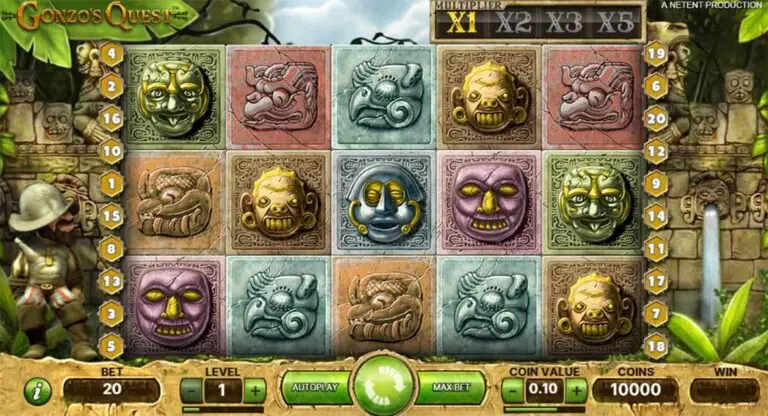
An early reference point is NetEnt’s Gonzo’s Quest, released in 2010, which calls its version Avalanche. Big Time Gaming’s original Bonanza followed in 2016 with Dual Reactions alongside Megaways. These examples help explain the vocabulary, but they do not make every subsequent cascade game a copy of the same mathematical design.
The appeal is watching one round develop as symbols, wilds or meters change. Which version suits you depends on how much activity you want to follow, not on the cascade label alone.
Seven cascading reels slots compared
For a straightforward introduction, our pick is Gonzo’s Quest: its highlighted paylines and visible multiplier track make the basic idea easy to follow. Sweet Bonanza suits readers who prefer counting matching symbols without tracing connections. Reactoonz is the more involved option here, combining connected clusters with charge meters and queued features.
We selected the original games below for their different rules, not as a profitability or popularity ranking. The “best fit” column is our editorial assessment of what each design asks you to follow. Numbered sequels and Megaways adaptations are separate products.
| Original game | Provider | Defining mechanic | Best fit |
|---|---|---|---|
| Gonzo’s Quest | NetEnt | Payline Avalanches with a stepped multiplier | A clear introduction using highlighted winning paths |
| Sweet Bonanza | Pragmatic Play | Anywhere matches and free-spins multiplier symbols | Counting matches without tracing adjacent groups |
| Gates of Olympus | Pragmatic Play | Anywhere wins; a running multiplier during free spins | Following multiplier accumulation through a bonus |
| Reactoonz | Play’n GO | Connected clusters and queued Quantum features | A busier grid with meters and automatic feature events |
| Jammin’ Jars | Push Gaming | Cluster wins involving moving multiplier wilds | Tracking which clusters a wild helps form |
| Bonanza | Big Time Gaming | Megaways with vertical and horizontal refills | A changing reel layout and reactions in different directions |
| Sugar Rush | Pragmatic Play | Clusters and marked multiplier positions | Watching individual grid positions build during the feature |
How a cascade round works, from stake to settlement
First, the game accepts the selected stake and determines the opening arrangement. It then checks the applicable pay rule. If a qualifying combination appears, the relevant prize is recorded and the removal-and-refill process starts. Further wins are checked against the same game’s rules, including any active wild, multiplier or feature conditions.
In a straightforward version, the sequence stops when the refill produces no further win. Some games have an extra step: a queued feature can modify an otherwise non-winning grid and give the round another opportunity to continue. Read the end-of-round conditions as well as the exciting part of the feature description.
The total credited at settlement matters more than the number of animations. This hypothetical £1 round, with no separate multiplier, shows why several payouts can still produce a net loss.
| Stage | New payout | Running return |
|---|---|---|
| Opening win | £0.20 | £0.20 |
| First refill win | £0.35 | £0.55 |
| Second refill win | £0.15 | £0.70 |
| Next refill has no win | No additional payout | £0.70 final return |
The result is a £0.30 net loss: £0.70 returned against £1 staked. There were several paying events, but no overall profit. Conversely, you should not subtract another £1 for each automatic refill. That would confuse included cascades with separate paid spins and overstate the cost of this round.
A practical habit is to wait for the round to settle before reading its result. A win panel may show the most recent award, a running total or an amount awaiting a multiplier. The final transaction record is more useful than counting flashes, sounds or falling symbols.
Paylines, ways, clusters and anywhere wins are different
The pay system answers “what counts as a win?” Cascading answers “what happens after a qualifying win?” Keeping those questions separate prevents a common mistake: treating all grid slots as cluster games, or assuming every tumble game pays along reels. The same removal-and-refill idea can sit behind very different matching requirements.
| Pay system | What matters | Example | Common misreading |
|---|---|---|---|
| Fixed paylines | Qualifying symbols on specified winning paths | Gonzo’s Quest | Assuming matching symbols anywhere must pay |
| Ways to win | Qualifying matches across the required reels, without fixed drawn paylines | Bonanza | Treating the displayed ways count as a win probability |
| Connected clusters | A sufficiently large group of matching, connected symbols | Reactoonz | Counting disconnected matches as one cluster |
| Anywhere matching count | Enough matching symbols across the playing area | Sweet Bonanza | Requiring those symbols to touch |
For a concrete contrast, Reactoonz requires at least five matching symbols connected horizontally or vertically. A diagonal-only group does not meet that connection rule. Original Sweet Bonanza instead pays when at least eight matching symbols appear anywhere. Their similar falling-symbol movement does not make those qualifying conditions interchangeable.
The distinction also changes what is useful to watch. In a payline game, follow the highlighted path. In a cluster game, inspect the connected group. In an anywhere-count game, pay attention to the symbol counter rather than looking for a neat line through the grid.
A larger playing area does not supply enough information to compare your chance of a payout. You also need symbol frequencies, the required match size and the paytable. More visible positions can come with stricter qualifying rules. Likewise, a high ways count describes possible winning arrangements, not a percentage chance of winning the next round.
How the shortlisted games differ in play
The shortlist spans simple payline cascades and more layered grid designs. These are the differences that matter when reading a round, beyond the colour of the symbols or the size of a headline multiplier.
Gonzo’s Quest: a clear payline reference
Within the NetEnt range, the original Gonzo’s Quest has five reels, three rows and twenty paylines. Winning symbols are removed by Avalanches, while a visible multiplier progression can increase later qualifying awards. Its base-game multiplier reaches 5x; the Free Falls feature reaches 15x. These are multiplier limits, not maximum payouts. NetEnt lists a published RTP of 95.97%; the version shown in the operator’s game information is the one to check before playing.
This makes it a useful starting point for understanding the feature without simultaneously learning a large cluster grid. The limitation is equally important: following a visible progression does not let you control how long it lasts. A non-winning arrangement can end a chain before the upper steps become relevant.
Reactoonz: watch the feature queue as well as the grid
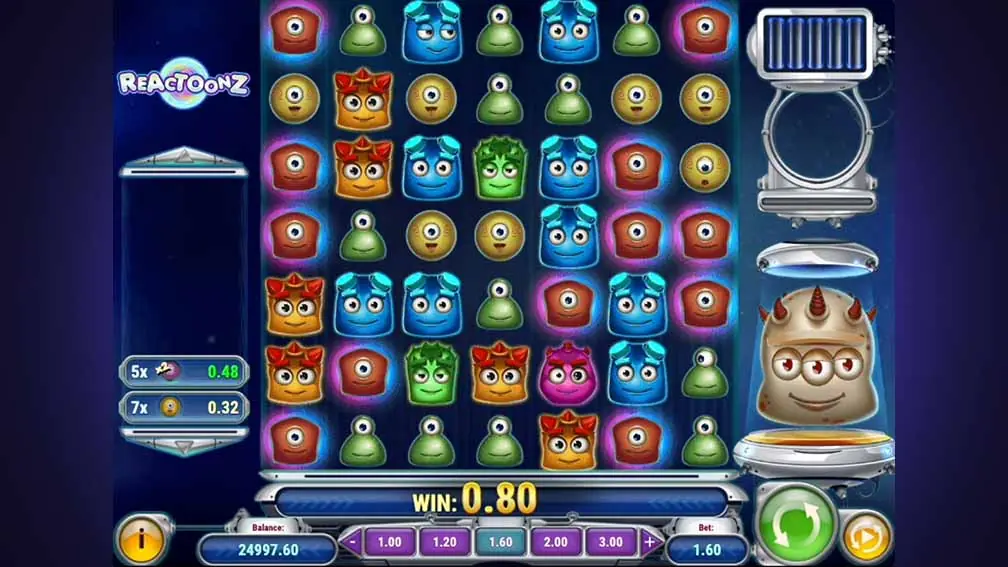
The original Reactoonz places its connected clusters on a seven-by-seven grid. Wins feed charge meters, and Quantum features can be queued to change the playing area when ordinary cascades run out. Its appeal lies in following that interaction, rather than expecting every extra event to be another conventional free spin.
For readers who like seeing a round develop, this is a more involved alternative to a simple refill. The trade-off is readability: the grid, charge indicators and pending events all compete for attention. Those automatic feature decisions are part of the game’s rules, not strategic moves chosen by the player.
Bonanza: two refill directions, one paid round
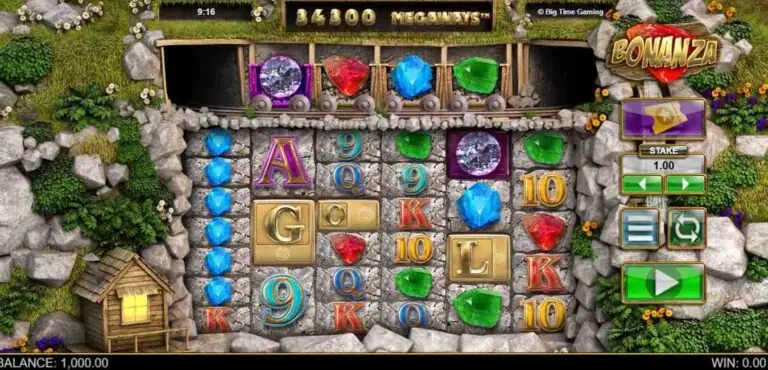
The original Bonanza combines a variable reel layout with up to 117,649 ways. Its main reels refill from above, while the extra horizontal reel receives symbols from the right. The Dual Reactions name therefore describes something more specific than an ordinary downward cascade.
During its free spins, a multiplier increases after reactions. That creates a different point of attention from simply counting matching symbols. Do not read an increasing or uncapped feature multiplier as a promise of unlimited money: the game’s payout rules and applicable limits are separate questions.
Sweet Bonanza, Jammin’ Jars and Sugar Rush: similar colour, different rules
The colourful presentation of Fruit themed slots can make these games look closely related at a glance. Their rules tell a different story: Sweet Bonanza counts matches anywhere, Jammin’ Jars connects wins to moving jar wilds, and Sugar Rush builds multipliers on marked positions. Choose according to which behaviour you want to follow, not the shared visual palette.
Check the full name before transferring any figure between games. An original release and a numbered follow-up are separate products, not automatically interchangeable versions of one paytable. The official Pragmatic Play catalogue is useful for distinguishing its similarly named releases before comparing the operator’s actual game information.
Gates of Olympus: a multiplier that builds through free spins
The original Gates of Olympus pays for at least eight matching symbols anywhere on its tumbling reels. During free spins, multiplier symbols on winning spins add to a running multiplier, which applies to the qualifying win. That accumulated value carries through the feature rather than resetting after each free spin.
This makes it a useful contrast with Sweet Bonanza’s sequence-based multiplier calculation. Choose between them on that difference in behaviour, not the apparent similarity of their falling symbols. The original Gates of Olympus and Gates of Olympus 1000 should also be assessed separately.
Multipliers: what is multiplied, and when?
When comparing Multiplier slots, the large multiplier on screen is only part of the calculation. You also need to know which amount it applies to. It might affect one winning combination, wins involving a particular wild, the combined return from a tumble sequence or a wider feature total. Applying it to the wrong amount can make an ordinary payout look incorrect.
Imagine two qualifying wins of £0.40 and a 5x multiplier. If the multiplier applies only to the second win, the combined return is £2.40. If it applies to the £0.80 sequence total, the return is £4. These hypothetical rules produce different results from the same displayed multiplier.
| Hypothetical rule | Calculation | Total return |
|---|---|---|
| 5x applies only to the second £0.40 award | £0.40 + (£0.40 × 5) | £2.40 |
| 5x applies to both awards together | (£0.40 + £0.40) × 5 | £4 |
| First award at 1x, second at 2x | £0.40 + (£0.40 × 2) | £1.20 |
Original Sweet Bonanza provides a title-specific example: its free-spins multiplier symbols have values from 2x to 100x, and the values are added at the end of a tumbling sequence. That is not a universal instruction to multiply every bomb by every other bomb. Nor does every refill automatically bring a new multiplier.
A different rule applies to the jar wilds in original Jammin’ Jars. Their multipliers affect wins the jars contribute to; a successful jar moves and its multiplier increases. When multiple jars contribute to the same cluster, their multiplier values are combined. An unrelated cluster should not be assigned a jar’s multiplier merely because the jar is visible elsewhere.
The useful checklist is therefore specific: identify the qualifying win, identify the multiplier that applies to it, then establish when the calculation is settled. A game offering larger headline multipliers is not necessarily preferable if the relevant wins are rarer or the rest of the paytable is less suitable for your preferences.
What persists between cascades, spins and bonus rounds?
Do not assume a feature resets at the same point in every game. “Until the next cascade”, “until the end of this spin” and “until the end of free spins” describe different periods. A screenshot taken halfway through a bonus can show a stronger position than the same game normally starts with.
Original Sugar Rush makes the distinction particularly clear. Winning positions become marked, and qualifying subsequent wins on those positions can build multipliers from 2x up to 128x. In the free-spins feature, the marked positions and multipliers remain across the round. That persistence should not be assumed for an ordinary new paid spin.
Persistence also explains why it is misleading to describe every cascade as an identical fresh trial. Symbols can remain on the grid, multipliers may have changed and feature events can be waiting. The new arrangement is evaluated within that current state. This is different from saying the random generator owes you a win after a losing spell.
Look for an explicit description of what survives settlement and what clears before another wager. A nearly full meter that resets with the round does not carry value into the next paid spin. Nor does an earlier losing spell improve the next result simply because you have waited longer.
RTP: compare the game version, not the cascade label
There is no single RTP for cascading reels as a category. Return to player describes a game’s theoretical long-run return relative to the total staked. It does not tell you whether your next chain will continue, whether a feature will trigger or how much of your deposit you will withdraw. Our guide to what RTP means covers the underlying calculation.
Version selection can matter even before comparing different games. For original Jammin’ Jars, Push Gaming publishes both 96.83% and 94.25% RTP options and states that RTP can vary by casino. Those published options are not proof of which one a particular operator has selected.
| Published RTP option | Implied house edge | Expected cost per £100 total wagered |
|---|---|---|
| 96.83% | 3.17% | £3.17 |
| 94.25% | 5.75% | £5.75 |
The difference is £2.58 per £100 of turnover in the long-run model. This is not a forecast for an individual £100 deposit or a suggestion to wager that amount. Actual results can vary widely, and total turnover includes stakes made again using earlier returns.
Included cascades do not add another paid stake to that calculation. They are part of the return generated by the original round. Equally, they are not an extra RTP bonus to add on top of the game’s advertised percentage; the overall mathematical model already accounts for the features it contains.
Read the information panel of the exact game at the casino you intend to use. If it disagrees with a catalogue card, resolve the version with the operator. Compare like-for-like modes and rules before treating an RTP difference as meaningful.
Volatility, hit frequency and maximum win answer different questions
Volatility concerns the spread of returns; RTP concerns the long-run average. A slot can have an appealing published RTP and still produce an uneven sequence of results. Several small cascade payouts in one round also do not necessarily mean a high frequency of profitable paid rounds. For a fuller comparison of those measures, see our Slot Volatility guide.
Some of the examples here are explicitly marketed as high volatility, including original Jammin’ Jars and Bonanza. That does not justify assigning the same label to every cascade game. Nor should a provider’s high label be treated as a precisely standardised numerical scale shared by every other studio.
A maximum-win figure is another separate measure. It describes a ceiling under stated conditions, not a likely result or the average value of a bonus. A provider’s highest observed win is different again: an observation does not necessarily establish a theoretical cap. We would not choose between cascade games on that headline alone.
For practical selection, decide whether an irregular pattern of returns would make you uncomfortable or tempt you to chase a feature. Hit frequency also needs a definition: any paying event and a paid round that returns more than its stake are different measures. A busier screen is not necessarily a gentler game. If you find the build-up encourages another wager beyond your limit, that is a reason to stop, not a sign that you have almost reached a reward.
How cascades differ from neighbouring slot features
A respin, a collection meter and a cascade can all keep a round visually active, but they describe different rules. In a cascade, paying symbols are removed and the resulting gaps are refilled. A respin can instead rerun selected reels or positions, sometimes while other symbols remain fixed.
A hold-and-spin feature generally centres on retaining qualifying symbols while other positions receive further chances to land additions. It can coexist with a cascade elsewhere in a game, but it is not simply another name for removing winners. Check whether the displayed counter tracks remaining respins or a continuing refill sequence.
Likewise, a symbol-collection feature records progress towards a condition or event. Cascading wins may supply that progress, as part of a documented game design, but the meter does not itself tell you the win rule. You still need to know what is collected, when the threshold is reached and when progress resets.
Wild behaviour forms another layer. In slots with Walking Wilds, a wild moves according to its rules; a random-wild feature introduces substitutions under a different condition. Neither label, on its own, establishes that winning symbols will be removed and replaced.
These distinctions are useful when a category page groups games loosely. A title can belong to several feature categories without using every feature on every spin. Look for the mechanic you actually want to follow, then check whether it appears in ordinary play or only after a bonus trigger.
How to choose a cascading slot that suits you
Start with the pay rule you can comfortably read. If drawn paths feel clearer, a payline cascade may be easier to follow. If you prefer seeing connected groups build, examine the cluster requirement. If you dislike tracking adjacency, an anywhere-count game offers a different way to read a win.
Next, decide how much secondary information you want on screen. Some games ask you to watch a simple multiplier track; others add wild movement, tile values and feature meters. More layers can make the presentation engaging, but they can also make settlement harder to understand. A useful test of clarity is whether the rules explain why a visible multiplier did or did not apply. Complexity is a preference, not a quality score by itself.
Theme should come after those checks. The scenery in Mining and Gold Rush slots, for example, tells you about presentation, not RTP or the likelihood of a long chain. A familiar setting may help you distinguish symbols, but it cannot substitute for the paytable.
Finish with the operator checks: the selected RTP version, available stake increments, current game rules and the business holding your account. Use the Gambling Commission’s official site to check the operator’s licensing details. A familiar software-provider logo does not, by itself, establish that an unrelated casino website is authorised to serve British players.
British play rules: stakes, autoplay and feature buys
For online slots offered under Great Britain’s licensing framework, the maximum stake per game cycle is £2 for adults aged eighteen to twenty-four and £5 for those aged twenty-five or over. An operator or game can impose a lower limit. These caps are limits, not recommended stake sizes.
Automatic cascades within the existing wager should not be confused with autoplay, which starts further paid rounds. British online gaming requires a separate commitment to each game cycle. For slots, at least 2.5 seconds must elapse before another cycle can begin; a cascade sequence can make the actual round substantially longer.
Turbo and quick-spin functions that reduce the time until results are presented are restricted, with specific treatment for features that do not involve an additional stake. An older or overseas screenshot may therefore show controls that are not offered in the British version. Use the current interface and rules, not a historical image, to establish what you can do.
Direct bonus-buy access is another important difference. The regulator has instructed licensees to remove slot feature-buy functionality. A provider’s international product description is not evidence that the same purchase option is available for British play. Naturally triggered free spins and the cascades already included in a round are different from paying to enter a bonus directly.
Casino bonuses: check eligibility before counting cascades
A casino promotion and a slot’s own bonus feature are separate things. The first has operator terms governing eligibility and withdrawals; the second belongs to the game’s rules. Winning a free-spins feature during play does not automatically mean the resulting balance has no promotional restrictions.
Before accepting a promotion, read how Casino Bonus Wagering works and check the exact eligible title, stake restrictions, expiry and how qualifying play contributes. A similarly named sequel may not be included. If the terms exclude a particular mode or game, the fact that another cascade slot is permitted does not override that exclusion.
Included refills are not extra wagers: their payouts do not become additional wagering turnover unless you subsequently stake that money. For a turnover-based promotion, check the contribution of the original stake. For an offer requiring a number of rounds, check the operator’s definition of a qualifying round.
Finally, distinguish the game’s payout limit from any promotional winnings cap or withdrawal restriction. Those limits act at different points. If the terms are unclear about the feature you intend to use, get clarification before accepting the offer. A promotion is optional; it is not a reason to increase your planned spending.
Mobile and demo play: use them to understand the rules
A useful mobile check is whether you can read the symbol values, active stake, multiplier and final return without guessing. Larger grids can make individual symbols small, while several feature meters can crowd the available space. Rotate the screen if supported and check whether the information panel remains readable.
Also distinguish the selected total stake from any displayed coin value or denomination. A familiar-looking number can represent a different unit in an older interface. Confirm the actual amount charged before committing to a round, especially after changing device, reopening a game or moving between titles.
Where a demo is lawfully available, it can help you identify where the rules and settlement information sit. It cannot establish an individual game’s long-run RTP through a short run of results, and its virtual credits are not withdrawable winnings. A feature appearing in a demonstration does not prove how often it will occur with real stakes.
British licensees must verify age before customers access their free-to-play games, including relevant consumer-facing affiliate arrangements. Do not assume that “demo” means unrestricted access or no verification. If an appropriate demo is unavailable, reading the official rules and looking at clearly labelled screenshots is still a useful way to understand the layout.
Keep spending and time limits independent of the animation. Set them before play, allow a round to settle and then stop when the limit is reached. If gambling is becoming difficult to control, use account restrictions and seek specialist support. Moving to another feature category is not a remedy for chasing losses.
Our verdict on cascading reels slots
Cascades suit readers who enjoy watching one paid round develop through several possible stages. The strongest reason to choose them is the presentation and rule interaction: a payline Avalanche, a connected cluster, a moving wild or a persistent tile can each make the same broad idea feel different.
Our assessment is that the best starting point is a game whose win rule and settlement you can explain clearly. Add complexity only if you enjoy following it. None of the falling-symbol animation, multiplier growth or feature build-up supplies a financial advantage by itself.
Before deciding, identify what pays, what is removed, what persists and what ends the round. Then check the operator’s version and choose a spending limit you can afford to lose. That gives you a more useful basis for comparison than treating every extra cascade as free profit.
Cascading Reels Slots FAQ
They usually describe the same broad remove-and-refill idea, but the complete rules can differ. Check the pay system, multiplier conditions and stopping rules rather than assuming that games using different names are mathematically identical.
An ordinary automatic refill belongs to the existing paid round and does not require another stake. Starting a new paid spin is different. Any optional extra-stake feature, where permitted, must be assessed under its own rules.
The original uses an anywhere-matching count: at least eight matching symbols can pay without touching. That differs from connected-cluster games such as Reactoonz, where adjacency forms part of the qualifying rule.
No. Add the credited payouts and compare the total with the original stake. Several small awards can still return less than the round cost, and a visible multiplier may apply only to specific qualifying wins.
There is no single category RTP. It depends on the title and selected version; even the same named slot can offer different published options. Use the game information at the operator, and do not treat theoretical RTP as a promise for your session.
Where an appropriate demo is available, it can explain the layout without a real-money wager, but its credits cannot be withdrawn. British licensees still require age verification before access to their free-play games, and availability can depend on the provider and jurisdiction.