High RTP Slots
Best High RTP Slots










What counts as a high RTP slot?
For this guide, we compare published reference versions from 96.50% upwards, with particular attention to the 98–99% examples. The threshold is our editorial screen, not an official definition of “high” or a regulator’s quality badge. The useful distinction is the cost of the version you can actually access, not whether a title carries a favourable category label.
The game cards above are a broader browsing catalogue, including some lower-return entries. They are not a strict ranking or confirmation of a casino’s current settings. Use the table below for the selected reference versions and the cards for individual game information.
Elsewhere on Slotty House, the High RTP list sits within our separate Highest RTP Slots guide. This page has a broader purpose: choosing between familiar slots, recognising a lower-return configuration and deciding whether the mechanics suit you. An exceptionally high headline figure belongs in that decision, but it is not the only useful starting point.
High RTP slots compared: five published reference versions
Book of 99 and original Blood Suckers provide the higher-return benchmarks; Jammin’ Jars, Razor Shark and Divine Fortune add three contrasting games from this page’s catalogue. We selected them for documented returns and different mechanics, not popularity or paid-play results. The figures descend numerically, but the rules and jackpot arrangements differ: this is a shortlist, not a ranking of equivalent bets.
| Game and studio | Reference RTP | Comparison value | Evidence and limitation |
|---|---|---|---|
| Book of 99 — Relax Gaming | 99.00% | Higher-return benchmark with expanding-symbol free spins | Official Relax product page; confirm the casino’s version |
| Blood Suckers — NetEnt, original game | 98.00% | Higher-return benchmark; supplier-rated low volatility | Evolution product listing; not Blood Suckers 2 or Megaways |
| Jammin’ Jars — Push Gaming | 96.83% | Cascading clusters; supplier-rated high volatility | Push product page; also lists a lower-return version |
| Razor Shark — Push Gaming | 96.70% | Fixed paylines and mystery stacks; supplier-rated high volatility | Push product page; also lists a lower-return version |
| Divine Fortune — NetEnt | 96.59% | Wild respins and jackpot design; supplier-rated medium volatility | Evolution product listing; not a verified base-game-only figure |
All five figures come from official studio or corporate product records checked in September 2026. They do not establish current availability or settings at every British casino. Supplier volatility labels are broad guides, not a shared numerical scale. The two benchmarks supplement the catalogue rather than claiming membership of the current game-card grid.
What the comparison games offer
Book of 99: the highest reference RTP in this shortlist
Relax Gaming’s Book of 99 is the starting point here if your priority is the published return. Its 99% reference figure is higher than the other four examples, while its expanding-symbol free spins provide a recognisable “book” feature. That is a comparison within our selection, not a claim that this is the highest-return slot on the entire market.
The provider describes two routes into the feature: the three-symbol trigger and collecting 99 books in the base game. The feature starts with 10 free spins and a selected character gains the ability to expand across a reel. The explanation of how Symbol Collection works helps distinguish a rules-defined feature from a supposed payout debt. Check the active game’s collection and feature rules rather than treating a partly filled display as a reason to exceed your limit.
Original Blood Suckers: the lower-volatility benchmark
Original Blood Suckers is the more relevant comparison if you want a high published return alongside a supplier-rated low-volatility profile. Evolution lists 98.00% and low volatility, unlike the high labels attached to both Push titles below. That combination provides a different selection criterion from Book of 99’s headline percentage; it does not guarantee frequent profitable rounds or a longer session.
The corporate catalogue from Evolution is useful for checking the exact identity. Blood Suckers 2 and Blood Suckers Megaways are different products: a shared vampire theme is not a reason to transfer the original game’s percentage to either. Check the complete title in the casino before comparing its figure.
Jammin’ Jars: clusters with a high-volatility profile
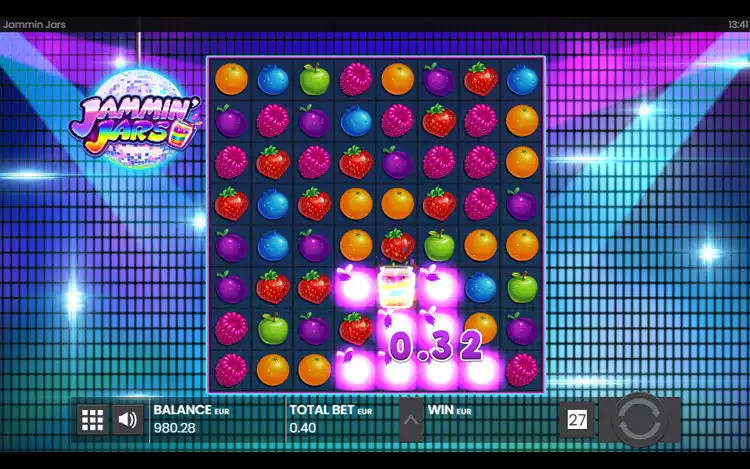
Original Jammin’ Jars is the cluster-based alternative. Its eight-by-eight cascading grid replaces conventional paylines with groups of matching symbols, while jar symbols act as wilds and carry multipliers. This makes it a better reference for readers interested in interacting clusters than for those who prefer checking a familiar line across reels.
Push Gaming labels it high volatility. Follow the jar’s contribution and the completed round’s total award, not just the number of cascading refills. Several awards within one paid round need not cover the stake. The colourful presentation does not make it a gentler financial choice than the other examples.
Razor Shark: a conventional grid with mystery features
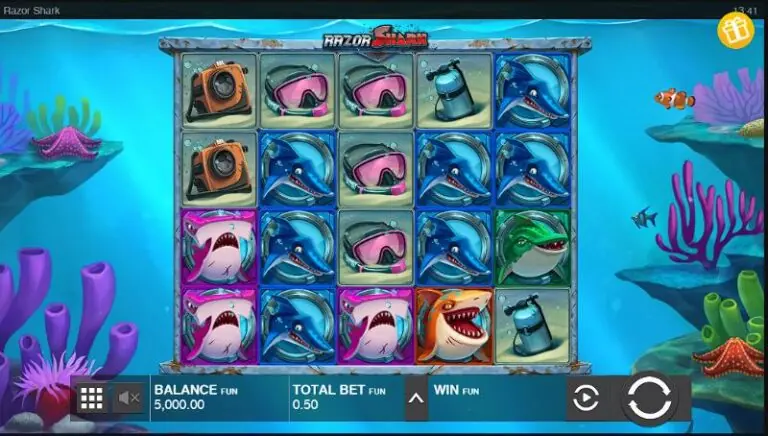
Razor Shark keeps a five-by-four layout and 20 paylines, with mystery stacks, nudges and reveals layered onto that familiar framework. It is the more relevant Push example if you prefer a fixed-payline foundation to Jammin’ Jars’ cluster grid. Both carry the provider’s high-volatility label, so the change of pay system is not a move into a low-volatility game.
Razor Shark also offers a useful comparison with itself: Push publishes two RTP settings. Alongside the mystery mechanics, check which setting is active; the distinction can change theoretical cost without changing the familiar title or artwork.
Divine Fortune: understand the jackpot component
Original Divine Fortune combines a five-reel, three-row layout and 20 paylines with falling-wild respins and jackpot features. Evolution lists it as medium volatility. The jackpot structure makes it a useful comparison with the two Push titles, but also means the headline return should not be read as a promise about ordinary reel awards alone.
It is the jackpot-focused option in this selection, not the strongest headline-return example. For related NetEnt slots, compare the individual jackpot and feature rules rather than assuming a studio-wide profile. A reader mainly interested in ordinary reel awards has a different question from someone comparing jackpot participation.
Why the same slot can have different RTPs
Push Gaming explicitly lists alternative percentages for these two games and directs players to the user panel or loading screen for the active RTP. The same title and artwork therefore do not establish the same theoretical return at different casinos.
| Exact game | Higher listed RTP | Lower listed RTP | What to check |
|---|---|---|---|
| Jammin’ Jars | 96.83% | 94.25% | RTP in the active game’s user panel or loading screen |
| Razor Shark | 96.70% | 94.06% | RTP in the active game’s user panel or loading screen |
For a hypothetical £100 of turnover, the two Razor Shark settings imply expected losses of £3.30 and £5.94. The RTP gap is 2.64 percentage points, but the lower-return version has an 80% greater theoretical cost for that same turnover. Neither amount predicts what an individual session will lose. The calculation shows why a seemingly modest difference in the headline percentage deserves attention.
A configured version is not adaptive compensation. British technical standards prohibit compensation based on past results and constrain changes to rules and payout probabilities. Different published configurations do not mean a casino can decide that a particular player is due a losing spin.
If the in-game figure differs from a review, do not average the two or assume the larger number applies. First check the full title and play mode. If those match, use the percentage disclosed in the active game for that operator-specific comparison; the higher figure on a general product page does not override it. Ask support to clarify an unclear setting rather than making a deposit on the strength of an old screenshot.
What RTP means in pounds: turnover and expected loss
RTP describes the share of total stakes a game is designed to return over the long run. The associated house edge is the remaining share. In a like-for-like comparison of ordinary play, a higher return therefore means a lower theoretical cost. It does not turn a negative-expectation slot into an income source or create a personal entitlement to receive a fixed proportion back.
The calculation uses turnover, not the opening deposit. If you stake £1 on 100 paid rounds, turnover is £100, even if you began with £20 and reused some winnings. Every new stake adds to the amount exposed to the game’s edge. A deposit figure by itself cannot tell you how much you eventually wagered.
| RTP | House edge | Theoretical returns | Expected loss |
|---|---|---|---|
| 94% | 6% | £94 | £6 |
| 96% | 4% | £96 | £4 |
| 96.50% | 3.50% | £96.50 | £3.50 |
| 98% | 2% | £98 | £2 |
These are calculations, not results observed during play. The formula is total stakes multiplied by one minus RTP expressed as a decimal. For a wider look at how Low House Edge works, compare games only when the assumptions remain aligned: the same total amount staked, the relevant version and no unaccounted-for change in mode or participation conditions.
Actual RTP answers a different question: how much did a particular recorded set of wagers return? If £50 of stakes produced £40 in prizes, the observed return was 80%. That describes the recorded sample, not the theoretical setting. It is not evidence, by itself, of a faulty game or a future obligation to repay the shortfall.
RTP versus volatility, hit frequency and session results
Return and volatility describe different aspects of the same game. RTP concerns the overall balance between stakes and prizes; volatility concerns how unevenly those prizes are distributed. A high-volatility design may put more emphasis on infrequent large awards, while a lower-volatility design may distribute more of its return through smaller prizes. Neither description guarantees a particular session length.
The supplier labels in our sample make that distinction concrete. Jammin’ Jars and Razor Shark are not low-volatility choices simply because their higher published versions clear our return threshold. Original Blood Suckers provides a different supplier-rated profile, while Divine Fortune adds a jackpot-related consideration. There is no need to compress these differences into an unexplained score out of ten.
The detailed slot volatility guide can help if your priority is the distribution of results rather than the headline return. Ask what you actually want from the experience: following a complex feature, seeing a straightforward payline outcome or avoiding a design whose large-prize emphasis you find uncomfortable. Choosing not to play is a valid outcome of that comparison.
Hit frequency is another separate measurement. A reported paying event need not cover the stake: a hypothetical £1 round paying £0.40 is still a £0.60 loss. Without a clear definition, “frequent wins” could refer to small awards, profitable rounds or individual cascade steps. We do not turn those phrases into an estimated bonus interval or a promise of steady returns.
A dry spell is not a countdown. A rules-defined bonus state can change what happens inside that feature, but losses alone do not make an unrelated new paid round overdue. Continuing solely to restore a personal percentage replaces a bounded entertainment decision with an open-ended recovery target.
Features and jackpots: what the percentage includes
A slot’s overall return is produced by its complete rules, not just the most visible part of the screen. Ordinary symbol awards, free spins, multipliers and jackpots may contribute differently. The important question is which components are included in the displayed figure for the mode you intend to use.
The wider explanation of what Slot Bonus Features means is useful here because a feature name is not a mathematical guarantee. A multiplier can change an award without increasing the total RTP relative to another game: its effect is already part of the model alongside the probabilities and other payouts. A visually generous feature is therefore not a substitute for reading the return information.
Divine Fortune illustrates the jackpot issue. An overall product figure should not be relabelled as the return from ordinary symbols alone. Check whether a separate jackpot component is stated, whether you qualify at your chosen stake and whether the rules describe different participation conditions. If the information is insufficient, avoid presenting a base-game comparison as though the components were identical.
An optional gamble raises a further question: what are you risking after the initial feature has been awarded? The headline return alone does not describe that decision. Read the stated odds, the award put at risk and any collection or retention rules; do not assume that selecting the more dramatic option is necessary to receive the advertised return.
A concrete example is Extra Chilli, another game in the broader catalogue. Big Time Gaming describes a Free Spins Gamble alongside a separate Feature Drop purchase. The distinction matters: risking an offered award and spending additional cash are different decisions. Neither should be evaluated from a generic RTP headline or another title’s rules.
How to check a slot’s RTP before staking
Start inside the exact game offered by the casino, using its information, help or paytable menu. A lobby description is useful for identifying a title but can be less specific than the client’s own rules. Do not assume that the first percentage appearing in a web search belongs to the version you are about to use.
- Confirm the full title. Keep originals, sequels, Megaways adaptations and jackpot editions separate.
- Find the theoretical return entry. Distinguish it from a historical casino payout statistic, promotional percentage or advertised maximum win.
- Read the mode label. Check that the number applies to standard play rather than an alternative stake option or purchased feature.
- Check relevant conditions. Look for jackpot participation, qualifying stake requirements or rules that affect the comparison.
- Resolve missing information before playing. Ask the operator to identify the active version if the available text is unclear.
When using our Progressive Jackpot guide, also distinguish a fixed award from a prize that changes. The regulator’s monitoring guidance separates jackpot performance from ordinary game performance. That does not supply a player with a guaranteed share of the displayed jackpot, and a rising prize meter is not, by itself, evidence that continuing to stake is a favourable decision.
For a personal comparison, record the title, operator, date, displayed RTP and mode together. A percentage copied without its context is easy to misapply later. This is a record of what the game disclosed, not proof obtained through a play test; no paid spins are needed simply to document the setting.
On a small screen, make sure the information panel has finished loading and check whether its text scrolls. A truncated help window can hide the qualifying line below the visible percentage. If you cannot read the rules comfortably, stop there rather than treating an accessible spin button as sufficient information.
Bonuses and wagering requirements are a separate calculation
A casino promotion and a slot’s in-game bonus are different things. Naturally triggered free spins form part of the game rules; an account offer can add conditions about eligible titles, qualifying funds and withdrawals. Neither a high return nor a free-spins feature establishes that a particular promotional balance may be used on that game.
The explanation of what the wagering actually costs helps separate these account conditions from the paytable. Check the current offer’s eligible-game list, contribution rate, expiry and stake restrictions. A game that contributes less towards a requirement can involve a different amount of actual wagering from a game that receives full credit, even when the advertised requirement looks the same.
Under the current British rewards-and-bonuses code, wagering requirements must not exceed ten times the bonus funds. That is a ceiling, not a recommendation to complete the maximum amount. Clear, accessible terms are still important: the headline multiplier does not, on its own, establish which games qualify or whether an offer suits your intended play.
Decline an offer if its conditions do not suit you. Ordinary cash-play expected loss is not a full valuation of a restricted bonus balance, and inclusion in this game comparison does not confirm promotional eligibility.
Stake size can outweigh a better return
A higher RTP can reduce expected cost for the same turnover, but raising the stake changes that comparison. Consider two hypothetical sets of 100 paid rounds. Staking £0.20 per round at 96% RTP creates £20 of turnover and an expected loss of £0.80. Staking £1 per round at 98% creates £100 of turnover and an expected loss of £2.
The higher-return example costs more in expectation because it involves greater turnover. Compare the stake and intended number of rounds alongside RTP; increasing spending is not an improvement in value simply because the return percentage rises.
Before accepting an optional gamble, use our Gamble Feature guide to understand the decision, including the value of an offered award even if no new cash stake is requested. Where collection is available, keeping the award can be preferable to accepting additional uncertainty. The fact that a gamble button exists is not a reason to use it.
Set a money limit and a stopping time before play, using only money you can afford to lose without affecting essential spending. A limit is a boundary, not a bankroll calculation designed to make a bonus arrive.
Lowering the stake can reduce the amount at risk per paid round, but it does not make an indefinitely extended session harmless. At an unchanged return, doubling turnover doubles the mathematical expected loss. If you reach a limit, stop. Where gambling is becoming difficult to control, use account limits or a time-out and seek independent support; changing to a higher-RTP slot is not a solution.
Licensing and testing do not certify a winning choice
For play in Great Britain, check the casino operator as well as the game. Use the Gambling Commission’s official site to search its business register by the operator or website details. A recognisable supplier logo is not a substitute for checking the business taking the deposit and the activities its licence permits.
The studio supplies the software; the casino operates your account. Check the latter’s terms and complaint process. British requirements include game testing and ongoing performance monitoring, but regulatory oversight is not an endorsement of a slot as a good bet.
Our assessment uses published rules, provider information and explicit calculations, checked in September 2026. We have not conducted paid-play, deposit or withdrawal tests for this comparison.
British slot rules and international screenshots
For adults aged 18–24, the British online-slot stake limit is £2 per game cycle; for those aged 25 and over, it is £5. These are ceilings on the total amount staked in the cycle, not suggested playing amounts. A foreign-currency maximum in a supplier document does not override them.
British slots also have a minimum 2.5-second interval before the next game cycle can begin. Players must commit to each cycle individually, and result-acceleration controls such as turbo or quick spin are restricted. An older or international screenshot showing autoplay or different controls should be read as an illustration of the layout, not a current local instruction.
For alternative stake modes or paid feature purchases, establish what the British version actually offers and which return applies. International controls are not local playing instructions.
Demos and mobile checks: learn the rules, not your future result
A suitable demo can help you understand a layout and how its awards are displayed without staking real money. Look at how the total round result is shown, where the information menu sits and how the game distinguishes a paid spin from a feature sequence. Age verification is required for relevant consumer free-play access under British rules; demo credits are not withdrawable funds.
For a same-site free-play version, British standards require the rules and representation of winning chances to match the corresponding paid game. A supplier demonstration designed to showcase features is a different context and must be presented accordingly. Neither a promising demo balance nor a video highlights reel forecasts a later cash session.
When examining the mechanics in our Free Spins guide, use the demonstration to learn the trigger, progression and end of the feature. Do not turn the number of bonuses you happen to see into a reliable frequency estimate. For multiplier slots, the equivalent useful check is which wins the multiplier affects and when it resets—not whether a short run looked generous.
On mobile, check that stake labels and game information remain legible in your chosen orientation. If the cost or rules are difficult to read, a higher published RTP does not compensate for the interface problem.
Our selection checklist: make the comparison useful
Once you have identified a suitable version, use this checklist to decide whether the game and account conditions fit. A small shortlist is enough; there is no need to open extra accounts simply to try every title.
- Version: the full title and active RTP match the information being compared.
- Cost: the intended stake and total spending limit are affordable independently of possible winnings.
- Rules: the pay system, feature states and any jackpot conditions are understandable.
- Experience: the volatility profile and visual presentation suit your preferences.
- Account: the operator and any optional promotion have been checked separately.
Exclude a game that fails an important condition rather than giving it compensating points for a higher percentage. Choosing none of the options is a valid result.
Our verdict on high RTP slots
Book of 99 leads this shortlist on published RTP; original Blood Suckers combines a high reference figure with a lower-volatility label. Jammin’ Jars and Razor Shark offer contrasting high-volatility mechanics, while Divine Fortune adds a jackpot-focused alternative. Those are different reasons to investigate a game, not promises about what it will return to you.
Confirm the active version, compare the cost for the amount you intend to stake, and stop at your chosen limits. A lower house edge is useful information, not a reason to spend more.
High RTP Slots FAQ
This guide uses published reference versions from 96.50% upwards as an editorial comparison screen, not an official classification. A higher return reduces theoretical cost for the same turnover, but stake size, volatility and the applicable game rules still matter.
Book of 99 has the highest reference figure in this five-game shortlist, at 99% on Relax Gaming’s product page. Original Blood Suckers follows at 98%. These are provider-published figures, not a market-wide ranking or confirmation of the version available at a particular British casino.
Yes. Providers can offer different configurations of a title. Check the percentage disclosed by the active game and the play mode it applies to, rather than assuming a general review describes every operator’s version.
No. RTP describes a theoretical return on total stakes, including any winnings staked again. Your deposit and turnover are different amounts, and an individual session can finish far from the long-run expectation.
No. Return describes the average relationship between stakes and prizes; volatility describes how uneven those prizes can be. A game can have a relatively high return and still expose the player to substantial swings.
There is no personal payout quota to complete. Additional wagering adds exposure to the game, and previous losses do not make an unrelated new paid round due to compensate you. Stop at your chosen limits rather than trying to recover a percentage.