
Virtual Sports
Virtual Sports offer simulated football, horse racing, greyhounds, tennis, cycling, and basketball with results every two to five minutes, around the clock. This guide covers how RNG outcomes work, where the house edge sits across different bet types, strategies for reducing it, and four UKGC-licensed sites with strong virtual sports lobbies.
Featured Casinos

Ladbrokes
25 Free Spins No Wagering
T&Cs Apply. 18+ New players only.

Coral
£5 Free No Deposit
T&Cs Apply. 18+ New players only.

bet365
50 Free Spins
T&Cs Apply. 18+ New players only.

Sky Vegas
20 Free Spins + £10 Bonus
T&Cs Apply. 18+ New players only.

William Hill
30 Free Spins No Deposit
T&Cs Apply. 18+ New players only.

Paddy Power
100 Free Spins No Deposit
T&Cs Apply. 18+ New players only.

Betfair
40 Free Spins on Slots
T&Cs Apply. 18+ New players only.
888 Casino
88 Free Spins No Deposit
T&Cs Apply. 18+ New players only.
What Is Virtual Sports?
these are computer-simulated sporting events where outcomes are determined by a certified random number generator rather than real athletes or animals. A football match, horse race, or tennis fixture plays out as an animated or CGI simulation, odds are offered on the result in advance, and the outcome is settled within two to three minutes. The format runs continuously, around the clock, independent of any real-world sports calendar.
The category emerged in fixed-odds betting terminals in UK betting shops in the 2000s before moving online. UK-licensed websites now offer Virtual Sports alongside their casino and live sports betting products, and the format has grown significantly as providers improved simulation quality and added more sports types. The core appeal is immediacy — no waiting for a real match to start, no weather cancellations, no team news to monitor. The next event is always a few minutes away.
How Virtual Sports Games Work
Every round is governed by a certified random number generator. The provider's system generates a result before the animation begins — the outcome of the virtual horse race is already determined when the horses leave the starting gates, and the full match result is set before the opening whistle. The animation is a presentation layer over that pre-determined result, not a live contest. Understanding this is the most important thing a new player can take away about how Virtual Sports work.
UK Gambling Commission licensing requires the RNGs powering Virtual Sports to be tested by independent labs such as eCOGRA, GLI, or iTech Labs. Operators must display theoretical return-to-player percentages for each market, and payout data is subject to regular audit.
The betting interface mirrors standard sports betting. Players select a market — match result, top finisher, correct score, over/under — choose their stake, and confirm the bet before the event closes. Some platforms allow in-play betting on virtual matches, with odds updating as the simulation progresses. Results are settled automatically and funds are credited instantly. Most events complete within three minutes of the start, making the format one of the fastest-settling betting products at any UK-licensed site.
Virtual Sports vs Live Sports Betting
Virtual Sports and live sports betting share the same interface and bet types, but the underlying product is completely different. Understanding that distinction is the most important context for any new player.
| Factor | Virtual Sports | Live Sports Betting |
|---|---|---|
| Result determination | Certified RNG | Real athletes/events |
| Event frequency | Every 2–5 minutes, 24/7 | Scheduled fixtures only |
| Form, injury, weather | Irrelevant — all RNG | Highly relevant |
| In-play availability | Some markets | Extensive |
| Cancellations | None | Common |
| Research value | None | Significant |
| Odds source | Provider overround | Market pricing |
The critical difference is that no real-world knowledge — team form, jockey record, head-to-head statistics — has any bearing on Virtual Sports outcomes. Players who approach virtual football using the same analysis as real football betting are applying irrelevant information to an RNG result. the format is a betting-presentation layer layered over a random number generator, not a simulation of actual sports statistics.
Types of Virtual Sports
Virtual Football
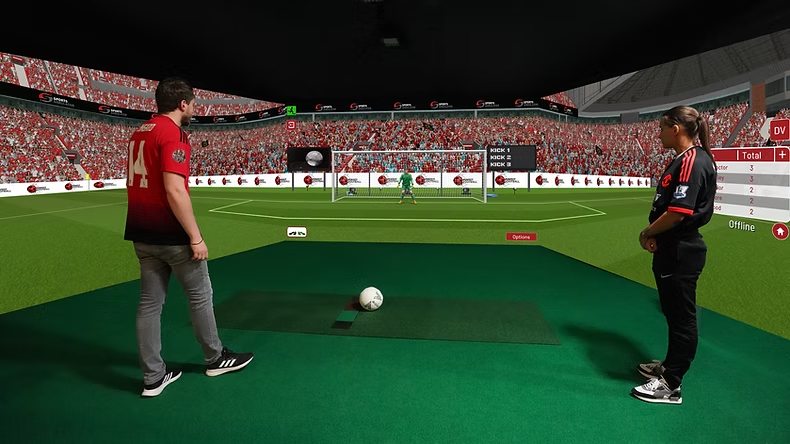
Virtual Football is the most widely-offered Virtual Sport at UK-licensed operators. Matches play out as short animated fixtures lasting one to three minutes, typically covering 90 simulated minutes with abbreviated play. Pre-match markets mirror real football betting: match result, both teams to score, over/under goals, correct score, and first goalscorer.
The simulation uses goal probability settings adjusted by the provider's RNG parameters — some virtual football products model different team quality levels, giving slightly different odds for simulated home vs away sides. Others treat all fixtures as statistically equal. Either way, no actual team data influences the result. The format suits players who enjoy football betting structures and want frequent fixtures without waiting for scheduled matches. Like online roulette, the outcomes are entirely random — the football presentation is cosmetic framing over an RNG draw. Most UK virtual football lobbies run league and cup formats with named teams and standings that update across sessions, giving the product a sense of continuity without affecting the outcome of any individual match.
Virtual Horse Racing
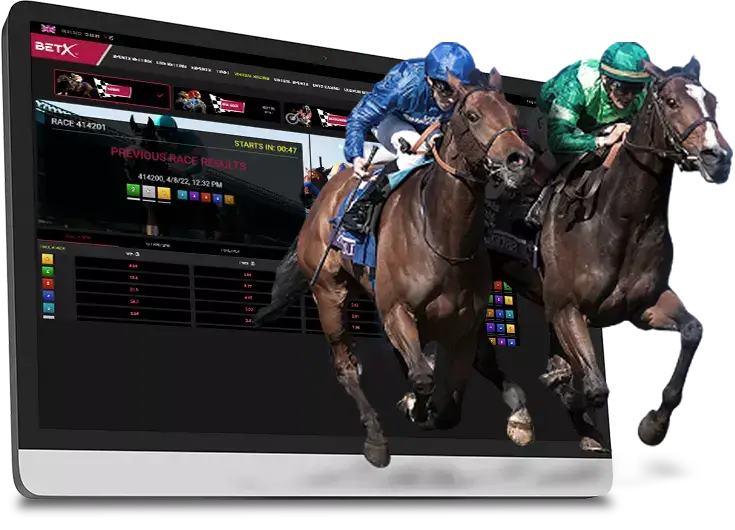
Virtual Horse Racing is the closest digital equivalent to the UK's long-standing horse racing betting tradition. Races typically feature six to twelve runners, each assigned odds that reflect the probability built into the RNG distribution for that event. Markets include win, each way, forecast (first and second), and reverse forecast.
This format has the deepest roots in the UK Virtual Sports market — it's been available in betting shops via fixed-odds terminals for longer than any other virtual format, and the transition online was natural. Round times are typically two to three minutes including the race itself. Odds volatility is similar to short-field real racing, with favourites, mid-priced, and outsider runners filling each race. The each-way market is popular for its secondary payout on top-three finishes.
Virtual Greyhounds
Virtual Greyhounds runs on the same structural principle as virtual horse racing but with shorter races and typically six runners. Markets include win, place, forecast, and trap combination bets (picking which traps the top finishers come from). Race duration is usually under 30 seconds, making it one of the fastest-resolving formats in the Virtual Sports category.
The format is particularly common in the UK due to greyhound racing's domestic betting tradition. Some operators run virtual greyhound events every three minutes or more frequently, making it the highest-volume virtual betting format by event count. Odds are generated by the provider's RNG distribution for each race, with no actual greyhound form or draw statistics applicable.
Virtual Tennis
Virtual Tennis simulates matches at point and set level, with results generated by the underlying RNG system. Pre-match markets include match winner and correct sets; some platforms offer game-by-game betting during the simulation. Matches typically last two to four minutes of screen time.
The format is less popular than football or racing but provides variety within a virtual lobby. It suits players who want a longer-format virtual event — tennis simulations run for slightly more screen time than a sprint race — and the scoring structure creates natural in-play betting opportunities where they are offered. Major virtual tennis providers model men's and women's circuits with bracket-style tournament simulations alongside standalone matches.
Virtual Cycling
Virtual Cycling simulates road races and stage events with a peloton field typically of twelve to twenty riders. Markets focus on stage winner, top-three finishes, and nationality of the winner. Race simulations last two to four minutes and are staged as dramatic graphic representations rather than detailed rider-by-rider tracking.
The format is one of the more niche Virtual Sports offerings but is available at several major UK-licensed operators. Unlike virtual football or racing, the large field size makes favourite-backing less straightforward — more runners means more spread in the RNG probability distribution, and top-three markets often produce better value than outright winner bets. Round frequency is typically lower than racing formats.
Virtual Basketball
Virtual Basketball simulates short-form matches with full-game results generated by the RNG. Markets include match winner, total points over/under, and point spread. Simulations typically last one to two minutes of animated play.
Basketball is the most popular Virtual Sport in several European markets and is gaining traction in the UK. The over/under points market — where you bet on whether combined scoring will exceed or fall below a set total — is particularly active and mirrors the structure of real basketball betting closely. Total points lines in virtual basketball function similarly to spread betting on points totals in online keno number pools — both involve betting on a range rather than a single outcome.
Top Providers
Sportradar
Sportradar is one of the leading data and technology companies in the global sports betting industry. The studio produces high-quality CGI simulations across football, horse racing, greyhounds, cycling, and other sports, distributed to major UK-licensed operators.
The studio's strength is production quality — Sportradar's virtual football and racing animations use motion-captured athlete movements and photorealistic environments, making them among the most visually convincing simulations available. RNG certification is handled through standard industry testing. UK operators using Sportradar include several of the largest betting brands, and the product integrates seamlessly into standard sports betting interfaces.
Kiron Interactive
Kiron Interactive is one of the longest-established virtual sports providers, supplying over 30 virtual sport types to operators worldwide. The company's UK footprint covers virtual football, racing, greyhounds, tennis, basketball, and cycling. Kiron's technology runs in both online and retail (fixed-odds terminal) environments.
The provider's breadth is its main differentiator — the range of virtual sport types available through Kiron is wider than most competitors. Alongside online baccarat and other casino content, Kiron virtual sports sit within many operators' broader gaming lobbies as a distinct tab. The RNG infrastructure is independently tested and the platform handles high event frequency — some Kiron sports events run every 90 seconds. The company has also developed a Virtual Sports suite aimed specifically at mobile-first operators, with a lighter interface suited to smaller screens.
IMG Arena
IMG Arena is the sports content and technology division of IMG, providing virtual sports alongside real-event streaming data to major UK bookmakers and casino operators. The virtual sports catalogue includes football, horse racing, cycling, and other formats.
IMG Arena's distinguishing factor is the quality of its production partnerships — some of its virtual content is developed using licensed real-venue footage combined with CGI overlays, giving a more integrated visual experience than fully synthetic alternatives. Distribution in the UK is through large multi-product operators rather than dedicated bingo or casino sites. The platform handles event scheduling, result settlement, and odds generation in a single integrated stack.
Golden Race
Golden Race is a Sofia-based provider with a significant presence in the UK market. The company offers virtual football, horse racing, greyhounds, basketball, and other formats to UK-licensed operators, with particular strength in retail betting terminal environments that have translated online.
The provider's pricing and integration model suits mid-market operators who want a full virtual sports suite without the premium licensing costs of the largest players. Odds generation and RNG certification meet UKGC requirements. Golden Race content appears in a number of UK-licensed lobbies alongside casino products, often accessible from the same account that a player uses for slots or table games.
How to Play: A Beginner's Guide
Interface and Bet Types
The betting interface mirror standard sports betting layouts. A schedule or lobby screen shows upcoming events with their start times — typically every two to five minutes. Clicking an event opens the full market menu: match result, goal totals, first scorer for football; win/each way/forecast for racing; similar formats for other sports.
Odds are displayed in decimal format at UK-licensed operators (e.g., 2.50 for evens in decimal). The bet slip collects selections, allows stake entry, and shows potential returns before confirmation. Most platforms support multiple selections on a single bet slip, enabling accumulator bets across virtual events.
Bet Types Breakdown
| Bet Type | Description | Typical Markets |
|---|---|---|
| Single | One selection, one event | Match result, race winner |
| Each way | Win + place at a fraction of win odds | Horse racing, greyhounds |
| Forecast | Predict first and second finisher in order | Racing formats |
| Accumulator | Multiple events combined, all must win | Football, cross-sport |
| Over/Under | Whether a total exceeds or falls short | Football goals, basketball points |
Accumulators produce higher potential returns but are subject to compounding overround — the house edge multiplies with each additional selection added to the slip.
Payouts and Odds Explained
Odds in this format reflect the probability the provider has built into the RNG distribution plus a margin (the overround). A virtual horse race with a 2.50 favourite is offering slightly less than the true probability of that outcome, which is where the house edge sits.
Decimal odds convert directly to implied probability: 2.50 implies a 40% chance (1 ÷ 2.50). If the true probability is 43%, the overround accounts for the difference. In a five-runner virtual race, all five implied probabilities summed will exceed 100% — the excess is the operator's margin. On a single match-result market, overround is typically 5% to 10%.
Strategies
Back Lower Odds, Avoid Accumulators
The lowest-edge approach available is sticking to simple single bets on the most-liquid markets — match result in football, win market in racing. These markets carry the lowest overround the provider applies. Accumulators compound the house margin with every leg added: a five-fold accumulator at 6% overround per leg produces an effective house take of around 26%. The potential return is higher, but so is the expected loss per pound staked.
For comparison, a single match-result bet at 6% overround has an expected return of 94p per £1. Adding four more legs to make an accumulator drops that to around 74p per £1. Players attracted by the payout size of accumulators should understand they are paying significantly more for the entertainment. The same principle applies across all Virtual Sports categories — the simpler the market, the lower the margin built in by the provider.
For comparison, a single match-result bet at 6% overround has an expected return of 94p per £1. Adding four more legs to make an accumulator drops that to around 74p per £1. Players attracted by the payout size of accumulators should understand they are paying significantly more for the entertainment.
Set Event Limits, Not Just Stake Limits
the format runs continuously. Without a session limit on number of events, the combination of two-minute round times and 24/7 availability makes it easy to place far more bets in an hour than originally planned. Setting a maximum number of events per session — not just a monetary budget — is a more effective brake than budget alone, because individual stakes can feel small even as volume adds up.
Unlike slower formats like crash games, where a round involves an active cashout decision, virtual sports betting resolves passively once the bet is placed. The pace is genuinely fast and the effort required per bet is very low, which is why event-count limits are worth building into any session.
Understand Overround Before Choosing Markets
Each market within a virtual event has a different overround. Match result in virtual football typically carries 5% to 8%; correct score in the same match might carry 15% to 20%. Each-way in virtual horse racing is better value than a forecast on most race configurations. Checking implied probability across market options before betting — rather than simply backing the selection that looks attractive — can materially reduce the effective house edge per session.
Do These Strategies Actually Work?
No betting strategy changes the RNG-determined outcome of any virtual event. Each race, match, and game is independent of all previous results. Strategies here are entirely about bet selection and session structure — reducing the house take per bet and limiting total volume — rather than predicting outcomes.
The most common mistake is applying real-sports analysis to virtual results. No team form, jockey record, or head-to-head history has any bearing on results. Players who bet as if they do are not improving their odds; they're adding false complexity to a random process.
Odds and House Edge
Virtual Sports operate on an overround model rather than a fixed house edge per spin. The effective house take per bet depends on the market chosen. Single match-result markets typically carry 5% to 10% overround; more complex markets like correct score or forecast doubles run higher. This compares unfavourably with the Banker bet in online baccarat at 1.06%, but is broadly comparable with other betting-format products.
Market Comparison
| Market | Typical Overround |
|---|---|
| Virtual football match result | 5–8% |
| Virtual horse racing win | 8–12% |
| Virtual greyhounds win | 10–15% |
| Correct score (football) | 15–20% |
| Forecast (racing) | 12–18% |
| Accumulator (each leg adds) | compounds per leg |
Which Markets Offer the Best Value?
Simple win markets in virtual football and horse racing carry the lowest overround across the category. Each-way betting in virtual horse racing provides a place payout that reduces variance without significantly increasing the house take. Forecast and correct-score markets should be used selectively — their higher overround means expected value declines quickly.
The practical advice is to compare implied probabilities across the available markets for any given event. Where two markets cover similar outcomes at different odds structures, the one with the lower implied probability total is better value.
Best Virtual Sports Casino Sites in the UK
bet365
bet365 holds a UKGC licence and operates one of the largest and most comprehensive Virtual Sports offerings in the UK market. The virtual sports section is accessible from the same account as live sports betting and casino products, covering virtual football, horse racing, greyhounds, cycling, basketball, and more. Round frequency is high and the animated quality is among the best available.
The welcome offer for new sports customers is a deposit match; specific terms should be checked at registration. For players in this category, the main draw is the depth and frequency of events across multiple sport types rather than any specific bonus structure. Withdrawals are reliable and the platform handles high bet volumes consistently.
William Hill
William Hill is one of the UK's longest-established bookmakers with a full UKGC licence and a strong virtual catalogue. Events include virtual football leagues, horse racing circuits, and greyhound meetings running on tight schedules throughout the day and night.
The welcome offer is a sports-bet qualifying bonus; current terms should be confirmed at signup. For regular players, William Hill's multi-sport virtual lobby and the integration between virtual and live sports markets on the same account make it a practical choice. The mobile app is well-built for both sports betting and casino products.
Coral
Coral holds a UKGC licence as part of the Entain Group. The virtual section is available through the same platform as real-event betting and casino products, with virtual football, horse racing, greyhounds, and cycling all represented. Events run at standard two-to-five-minute intervals across all formats.
The welcome offer is a sports deposit bonus with associated qualifying conditions; check current terms before registering. Coral's integration of virtual and real-event markets means players can move between both without separate accounts. For players who also want scratch cards or instant-win games alongside their virtual sports, the casino tab is within the same login.
Betway
Betway holds a UKGC licence and provides a focused virtual offering covering football, horse racing, greyhounds, and tennis simulations. The lobby interface is clean and event scheduling is clearly displayed, making it easy to find upcoming fixtures and plan a session without navigating multiple sub-menus.
The welcome offer is a matched sports bonus with qualifying conditions; current terms should be confirmed at signup. Betway's customer service is responsive and the platform's live chat function handles settlement queries efficiently. For players who also enjoy table games, the casino section covers the standard range.
UKGC Licensing and Fair Play
A UK Gambling Commission licence is the most important verification for any player in this format. Licensed operators must use independently tested RNGs, display theoretical return-to-player percentages for each market, segregate player funds, and comply with responsible gambling requirements. Unlicensed operators provide none of these protections.
virtual events are occasionally offered on offshore sites without UKGC oversight. These operators are not legally permitted to serve UK players, their RNG testing is unverified, and player funds are not protected. Always confirm the licence number in the site footer against the Gambling Commission's public register before depositing.
Bonuses and Wagering Requirements
Bonuses at the operators are usually structured as sports betting welcome offers — deposit match with a qualifying bet requirement — rather than casino-style bonus credit. Wagering requirements are typically lower than casino bonuses: a matched bet structure requires one qualifying bet rather than 30x to 40x playthrough.
The important detail is whether the qualifying bet can be placed on virtual events or only on real-event sports markets. Many operators specify that the welcome offer requires a bet on live sports rather than virtuals. Always read the qualifying bet terms specifically before opting in.
Play on Mobile
this is one of the strongest categories for mobile play. Events are short, the bet slip is lightweight, and watching a two-minute virtual race simulation requires less screen real estate and data than live video streaming. Most major UK operators have dedicated apps for iOS and Android where virtual sports events are prominently signposted.
The user interface for placing bets scales well to smaller screens — market menus are compact, odds are displayed clearly, and the bet slip functions identically to the desktop version. For players who want fast-resolution betting on a mobile device between other activities, the format provides a more structured experience than online poker table games, where longer hand sequences and strategic decisions are less suited to brief sessions.
Is It Rigged?
At UKGC-licensed operators, no. Results are determined by independently certified RNGs before the animation plays, and the certification process confirms that the probability distribution matches the published odds. Operators cannot alter results after bets have been placed.
The more common concern is whether the published odds accurately reflect the built-in probabilities. At licensed operators, the RTP data is required to be accurate and is subject to audit. If a virtual horse race offers a favourite at 2.50, the underlying probability distribution must be consistent with those odds across a large sample of events.
A realistic caution is about unlicensed offshore sites. Virtual sports offered without UKGC oversight have no requirement for RNG testing, accurate RTP disclosure, or result integrity. The licensed operator requirement is particularly important in this category because the format's animated presentation makes it easy to conflate randomness with genuine contest simulation — which is exactly the environment where unregulated operators can exploit player trust. Always verify the UKGC licence before depositing.
Real Money vs Free Play
Free or demo versions are rarely offered by major UK operators. Unlike slots or table games, where demo modes are standard, virtual sports betting is typically real-money only. Some operators allow free bet credits earned through welcome offers to be used on virtual events, which functions as a cost-free introduction to the format.
The practical entry point for new players is placing small single bets — £0.10 to £0.50 — on straightforward match-result or race-win markets. This covers the full cycle: choosing a market, watching the simulation, and seeing the result settled. Three or four events at minimum stakes is enough to understand how the format works without significant exposure.
Common Mistakes to Avoid
The most common mistake is treating the simulation as if real-world knowledge applies. Analysing virtual team names, past virtual results, or jockey-equivalent patterns in virtual racing to predict outcomes is wasted effort — every result is RNG-determined and has no connection to previous events or simulated form. This misunderstanding is more widespread in Virtual Sports than in any other casino category, because the sports framing encourages analytical thinking that simply doesn't apply.
The second is accumulator overuse. Accumulators across multiple Virtual Sports events compound the house margin rapidly and produce very low expected returns per pound staked. The payout sizes look attractive, but the mathematical cost escalates with each additional leg.
The third is under-estimating session speed. A virtual event every two to three minutes means twenty or more bets per hour is easy without feeling that way. Players who set a money budget without a time or event-count limit often exhaust their session funds faster than expected.
The fourth is ignoring the overround on side markets. Correct score, first goalscorer, and forecast bets carry significantly higher house margins than simple win or result markets. Using these markets regularly increases the effective cost per session well above the headline rate.
Responsible Gambling and Player Protection
the format runs continuously, day and night, with no natural stopping point. The combination of fast event cycles and 24-hour availability makes session limits particularly important. Every UKGC-licensed operator must offer deposit limits, session reminders, time-out periods, reality checks, and self-exclusion. These tools are mandatory and using them is a standard part of responsible play.
For players who want a national-level pause, GamStop offers self-exclusion across all UKGC-licensed sites simultaneously, with periods from six months upward. For support, advice, or someone to talk to, GamCare provides free confidential help via phone, live chat, and online forums, available around the clock.
Virtual Sports FAQ