Progressive Jackpot Slots
Progressive Jackpot Slots pool a small percentage of every player's stake into a shared prize that grows until someone wins it. From the legendary Mega Moolah franchise to the modern Age of the Gods network, the category produces the largest single payouts in the UK slot market. This guide covers the strongest titles, network mechanics, UKGC casinos, and realistic odds.
Best Progressive Jackpot Slots

Progressive Jackpot Slots UK — Quick Overview
Progressive Jackpot Slots pool a small percentage of every player's stake into a shared prize that continues to grow until someone hits the trigger condition. The contribution rate is typically 1% to 2% per spin, drawn from the slot's total RTP, and the prize escalates across thousands of players spinning simultaneously across dozens or hundreds of casinos. The headline figures — £15 million on Mega Moolah's most famous wins, regular six and seven-figure hits on Mega Fortune and the Age of the Gods network — are real, verifiable, and life-changing.
The trade-off is the math. Progressive Jackpot Slots have lower base RTPs than equivalent non-progressive slots because the jackpot contribution is funded out of the player's expected return. A 95% base RTP that contributes 1% to the progressive jackpot effectively pays 94% to standard wins and 1% toward the lottery-style top prize. Players who never trigger the jackpot — which is the overwhelming majority — get a meaningfully worse expected return than they would on a non-progressive slot of the same studio.
This guide covers the strongest current Progressive Jackpot Slots in UK lobbies, the difference between standalone, local, and network progressives, what no deposit offers actually look like for jackpot games, the realistic odds of triggering each major jackpot tier, and how to think clearly about session play on slots designed around extremely low-probability life-changing payouts.
Best Progressive Jackpot Slots to Play in 2026
The six titles below all hold a current spot in UK casino lobbies and use progressive jackpot mechanics as a central feature. The picks span the major progressive networks active on UKGC sites in 2026 — Microgaming's WowPot, NetEnt's Mega Fortune network, Playtech's Age of the Gods, Blueprint Gaming's Jackpot King, and IGT's MegaJackpots. Average jackpot figures fluctuate constantly with each hit and reset cycle.
| Game | RTP | Top Jackpot Tier (avg) | Volatility | Provider |
|---|---|---|---|---|
| Mega Moolah WowPot | 93.42% | £8m–£15m+ | Medium-High | Microgaming/Gameburger |
| Mega Fortune Dreams | 96.40% | £2m–£4m | High | NetEnt |
| Age of the Gods | 95.02% | £500k–£2m | Medium | Playtech |
| Genie Jackpots Megaways | 96.00% | £200k–£500k | Medium | Blueprint Gaming |
| Divine Fortune | 96.59% | £150k–£500k | Medium-High | NetEnt |
| Cleopatra MegaJackpots | 95.02% | £200k–£600k | Medium | IGT |
Mega Moolah WowPot
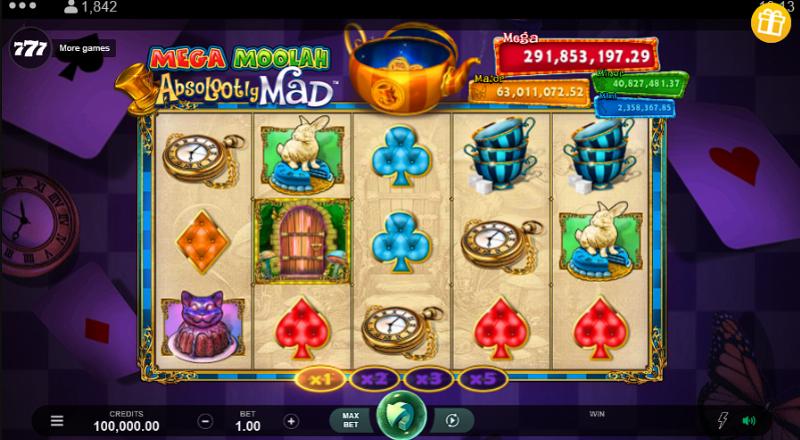
Mega Moolah WowPot from Microgaming and Gameburger Studios is the longest-running and most famous progressive jackpot slot in the UK market. The original Mega Moolah launched in 2006 and has paid out more record-breaking jackpots than any other slot in online gambling history, including a £15.1 million Guinness-record hit in 2018. The WowPot variant added a second progressive network on top of the original four-tier structure, producing a six-tier jackpot system that sits behind every Mega Moolah-themed release.
The base game runs a 5-reel, 3-row grid with 25 paylines and an African safari theme. The progressive jackpot triggers randomly during base game spins regardless of the win on that spin, opening a wheel-of-fortune mini-game where the player spins a wheel divided into Mini, Minor, Major, and Mega segments. The WowPot network adds two additional tiers (WowPot Mini and WowPot Mega) accessible via a separate bonus mechanic. Three or more scatters trigger 15 free spins with a 3x multiplier on all wins. RTP is 93.42% on the standard version, volatility is medium-high, and the Mega tier averages between £8 million and £15 million across the network. The Mega tier hits roughly once every 12 to 18 months on average across global play.
Mega Moolah WowPot in practice plays as a slot where the jackpot is the entire point. The base game is functional but unspectacular — modest win frequency, a 3x multiplier free spins round that produces moderate returns, and a 93.42% RTP that's well below the modern standard for non-progressive slots. The jackpot wheel is the only reason to play. Sessions should be sized around how many spins you're willing to commit for jackpot-trigger probability rather than expected base game return.
A 5x3 safari-themed slot from Microgaming and Gameburger Studios with a six-tier progressive jackpot wheel including the Mega Moolah and WowPot networks, 93.42% RTP, medium-high volatility, and an average Mega jackpot between £8m and £15m+.
Mega Fortune Dreams
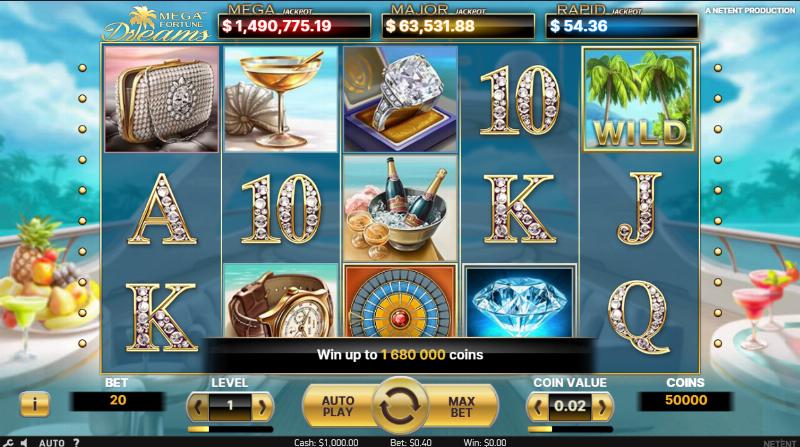
Mega Fortune Dreams from NetEnt is the spiritual successor to the original Mega Fortune and one of the highest-RTP Progressive Jackpot Slots on UKGC sites. Released in 2014 with a luxury yachts and champagne theme, it kept the original's three-tier progressive structure and improved both the base game RTP and the bonus round generosity. Several seven-figure jackpots have been paid out on the slot since its UK release.
The base game runs a 5-reel, 3-row grid with 20 paylines. Three or more bonus wheel scatters trigger the jackpot bonus, where the player spins a wheel with Rapid, Major, and Mega progressive segments. The Mega tier is the network jackpot drawn from contributions across all NetEnt operators. Five or more bonus scatters automatically trigger the Mega wheel directly. Three or more free spins scatters trigger a free spins round with sticky wilds, multipliers, and re-trigger potential. RTP is 96.40% on the standard version (notably higher than the original Mega Fortune's 96.40% / 96.6% range), volatility is high, and the Mega jackpot averages between £2m and £4m. Mega tier hits land roughly once every 6 to 12 months on average across the NetEnt network.
Mega Fortune Dreams in practice plays as a more rewarding base game than Mega Moolah at the cost of a smaller top jackpot. The 96.40% RTP gives players a meaningful expected return on standard play, the free spins round produces consistent bonus payouts via sticky wilds and multipliers, and the jackpot bonus is genuinely entertaining as a feature even when the Mega tier doesn't land. Sessions feel sustainable on moderate bankrolls because the base game does enough work to extend playtime between jackpot trigger attempts.
A 5x3 luxury-themed slot from NetEnt with a three-tier progressive jackpot wheel and a multiplier free spins round, 96.40% RTP, high volatility, and an average Mega jackpot between £2m and £4m.
Age of the Gods
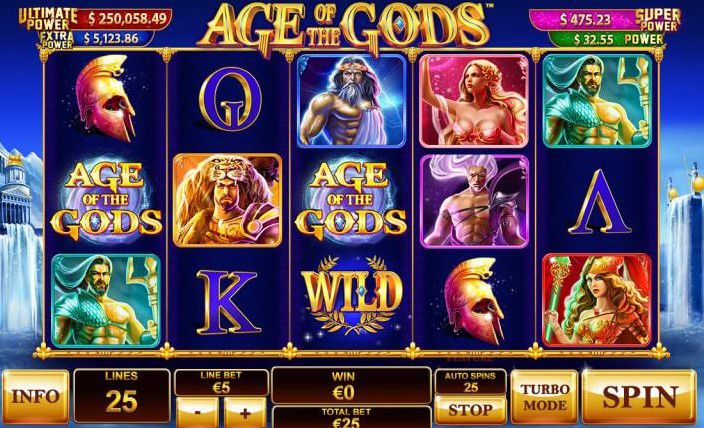
Age of the Gods from Playtech is the foundation of the Age of the Gods network — a shared progressive jackpot ecosystem that links dozens of branded slots through a single four-tier jackpot pool. Released in 2016 with a Greek mythology theme, it has since grown into one of the largest progressive networks active on UKGC sites, with the Ultimate Power tier paying out regularly across the wider Playtech catalogue.
The base game runs a 5-reel, 3-row grid with 25 paylines. The Age of the Gods Jackpot triggers randomly on any spin regardless of win amount, opening a 4x5 grid pick screen where the player selects coins to reveal jackpot symbols. Matching three identical symbols awards the corresponding tier — Power, Extra Power, Super Power, or Ultimate Power. The Ultimate Power tier is the network jackpot drawn from contributions across the entire Age of the Gods franchise. The base game also includes a free spins round triggered from three or more god scatters with random god features. RTP is 95.02%, volatility is medium, and the Ultimate Power tier averages between £500k and £2m. Ultimate Power hits land roughly once every 4 to 8 weeks across the Playtech network.
Age of the Gods in practice plays as a network entry point — the base game is solid rather than exceptional, and the appeal sits in the network breadth. Players who want jackpot exposure to the Ultimate Power tier can choose between dozens of Age of the Gods titles (Furious 4, Fate Sisters, Prince of Olympus, and many more), all of which contribute to the same shared jackpot pool. The Ultimate Power tier hits more frequently than Mega Moolah or Mega Fortune Dreams' top tiers because the network is smaller and the jackpot reset is lower.
A 5x3 Greek mythology slot from Playtech anchoring the Age of the Gods progressive network with four jackpot tiers, 95.02% RTP, medium volatility, and an average Ultimate Power jackpot between £500k and £2m.
Genie Jackpots Megaways
Genie Jackpots Megaways from Blueprint Gaming combines the Megaways engine with a pick and click bonus slotsfeature and the Jackpot King progressive network, producing one of the most mechanically integrated jackpot titles on UKGC sites. Released in 2020, it remains a top-tier UK Blueprint release and a regular promotional spin target.
The game uses the Megaways engine — six reels with variable symbols per reel and up to 117,649 ways to win on each spin. Wins clear and trigger a tumble. Three or more genie scatters trigger the lamp pick bonus, where players choose lamps to reveal one of three free spin variants or one of four progressive jackpot tiers (Mini, Minor, Major, Mega Big Spin). The Mega Big Spin is the network jackpot drawn from the wider Jackpot King ecosystem across all Blueprint progressive titles. RTP is 96.00% on the standard version (a notably higher base RTP than most network progressives), volatility is medium, and the Mega Big Spin tier averages between £200k and £500k. The Mega tier hits roughly once every 4 to 6 weeks across the Blueprint network.
Genie Jackpots Megaways in practice plays at a faster pace than most jackpot titles because the cascading base game keeps the spin loop active. The lamp pick is the focus of any session — choosing between free spin variants and jackpot tiers within a single decision tree gives the slot more density than most network progressives. The smaller top jackpot relative to Mega Moolah is offset by the higher base RTP and faster reset cycle.
A Megaways slot from Blueprint Gaming with a lamp pick bonus offering three free spin variants and a four-tier Jackpot King progressive, 96.00% RTP, medium volatility, and an average Mega Big Spin between £200k and £500k.
Divine Fortune
Divine Fortune from NetEnt is one of the higher-RTP network progressive titles on UKGC sites and the strongest entry-point for players new to jackpot slots. Released in 2017 with a Greek mythology theme, it features three jackpot tiers (Minor, Major, Mega) with the Mega tier drawn from a smaller network than Mega Fortune Dreams, which produces more frequent hits at lower averages.
The base game runs a 5-reel, 3-row grid with 20 paylines. Throughout play, jackpot symbols can land on reels and contribute to a coin collection meter — collecting 15 jackpot coins triggers the jackpot bonus round, where the player must collect three matching symbols across three rows to unlock each progressive tier. The mechanic combines symbol collection slots elements with the standard progressive jackpot structure. Three or more scatters trigger free spins with falling wilds and re-spins. RTP is 96.59% on the standard version, volatility is medium-high, and the Mega tier averages between £150k and £500k. Mega tier hits land roughly once every 2 to 4 weeks across the NetEnt Divine Fortune network.
Divine Fortune in practice plays as one of the most well-rounded jackpot slots in the UK market. The 96.59% base RTP is notably higher than most progressives, the falling wilds re-spin mechanic produces consistent base game wins, and the jackpot trigger via the coin collection meter feels more earned than the random wheel triggers on Mega Moolah and Age of the Gods. Sessions on Divine Fortune feel less like a pure lottery and more like a slot with a meaningful jackpot upside.
A 5x3 Greek mythology slot from NetEnt with a three-tier progressive jackpot triggered via coin collection and a falling wilds re-spin feature, 96.59% RTP, medium-high volatility, and an average Mega jackpot between £150k and £500k.
Cleopatra MegaJackpots
Cleopatra MegaJackpots from IGT is the progressive variant of one of the longest-running slot franchises in the UK market. The original Cleopatra debuted in 2005 as a non-progressive slot and remains a fixture in major UK casino lobbies; the MegaJackpots variant added a single-tier progressive jackpot drawn from the wider IGT MegaJackpots network. Several seven-figure hits have been recorded on the network across the past decade.
The base game runs a 5-reel, 3-row grid with 20 paylines and an Ancient Egyptian theme. Three or more sphinx scatters trigger 15 free spins with all wins tripled — one of the most generous standard free spins multipliers in the UK market. The MegaJackpots progressive triggers randomly on any base game spin regardless of win amount, awarding the current jackpot pool directly to the player. The progressive is a single-tier jackpot rather than a multi-tier wheel structure, which means the headline figure is the entire prize. RTP is 95.02% on the standard version, volatility is medium, and the jackpot averages between £200k and £600k. Hits land roughly once every 6 to 10 weeks across the network.
Cleopatra MegaJackpots in practice plays as a polished classic. The 3x free spins multiplier produces meaningful payouts on bonus rounds even without the jackpot triggering, and the Ancient Egyptian visual identity remains genuinely well-executed despite the slot's age. The single-tier jackpot structure is simpler than the wheel and pick mechanics on other network progressives — the jackpot either triggers or it doesn't, with no intermediate consolation prizes. The 95.02% RTP is below the modern standard, which is the cost of jackpot eligibility.
A 5x3 Ancient Egyptian slot from IGT with a single-tier MegaJackpots progressive triggered randomly and a 3x multiplier free spins round, 95.02% RTP, medium volatility, and an average jackpot between £200k and £600k.
How Progressive Jackpot Slots Work
The Core Mechanic Explained
The defining feature of a Progressive Jackpot Slot is the contribution-and-pool structure. Every spin that a player makes on the slot contributes a fixed percentage — typically 1% to 2% — of the stake to a shared jackpot pool. The pool grows continuously across thousands of players spinning simultaneously, and the jackpot continues to escalate until someone triggers the win condition. When the jackpot is won, the pool resets to a predetermined seed value (often £100,000 or £1m on the largest networks) and begins growing again.
UKGC rules require every progressive jackpot trigger to be generated by a certified random number generator and predetermined for each individual spin. The trigger condition itself varies by slot — some progressives trigger via a wheel-of-fortune mini-game accessed by random base game events, others trigger via specific symbol matches in a separate bonus screen, and some trigger as a random outcome on any single spin regardless of stake. The probability of triggering a jackpot on any individual spin is extremely low, typically in the range of 1 in 50 million to 1 in 200 million for the top tier on the largest networks.
The base RTP of a Progressive Jackpot Slot is calculated separately from the jackpot contribution. A slot with a 96% advertised RTP that contributes 1.5% to the progressive pool effectively pays 94.5% to standard wins and 1.5% to the jackpot lottery. Players who never trigger the jackpot get the lower expected return; players who trigger it get the entire pooled value. The math balances out across the network as a whole, but for any individual player, the practical experience is almost always a slightly worse base RTP without the jackpot upside materialising.
Variants Across Different Games
Studios have developed three main variants of the progressive jackpot structure. Standalone progressives accumulate from a single slot at a single casino — these are essentially extinct in 2026 because the trigger probabilities required to keep the slot's RTP balanced are too low to produce meaningful jackpots. Local progressives accumulate from a single slot across all players at one casino group — these still exist on a few smaller-network titles but produce smaller jackpots than network progressives.
Network progressives accumulate from multiple slots across multiple casinos — these dominate the modern UK market. Mega Moolah WowPot, Mega Fortune Dreams, the Age of the Gods Ultimate Power tier, the Jackpot King network, the IGT MegaJackpots network, and the Divine Fortune network are all network progressives. The advantage is jackpot size; the trade-off is that the trigger probability per spin is even lower because the contributions come from a much larger spinning population.
Multi-tier progressives present several jackpot pools at once with escalating prize values — Mini, Minor, Major, and Mega tiers are the most common structure. Each tier has its own separate trigger probability and its own seed value. Lower tiers hit relatively often (Mini tiers can trigger several times per day across the network); higher tiers hit rarely. The structure produces frequent small consolation jackpots alongside the rare top-tier hit, which is psychologically appealing and explains why most modern Progressive Jackpot Slots use multi-tier rather than single-tier designs.
Progressive Jackpot Slots Free Spins No Deposit UK 2026
What No Deposit Offers Actually Look Like in Practice
UK no deposit free spin offers on Progressive Jackpot Slots are uncommon. Most casinos exclude jackpot-eligible slots from welcome free spin promotions because the math creates an unfavourable promotional cost — if a player triggers the jackpot during free spins, the casino is liable for the full payout while having received zero deposit. The exceptions are typically lower-tier jackpot slots like Divine Fortune or specific operator-funded promotions on the Age of the Gods network during marketing pushes.
A typical no deposit offer on a jackpot slot provides 10 to 25 free spins on Divine Fortune or a similar mid-tier progressive at 10p or 20p stake, with a maximum win cap of £20 and explicit terms excluding jackpot wins from the cap. Most no deposit offers simply do not include progressive jackpot slots at all. Players who want to play Mega Moolah or Mega Fortune Dreams typically need to fund their own play.
Wagering Requirements & How to Read Them
From January 2026 the UKGC capped wagering requirements at 10x the bonus amount across all UK-licensed casinos. A worked example: 25 free spins slots at 20p stake produce £15 of winnings on a non-jackpot bonus round. The casino converts this to £15 of bonus cash with the new 10x maximum requirement — total wagering is £150. At a £1 per spin stake, that is 150 additional spins before the winnings clear.
Most jackpot slots either contribute 100% to wagering when they qualify for promotions, or they are excluded entirely. Bonus terms typically state explicitly whether the slot is bonus-eligible. Players should also note that any progressive jackpot won during bonus play is usually paid in full and not subject to the bonus wagering structure, but the bonus balance from non-jackpot wins follows the standard wagering rules.
Deposit Bonus Spins vs No Deposit — Which Suits You
Deposit-funded free spin offers occasionally include eligible Progressive Jackpot Slots, particularly on the Age of the Gods network or the Divine Fortune title. Volumes are usually 50 to 200 spins on a first deposit match, and the jackpot trigger probability during the spin sequence is mathematically identical to real-money play. Players new to a casino who want to test the platform should prioritise no deposit offers on non-progressive slots; players who specifically want jackpot exposure should focus on deposit-funded offers that explicitly include jackpot-eligible games.
How to Buy the Progressive Jackpot Bonus — UK Bonus Buy Rules
The UK Gambling Commission banned bonus buy features for UK-licensed casinos in October 2021 under RTS requirement 14A. The ban applies to feature-buy mechanics that let players pay a multiple of their stake to immediately access a slot's free spins or bonus round. For Progressive Jackpot Slots, the practical relevance of the ban is limited because the jackpot trigger itself is generally not purchasable in any jurisdiction — network progressives require contributions from organic spin activity to maintain mathematical balance, so feature buys for jackpot triggers don't exist in the same form as bonus buys on standard slots.
The exception is a small number of progressive titles that include a feature buy for the standard free spins round (the non-jackpot bonus). Genie Jackpots Megaways and Divine Fortune both offer free spins feature buys in some non-UK markets — those buys are hidden or disabled for UK-registered accounts. The progressive jackpot trigger on those slots remains accessible only through normal play regardless of jurisdiction.
Players who chase unrestricted bonus buy slots access on offshore unlicensed sites give up every UKGC-mandated player protection. For Progressive Jackpot Slots specifically, offshore sites often display the same network jackpots advertised on UKGC sites, but the player's contribution to the network may not actually flow into the licensed jackpot pool — verifying the legitimacy of jackpot eligibility on offshore platforms is effectively impossible.
Best UK Casinos for Progressive Jackpot Slots
The four casinos below all hold current UKGC licences and carry strong libraries of progressive jackpot titles across the major networks (WowPot, Mega Fortune, Age of the Gods, Jackpot King, MegaJackpots). Bonus terms change frequently, and the new 10x wagering cap took effect in January 2026, so verify current terms before depositing.
| Casino | Bonus | Wagering | UKGC Licence |
|---|---|---|---|
| bet365 Casino | 50 free spins on £10 deposit | 10x | Yes |
| William Hill Casino | 50 free spins on £10 deposit | 10x | Yes |
| 32Red | £20 bonus on £20 deposit | 10x | Yes |
| Casumo | 30 free spins on first deposit | 10x | Yes |
bet365 Casino
bet365 Casino runs on a UKGC licence held by Hillside Gaming and offers one of the largest progressive jackpot catalogues among UK operators, with full coverage across the WowPot, Mega Fortune, Age of the Gods, and Jackpot King networks. Mega Moolah WowPot, Mega Fortune Dreams, the entire Age of the Gods franchise, Genie Jackpots Megaways, and the IGT MegaJackpots network are all present. The standard welcome offer provides 50 free spins on a £10 first deposit with the new 10x wagering cap (free spins are typically credited on a non-jackpot slot for promotional cost reasons). Withdrawal speeds are competitive with same-day processing for verified accounts. Live chat support runs around the clock.
William Hill Casino
William Hill Casino runs on a UKGC licence held by WHG (International) and offers one of the longest-established progressive jackpot platforms in the UK market. The catalogue covers Mega Moolah and the wider WowPot network, Age of the Gods, the Jackpot King network, and IGT MegaJackpots — essentially every major progressive network active on UKGC sites. The standard welcome offer is 50 free spins on a £10 first deposit with the new 10x wagering. The platform's mobile app loads jackpot slots smoothly even on older devices, and customer support runs around the clock with live chat.
32Red
32Red holds a UKGC licence and is the strongest UK destination for the Microgaming WowPot ecosystem specifically, with deep coverage of Mega Moolah and the wider WowPot network alongside the full Microgaming/Gameburger Studios catalogue. The casino has been part of the Microgaming network since the early 2000s, which means historical progressive eligibility data is more transparent than most newer operators. The standard welcome offer provides £20 of bonus on a £20 deposit with the new 10x wagering. The platform has won multiple UK industry awards for customer service and the responsible gambling tools are well-implemented.
Casumo
Casumo holds a UKGC licence and runs a slot catalogue with strong NetEnt and Microgaming progressive jackpot coverage. Mega Moolah WowPot, Mega Fortune Dreams, Divine Fortune, and the wider NetEnt jackpot library are all available. The standard welcome offer is 30 free spins on first deposit with the new 10x wagering. The platform has a structured progression system with regular promotional events that include progressive jackpot tournaments. Withdrawal speeds are competitive with most major UK operators and the responsible gambling tools include detailed loss tracking and customisable session reminders.
What to Look For in a Casino
UKGC licence first. Beyond that, the criteria that matter for jackpot players are network breadth — specifically whether the casino carries the full WowPot, Mega Fortune, Age of the Gods, Jackpot King, and MegaJackpots networks rather than just one or two. Withdrawal speed becomes critical for jackpot players because a six-figure jackpot win at a slow-paying operator can mean weeks of waiting. The largest UKGC operators (bet365, William Hill, 32Red) typically have the highest jackpot withdrawal limits and the fastest verification processes. Casino reputation also matters more for jackpot players because any payout disputes around progressive triggers are extremely high-value.
UKGC Compliance Check
The UK Gambling Commission publishes a public licensee register at gamblingcommission.gov.uk. Any casino accepting UK players must appear in this register with a current operating licence. Footer claims of "UKGC licensed" can be verified by clicking through to the licence number and confirming the operator name matches the public record. Casinos that show a certified-by logo without a clickable verification link should be treated with caution — particularly important for jackpot players, where the legitimacy of progressive eligibility matters significantly. The licence confers specific obligations including segregated funds for player balances, which protects jackpot winnings against operator insolvency.
Progressive Jackpot Slots by Volatility
Low Volatility
Low volatility Progressive Jackpot Slots are uncommon because the jackpot mechanic itself adds extreme variance to any underlying base game. The few low-volatility progressives in the UK market typically carry small jackpots — usually local rather than network — and pair the progressive with frequent small base game wins. Max wins outside the jackpot tier typically cap between 500x and 1,500x stake. These titles suit longer sessions on smaller bankrolls because the variance is contained even with the jackpot lottery overlaid on top.
Medium Volatility
Medium volatility is where most modern Progressive Jackpot Slots sit. Age of the Gods, Genie Jackpots Megaways, Divine Fortune, and Cleopatra MegaJackpots all fall in this tier. Standard non-jackpot max wins range from 1,000x to 5,000x, with the progressive jackpot extending the ceiling indefinitely. Free spins or bonus rounds trigger every 150 to 250 spins. Sessions feel sustainable on moderate bankrolls and the base game produces enough win frequency to extend playtime between jackpot trigger attempts.
High & Extreme Volatility
High volatility progressive titles include Mega Moolah WowPot and Mega Fortune Dreams. Win frequency drops, dead-spin streaks lengthen, and most session value comes from feature triggers rather than base play — which is then compounded by the extreme rarity of the actual jackpot trigger. Standard non-jackpot max wins on these slots are typically modest (Mega Moolah's standard cap is well below the headline jackpot). The math is loaded toward extremely rare, life-changing outcomes, which makes these slots fundamentally lottery-style products. Treat them as lottery purchases rather than expected-value plays. Realistic comparison can be drawn with multiplier slots at the highest volatility tier, where the headline upside is locked behind extremely low-probability outcomes.
New Progressive Jackpot Slots in 2026
The 2025 and 2026 release cycle has continued the trend toward expanding existing networks rather than launching new ones. Microgaming has released multiple new WowPot-themed slots that contribute to the existing WowPot network jackpot pool — Sisters of Oz WowPot, Treasures of Aztec WowPot, and Book of Atem WowPot all share the same progressive ecosystem. NetEnt has integrated several new releases into the Mega Fortune network. Playtech has continued expanding the Age of the Gods franchise with additional themed releases. The defining trend is network consolidation — a smaller number of progressive networks each with broader catalogues and larger jackpot pools, rather than an expanding number of standalone progressive titles. New independent network launches have essentially stopped.
What to Check Before You Play
RTP Versions — Why the Same Game Pays Differently
The major jackpot studios publish the base RTP separately from the jackpot contribution rate. Multiple RTP versions exist for non-jackpot configurations of the same slots, but the progressive contribution rate is typically fixed across all versions. The version active on a specific casino is the operator's choice. The RTP figure displayed in the in-game information panel is the active version on that casino — always check it before any meaningful play. For Progressive Jackpot Slots, the difference between RTP versions matters more than on non-progressive slots because the base RTP is already lowered by the jackpot contribution; a reduced version compounds the math against the player.
Stake-to-Bankroll Ratios
Progressive Jackpot Slots produce a different bankroll profile than non-progressive titles because the headline upside is an extremely rare event. A general rule for jackpot session play is that the bankroll should be sized around how many spins the player wants to commit to jackpot trigger probability, not around expected base game return. For Mega Moolah WowPot, where the Mega tier hits roughly once every 12 to 18 months across global play, individual session probability of triggering the top jackpot is essentially zero regardless of bankroll size. Players who treat progressive jackpot slots as expected-value plays will lose money on average; players who treat them as lottery-style entertainment with a small chance of life-changing outcomes have framed the math correctly.
Feature Trigger Rates & What They Mean
The progressive jackpot trigger rates on the major networks are extremely low. Mega Moolah's Mega tier triggers roughly once every 50 to 100 million spins across the network. Mega Fortune Dreams' Mega tier triggers around once every 30 to 60 million spins. Age of the Gods Ultimate Power triggers more frequently because the network is smaller. The Mini and Minor tiers on multi-tier progressives hit far more often, sometimes several times per day across the network, but the prizes are correspondingly smaller. Players should size their expectations around the lower-tier hit probabilities rather than the headline Mega tier.
Common Progressive Jackpot Slots Mistakes to Avoid
The most common mistake on Progressive Jackpot Slots is treating them as expected-value plays. The base RTP on most network progressives is meaningfully lower than non-progressive equivalents, and the difference is funded into the jackpot pool. Players who never trigger the jackpot — which is essentially all players — get a worse expected return than they would on a non-progressive slot of the same studio. The mathematical correct framing is that progressive jackpot slots are lottery purchases with a small entertainment component, not slots with bonus upside.
The second is the gambler's fallacy applied to jackpot timing. A jackpot that hasn't hit recently is not "due" — each spin's trigger probability is the same regardless of how long it's been since the last hit. The headline figures on overdue jackpots are real but the probability of triggering on any individual spin remains unchanged.
Third is increasing stake size to "improve jackpot chances." On most network progressives, the jackpot trigger probability per spin scales with stake — a £5 spin has 50 times the trigger probability of a 10p spin — which means stake size affects probability proportionally but doesn't change the expected value of the jackpot lottery component. Players who increase stakes beyond their bankroll comfort to "chase the jackpot" simply lose money faster.
Fourth is misunderstanding network eligibility. Some casinos display network jackpots without actually being part of the qualifying network — verifying that the casino is a legitimate UKGC operator on the slot's qualifying network is essential before any meaningful play. The licence verification process matters more on jackpot slots than any other category.
Fifth is ignoring withdrawal limits. Major UK operators typically cap withdrawal speeds and amounts in ways that affect jackpot wins specifically. A six-figure jackpot win at an operator with a £25,000 weekly withdrawal cap can mean months of waiting for the full payout.
Playing Progressive Jackpot Slots Responsibly
UKGC Licensing & What It Means
A UK Gambling Commission licence is a legal requirement for any casino accepting UK players. It carries enforceable obligations: identity verification, deposit limits available on every account, mandatory affordability checks, source-of-funds checks above defined thresholds, segregated player funds, and integration with national self-exclusion. The licence number must appear in the casino's footer and be verifiable on the public register. For Progressive Jackpot Slots specifically, the segregated funds requirement matters because it protects jackpot winnings against operator insolvency — non-UKGC sites do not provide this protection.
Session Limits, Deposit Caps & Reality Checks
Every UKGC-licensed casino must offer deposit limits at daily, weekly, and monthly levels that take effect immediately when reduced and within 24 hours when increased. Session reminders must be available at customisable intervals — a 30-minute reality check is the most common default. Loss limits apply to net losses across a defined period and reset only at the end of the chosen window. These tools are most effective when set before any losing run rather than during one. Progressive Jackpot Slots particularly reward strict pre-session limits because the lottery-style framing can encourage extended sessions in pursuit of an extremely low-probability outcome.
Support Resources
The two primary UK support resources for gambling-related concerns are GamCare and GamStop. GamCare provides a free helpline, structured counselling, and educational resources on problem gambling, with confidential helpline access for anyone affected. GamStop is the national self-exclusion scheme covering all UKGC-licensed operators, which lets a player self-exclude from every UK-licensed gambling site for six months, one year, or five years through a single registration. Self-exclusion through GamStop is irreversible within the chosen period and is the strongest available UK protection for players who recognise their play has become harmful. NHS gambling clinics are also available across England, Scotland, and Wales for clinical support beyond what GamCare provides.
Progressive Jackpot Slots FAQ