Razz Review — Rules, Strategy and Where to Play
Razz is a traditional seven-card stud lowball poker variant with no house edge, as it is played player-versus-player with the house earning revenue via rake rather than a mathematical edge.
Play Now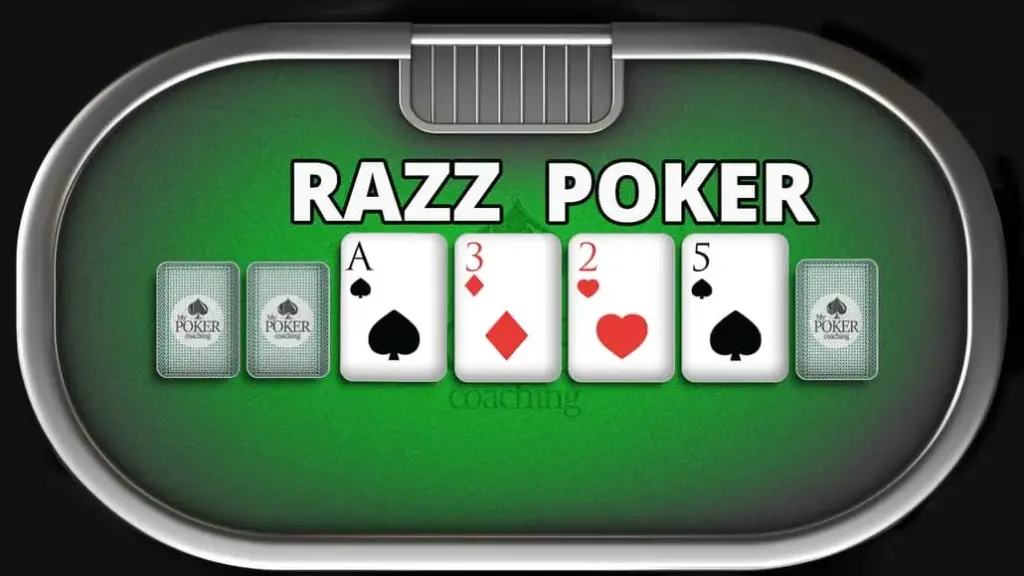
Featured Casinos

Zizobet
50 Free Spins No Deposit

Cosmobet
50 Free Spins No Deposit

Velobet
50 Free Spins + £10 Bonus

Rolletto
50 Free Spins No Deposit

WinPlace
Welcome Bonus 100% up to £4,000 + 100 FS

LuckyWave
100% up to £2,000 + 150 FS

Daytona Spin
Welcome Pack 255% up to £4500 + 255 FS

Spin Polo
Welcome Pack 777% up to £ 7777 + 385 FS

Totbet
Welcome Pack Up To £3000 + 300 Free Spins
This site earns commission when readers click casino links. This does not affect our editorial independence or the accuracy of this review.
Razz Quick Verdict
Razz is a seven-card stud lowball poker variant with no fixed house edge or RTP, since it is a player-versus-player card game rather than a house-banked casino game. There is no proprietary developer behind Razz; it is a traditional poker format that dates to the early twentieth century and has featured as a World Series of Poker event every year since 1971, with Jimmy Casella winning the inaugural $10,000 event. Bets in Razz follow a fixed-limit structure across five streets, with an ante, a forced bring-in on Third Street, small bets on Third and Fourth Street, and bets that double from Fifth Street onward. Because Razz is not a house-banked product, it carries no UKGC casino licensing in the conventional sense; it is spread at licensed poker rooms and mixed-game tournaments rather than in a standalone casino lobby. This review draws on Wikipedia's poker history entry, PokerCoaching's rules and strategy guide, and CardsChat forum discussion threads for player sentiment. Rules, format availability, and stakes are subject to change, so verify current details at the operator site before playing.
House Edge and Odds
Razz has no quantifiable house edge or RTP because it is a player-versus-player poker variant, not a game the house banks against you. This makes it fundamentally different from casino table games such as roulette or baccarat, where a fixed mathematical edge applies regardless of skill. Instead, the operator's revenue comes from rake, typically taken as a percentage of each pot, commonly cited in the 2.5% to 10% range with a cap, or via tournament entry fees. Because outcomes depend on the relative skill of the players at the table rather than a built-in house percentage, there is no expected-value formula that applies uniformly to every Razz hand, unlike a crash game's constant P = RTP / M relationship or a roulette wheel's fixed edge per bet type. A player's actual return depends on starting hand selection, dead-card tracking, and opponent tendencies, meaning a skilled Razz player can be a long-run winner against weaker opposition while a poor player consistently loses money to the field, all before rake is deducted. This distinguishes Razz from formats reviewed elsewhere on this site, such as Simplified Craps review or our Salon Prive Baccarat strategy guide, both of which carry a defined house edge you can calculate against any stake. For context, a £10/£20 fixed-limit Razz game with a £2 ante and standard rake structure might see an average £3 to £5 rake taken from a £150 pot, a cost that exists independent of how skilfully any individual hand is played. Compared with Seven Card Stud Hi-Lo or Omaha Hi-Lo, which also use split-pot Ace-to-Five low evaluation, Razz is a single-pot lowball game, meaning the entire pot goes to the single best low hand rather than being divided.
Rules and Gameplay
Razz is dealt from a single standard 52-card deck to up to eight players, using no community cards. Each player receives two cards face-down and one face-up on Third Street, and the player showing the highest upcard is forced to post the bring-in bet. Betting then proceeds with a small bet through Third and Fourth Street, before bets double to the big bet size from Fifth Street through to Seventh Street, with a cap of one bet plus three raises per street in most fixed-limit rooms. From Fourth Street onward, the player showing the lowest visible board acts first, a reversal of the high-hand convention used in standard stud games. Players ultimately hold seven cards, two of them face-down after the final Seventh Street card, and must construct the best possible five-card low hand from those seven. A useful slot-side benchmark is Winter Trophy Hold And Win review, especially when comparing RTP, volatility, and feature depth.
Ace-to-Five Lowball Rankings
Aces always play low in standard Razz, and straights and flushes are ignored entirely when ranking hands, meaning A-2-3-4-5, known as the wheel, is the best possible hand. Pairs weaken a hand significantly, so a hand such as 7-6-4-3-2 beats any hand containing a pair, regardless of how low that paired card is.
Bring-in System
Unlike Seven Card Stud high, where the lowest upcard brings in the action, Razz forces the player with the highest, or worst, upcard to post the bring-in. This inverted mechanic shapes early street strategy, since players showing strong low cards can often raise cheaply to isolate the forced bettor.
Visible Upcards and Card Removal
Four of each player's seven cards are dealt face-up, giving Razz significantly more visible information than Texas Hold'em or Omaha. Skilled players track which low cards are already visible in opponents' boards, since a hand needing 2s, 3s, and 4s to complete is far weaker if three of those cards are already dead in other hands.
Deuce-to-Seven Variant
A less common format, Deuce-to-Seven Razz, inverts the rankings again: straights and flushes count against the hand, and aces play high, making 2-3-4-5-7 the best possible hand. This variant receives minimal coverage and low table availability compared with standard Ace-to-Five Razz.
Strategy and Tips
No strategy eliminates the house edge in casino games, and in Razz there is no house edge to overcome at all, since profitability depends entirely on your skill advantage over the other players at the table, minus the rake taken from each pot. Optimal starting hand selection means entering pots with three unpaired cards ranked 8 or below, ideally 5 or below, with A-2-3 regarded as the premium holding. Tracking every visible upcard from Third Street onward is essential, because a draw that looks live on paper may be mathematically dead if the outs are already showing in opponents' boards. Fifth Street is the critical decision point, since bets double from this street onward; players who have not improved against opponents showing three low cards are generally better folding rather than continuing to chase. On Seventh Street, pot odds usually justify calling with any made low hand, given the pot has grown substantially relative to the final bet. Ante stealing, raising on Third Street to win the pot uncontested before Fourth Street, is cited by coaching sources as a major recurring source of profit in fixed-limit Razz. Readers who enjoy tracking visible information and probability-based decisions may also find the dice-reading elements of Poker Dice live review a useful comparison in how visible information shapes betting decisions, even though the games are structurally unrelated.
Where to Play
Razz is available at zero verified UKGC-licensed casinos in the conventional house-banked sense, because it is a player-versus-player poker format spread through licensed poker rooms rather than a standalone casino game title. Unlike house-banked table games or crash titles, there is no operator-branded RTP or edge to verify, so availability depends on which poker platforms currently spread Razz tables or run Razz events, most notably as the
Frequently Asked Questions
No. Razz is a player-versus-player poker game, so there is no fixed house edge or RTP figure. The house earns revenue through rake, typically a percentage of each pot, rather than a built-in mathematical edge against players.
Razz is dealt across five betting rounds from a single 52-card deck with no community cards. Players receive seven cards each, and the lowest five-card hand wins, with aces always low and straights or flushes ignored, making A-2-3-4-5 the best possible hand.
There is no fixed maximum payout, since Razz is a fixed-limit poker game and pot size depends entirely on the table stakes played and the number of participating opponents, not a preset multiplier.
Razz is generally mobile compatible where poker platforms spread it, though this review could not independently confirm mobile availability across all rooms given very low table liquidity for this niche variant.
Enter pots with three unpaired cards ranked 8 or below, ideally 5 or below, with A-2-3 considered the premium starting hand. Track every visible upcard to judge whether your outs are still live before continuing past Fifth Street.