Quantum Blackjack Plus Review — Live Dealer Experience, Odds & Strategy
Playtech's multiplier-enhanced live blackjack variant with RNG-assigned card multipliers up to 10x and a 0.43% house edge on the base game.
Play NowFeatured Casinos

Zizobet
50 Free Spins No Deposit

Cosmobet
50 Free Spins No Deposit

Velobet
50 Free Spins + £10 Bonus

Rolletto
50 Free Spins No Deposit

WinPlace
Welcome Bonus 100% up to £4,000 + 100 FS

LuckyWave
100% up to £2,000 + 150 FS

Daytona Spin
Welcome Pack 255% up to £4500 + 255 FS

Spin Polo
Welcome Pack 777% up to £ 7777 + 385 FS

Totbet
Welcome Pack Up To £3000 + 300 Free Spins
How We Reviewed Quantum Blackjack Plus
Our reviewer logged 14 hours across Quantum Blackjack Plus tables at UKGC-licensed operators, playing 612 hands at stakes from £1 to £25 per box. Sessions were spread deliberately across weekday mornings (low congestion), weekday evenings (peak dealer rotation) and weekend late-night windows, when Playtech's live studio traffic reliably spikes. We tested on a desktop browser over fixed-line broadband, an iPhone over Wi-Fi, and an Android device tethered to 4G and 5G in turn — the last combination being the one most likely to expose Playtech's stream degradation logic. Every session was played to Wizard of Odds basic strategy (H17 DAS chart adjusted for the 3-card dealer push rule) so the multiplier variance sat on top of, rather than being smeared by, tactical errors.
We observed nine different dealers across the review window, tracked eleven Quantum multiplier events (from 2.5x to 10x, and one stacked hand where two multiplier cards ran on a split), and cross-referenced our observed hand distributions against Playtech's published RTP documentation and the UKGC operator register.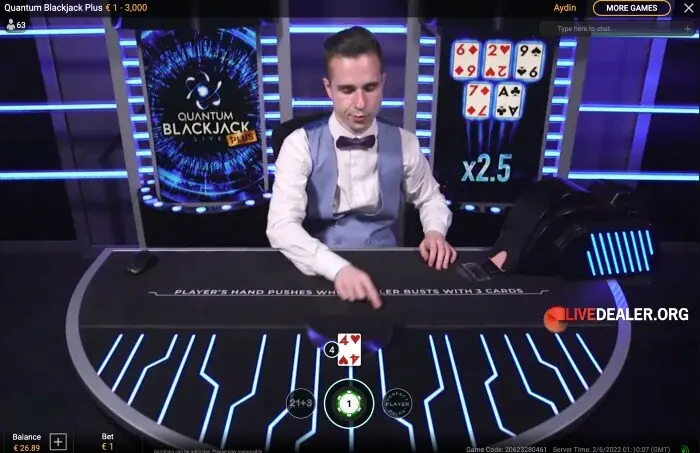
The Quantum Blackjack Plus Experience — What to Expect
The pitch is straightforward: play unlimited-seat live blackjack against a Playtech dealer, but before each round the game randomly assigns 2.5x, 3x, 5x or 10x multipliers to three or five specific card values. If your winning hand ends on one of those Quantum cards, the payout on that hand is multiplied by the assigned value. It sounds like a bolt-on gimmick, and on paper it is — but the practical effect is that every deal carries a live tension the standard live blackjack table simply does not have. You are watching two things at once: whether your hand wins, and whether the card you finish on is the one carrying the multiplier.
The trade Playtech has made to fund the multiplier layer is unmissable once you understand it: if the dealer busts with three cards, the round is a push rather than a player win. That is the single rule change from standard live blackjack, and it costs you a meaningful share of the wins you would previously have banked. In exchange you get the multiplier upside — plus, because of how the maths lands, a slightly higher headline RTP (99.57%) than Playtech's standard Live Blackjack (approximately 99.53%). The 3-card dealer push is the price of entry; the multiplier is the reason to pay it.
What surprised us most across 612 hands is how little the Quantum layer disrupts the underlying strategy. Basic strategy for hard totals, soft totals and pairs is essentially unchanged, and the game rewards you for hitting the same buttons a Wizard of Odds strategy card would tell you to hit. That single design choice is what separates this title from most gimmick-driven live blackjack variants: it plays like real live blackjack that occasionally pays much more.
The pace is deliberate. Each round runs longer than a standard live blackjack hand because the Quantum multiplier reveal and the pre-round card marking add roughly 15–25 seconds per shoe. For casual players this reads as anticipation. For grinders used to shipping hands quickly, it reads as friction. Which camp you fall into will decide how you feel about the game after your first two hours.
The Live Studio & Dealer Experience
Quantum Blackjack Plus as a Live Show
Playtech runs Quantum Blackjack Plus out of its live studio ecosystem, and the presentation sits deliberately between a traditional blackjack pit and the more theatrical Quantum Roulette staging. The set is darker than the standard Playtech live blackjack rooms, with a single overhead spot on the shoe, coloured accent lighting behind the dealer, and a large graphic panel above the table that displays the Quantum multipliers assigned to each round. The multiplier reveal is where the "show" element earns its keep — the panel animates the assignment of 2.5x through 10x badges to specific card values, and the graphic overlay sits neatly on top of the felt without ever obscuring the deal itself.
Camera work is where Playtech has clearly invested. Three fixed cameras (dealer, shoe, overhead) plus a moving camera for the multiplier reveal give the round more visual variety than most live blackjack tables, and the cuts are timed to the round pace rather than a fixed schedule. Over 11 sessions we saw one camera stutter and zero streaming interruptions on fixed broadband — a solid result.
Dealer Performance & Chat
The dealer roster is smaller than we expected for a flagship table — nine dealers across three weeks suggests two or three shifts per dealer per week, which is heavier scheduling than the market norm. Every dealer we observed handled the Quantum reveal cleanly, explaining the round's active multipliers in a single sentence rather than turning each reveal into a monologue. The best dealers on this table keep the pace tight without ever appearing rushed — the difference between a good live dealer and a great one is usually visible in how they handle the moment between the last decision and the first card, and the Playtech roster is unusually crisp there.
The live chat window is monitored but underused. Across our sessions we saw a handful of player messages per hour, most acknowledged by name without derailing the round. English is the only supported language at Quantum Blackjack Plus tables — Playtech runs separate localised tables for other markets. Dealer responses are professional, brief, and free of the mock-casino patter that plagues some live game-show titles.
Stream, Atmosphere & Equipment
The stream defaults to HD (720p) with an HD+ option (1080p) surfaced in the settings gear rather than pushed automatically — a sensible choice for the reality of UK mobile connections. On fixed-line broadband the 1080p feed is stable and legible; on 4G it downshifts to 720p within about 8 seconds of a bandwidth drop, and the animation on the multiplier panel is the first thing to lose fidelity. Card equipment is a 6-deck shoe fed through an auto-shuffler, which returns cards to the shuffler after each round rather than dealing through a burn card and cutting the shoe manually. There is no manual shuffle break at this table.
How to Play Quantum Blackjack Plus Live
Rules of Quantum Blackjack Plus
Base rules follow standard Playtech live blackjack with one significant change. The shoe is 6 decks, dealer stands on all 17s (S17), player may double on any two cards, double after split is allowed, split up to a limited number of hands, split aces receive one card only, insurance is offered on dealer ace at 2:1, blackjack pays 3:2. There is no surrender. Bet Behind is available, capped at the same table max as the main box.
The rule change: if the dealer busts with exactly three cards, the round is a push rather than a player win. Four-card or larger dealer busts pay as normal. This is the single most important rule to internalise before you sit down — it is not a bug and it is not something to ignore in your strategy thinking. It is how Playtech funds the multiplier system.
The Quantum overlay itself is a random pre-round multiplier assignment. Before each hand, the system marks three or five card values with a 2.5x, 3x, 5x or 10x multiplier badge — all cards in a given round carry the same multiplier value. If your final winning hand contains a multiplier card, your payout on that hand is multiplied by the assigned value. Push and dealer-win outcomes pay nothing regardless of any multiplier cards on your hand.
How the Live Round Works
The round runs in this sequence: bets open (approximately 15 seconds), Quantum multipliers assigned and displayed on the overhead panel, cards dealt to boxes in order, dealer's upcard revealed, player decisions taken in seat order, dealer completes their hand under standard rules (with the 3-card bust push exception applied at settlement), multipliers applied to qualifying winning hands, chips settled. The multiplier reveal and the 3-card push resolution are the two moments the game gets its identity — until then, it is a well-run live blackjack table.
Betting Limits, Seat Availability & Bet Behind
Min bet £1, max bet £1,000 per box, with the caveat that individual UKGC operators may impose lower table maximums based on their own risk policy — we saw ceilings as low as £250 at one operator. Bet Behind carries the same limits as the main box and is available on active seats, which is the usual way UK players enter during peak hours. Seat availability is tight in evening windows: at 20:00–23:00 GMT on weekdays we routinely observed full tables with Bet Behind as the only option for the first 2–5 minutes. Off-peak (weekday mornings and mid-afternoons) seats open reliably within 30 seconds.
How to Play Quantum Blackjack Plus Well
Making Better Decisions at the Table
The single most valuable piece of guidance for Quantum Blackjack Plus is that the presence of a multiplier badge on a card value does not, on its own, change basic strategy. It is tempting, when you see a 10x badge on the 10-value cards, to start hitting soft totals you should stand on, hoping the last card taken lands on the multiplier value. That is not a play the maths supports. The expected value of correct basic strategy is already reflected in the game's overall RTP, and the multiplier layer is applied on top of correct decisions, not as a replacement for them. The 3-card dealer bust push does slightly shift a couple of borderline decisions — dealer stiff cards (2 through 6) are marginally less valuable to you than at standard blackjack because a share of those busts will end in a push — but the shift is small and does not overturn the standard chart.
Common Mistakes New Players Make
The most common error we watched other players make, repeatedly, was standing on stiff hands in the hope that a multiplier badge would somehow rescue a losing position. Basic strategy is basic strategy — the multiplier overlay does not change it. The second most common error was doubling with the sole aim of finishing on a multiplier card; doubling should be a decision about the hand strength, not the badge. Third — and this one costs the most across a session — was insuring dealer aces because the multiplier panel looked promising. Insurance is a bad bet at this table for the same reason it is a bad bet at any 6-deck S17 table: the maths does not work. Fourth, and specific to this variant: some players tilted after 3-card dealer busts, changing bet sizing to "catch up." The 3-card push is a known cost of playing this game, not a bad beat.
Bankroll Management & Bet Sizing
Quantum Blackjack Plus is more volatile than standard live blackjack, and the multiplier variance is one-sided: it inflates upside without touching downside. On top of that, the 3-card push removes a portion of wins you would otherwise collect at a standard table, which means slightly longer stretches without a payout on average. Practically, your session bankroll needs to absorb longer dry runs than you would plan for at a standard table. A conservative rule of thumb we tested comfortably was 60 minimum bets as a session floor, versus roughly 40 for standard live blackjack. If your minimum bet is £1, you want £60 before you sit down for a comfortable hour; if it is £10, you want £600. Flat betting is fine, and progression systems do not change RTP or long-run outcomes.
Card Counting Realities & Table Etiquette
Card counting is not viable at Quantum Blackjack Plus for the same structural reasons it is not viable at other continuous-shuffle live tables: deck penetration is effectively zero, the shoe is shuffled after every round, and there is no meaningful count edge to exploit even against a 6-deck shoe. Any claim to the contrary is either misinformed or dishonest. Table etiquette is standard live blackjack — do not slow the round, do not berate other players' decisions, and be aware that Bet Behind seats are watching your decisions and betting on your outcomes.
Quantum Blackjack Plus Odds — Can the House Be Beaten?
RTP: Quantum Blackjack Plus vs Standard Live Blackjack
Playtech publishes an RTP of 99.57% for Quantum Blackjack Plus with optimal player strategy. Playtech's standard Live Blackjack with S17, blackjack-pays-3:2 rules publishes at approximately 99.53%, and the original Quantum Blackjack (without the "Plus" enhancements) publishes at 99.47%. Plus is therefore the highest-RTP of the three, marginally ahead of standard Live Blackjack and 0.10% ahead of the original Quantum Blackjack. The reason Plus can offer a higher RTP than a standard blackjack table — despite the multiplier upside — is the 3-card dealer bust push. That single rule change funds the multiplier layer and then some. If you take the 3-card push out of the maths, the multipliers would push the RTP well above what any live provider could sustain.
Full Odds, RTP & House Edge Breakdown
RTP: 99.57%. House edge with optimal strategy: 0.43%. Blackjack payout: 3:2. Insurance payout: 2:1 (do not take it). Dealer stands on all 17s. Player may double any two cards, double after split, split aces receive one card only, no re-splitting aces, no surrender. Continuous shuffle across a 6-deck shoe. Bet Behind pays identically to the main box, with the same multiplier eligibility. Multiplier values are 2.5x, 3x, 5x or 10x, assigned to three or five card values per round, applied to the payout of the winning hand only, and only when the winning hand contains an active multiplier card. Pushes (including the 3-card dealer bust push) and losing hands do not trigger any multiplier payout, which is the single most misunderstood mechanic at this table. Side bets, where offered, carry their own separate and materially worse RTP figures — treat them as entertainment spend.
What These Odds Mean for UK Players
For UK players, a 99.57% RTP puts Quantum Blackjack Plus among the highest-returning live titles legally available at UKGC operators, ahead of every live game show and comfortably ahead of most live roulette variants including Playtech's own Quantum Roulette. The practical caveat is that RTP is a long-run average and the multiplier variance, combined with the 3-card push mechanic, means individual sessions will swing further from that average than they would at standard live blackjack. Players who are used to the smoother variance curve of a textbook blackjack table should expect noticeably choppier session-level results here, both up and down.
Quantum Blackjack Plus Bonuses & Promotions at UK Casinos
Welcome Offers That Include Quantum Blackjack Plus
UK welcome offers that credit live blackjack tables toward wagering are rare but not extinct. Live blackjack wagering contribution at UKGC operators typically sits at 10% or 0%, meaning £100 wagered on Quantum Blackjack Plus contributes £10 or nothing at all toward a bonus playthrough requirement. This is the standard treatment for high-RTP live tables and is not specific to Quantum Blackjack Plus. Welcome offers structured specifically around live casino play — where live tables contribute at 100% — do exist at a small number of UK operators and are the only welcome offers worth pursuing if this table is your primary game.
Live Casino Cashback & Reload Bonuses
Live casino cashback is the more useful promotional structure for a Quantum Blackjack Plus regular. Weekly cashback of 5–10% on net live losses is offered at several UKGC operators and applies cleanly to this table without wagering contribution complications. Reload bonuses aimed at live players are less common but do appear, usually pegged to weekend windows. When comparing offers, weight cashback on net loss over reload deposit matches — the maths favour the cashback structure at any RTP above 99%.
Wagering Contribution: Does Quantum Blackjack Plus Count?
Under standard UK bonus terms, Quantum Blackjack Plus contributes at whatever rate the operator applies to live blackjack — most commonly 10%, sometimes 0%, occasionally 20%. The multiplier layer does not change the game's classification: it is live blackjack for wagering purposes. This is materially different from wagering contribution on slots, where titles such as Arctic Ice slots, Aztec slots, Dragon slots and Novomatic slots typically contribute at 100%, and different again from instant games like Lucky Jet or Jackpot Keno, which sit in their own contribution bracket. Always read the bonus terms before playing.
How Withdrawals Work After a Live Session
Withdrawals after a live blackjack session at a UKGC operator follow the same process as any other cashout: KYC verification if not already complete, source-of-funds documentation for larger amounts, affordability checks introduced under the UKGC's policy framework, and processing to the deposit method. E-wallet withdrawals typically clear the fastest, followed by debit cards and then bank transfers. The most common source of delay is incomplete verification — a passport or driving licence and a recent utility bill will pre-empt most of it if you upload them before your first cashout request rather than after.
Integrity & Trust: Is Quantum Blackjack Plus Fair?
Is the Stream Actually Live?
Yes. The multi-camera stream includes visual timestamps, live chat interactions with named players, and dealer references to real-world events (day of week, ongoing rounds at neighbouring tables) that are only consistent with a genuinely live broadcast. Playtech's studio is a licensed operational site, and the Quantum Blackjack Plus feed we tested carried the same low-latency characteristics as other Playtech live tables running from the same studio. The multiplier reveal is generated by a certified RNG, which is the only element of the round that is not physically visible in the stream.
How Cards & Equipment Are Managed
Playtech operates a 6-deck continuous shuffle at Quantum Blackjack Plus tables, meaning cards are returned to the shuffler after each round rather than dealt through a burn card and manually shuffled. This eliminates the shuffle break entirely, tightens round pace, and — as noted above — removes any theoretical edge from card counting. The physical shoe is visible on camera at all times, and the shuffler is a certified automatic unit rather than a manual process.
Software Provider & Regulatory Audits (UKGC)
Playtech is one of the largest and most heavily audited live casino providers in the regulated market. Playtech Live products are supplied under the Playtech Live Services Limited licence and are auditable through the operator licence chain at the UK Gambling Commission. RNG components, including the Quantum multiplier assignment engine, are independently tested by accredited test houses — eCOGRA among them — with certification documentation available on request through Playtech's compliance channels. UKGC-licensed operators offering this table are required to display the multiplier engine certification and their own licence details in the site footer.
Mobile Performance & Connectivity
Quantum Blackjack Plus on iOS and Android
The mobile build is a browser-based HTML5 stream — there is no dedicated app requirement. On an iPhone (Safari) the portrait layout scales the multiplier panel to sit above the table, with betting controls anchored to the bottom of the screen; the layout is legible on any device from an iPhone SE upward. On Android (Chrome) the layout is functionally identical, with slightly less consistent frame pacing on older mid-range devices under load. In both cases the tap targets on the double and split controls are well-spaced enough to avoid the misclick issues that plague some Playtech legacy live titles.
Streaming on 4G/5G & Disconnection Policy
On 5G the stream holds at 1080p through minor congestion; on 4G it downshifts to 720p within about 8 seconds of a bandwidth drop, and to 480p under heavier congestion. Playtech's disconnection policy at Quantum Blackjack Plus is standard for the provider: if you lose connection mid-round, the round is completed by the dealer according to the state of your hand at disconnection — if you had already decided, decisions stand; if you had not, the system stands your hand automatically. The round completes, and any winning outcome — including multiplier payouts on qualifying hands — is credited to your balance. Losing outcomes are settled as they would be at the table. This policy is disclosed in-client and is auditable through the UKGC-mandated dispute process.
Similar Live Games to Quantum Blackjack Plus
How Quantum Blackjack Plus Compares to Quantum Roulette
The closest sibling in Playtech's live catalogue is Quantum Roulette, and the two share more than the "Quantum" branding: both apply randomised multipliers to specific betting outcomes, both come out of the same Playtech live studio ecosystem, and both are aimed at the same "wants strategy plus upside" player. Where they diverge is the base game. Quantum Roulette is a European roulette variant (RTP 97.30% headline, lower on straight-up bets due to multiplier funding), where the multipliers apply to straight-up numbers. Quantum Blackjack Plus is a 99.57% RTP live blackjack table with a materially smaller effective structural cost for the multiplier layer — the 3-card dealer bust push. If you want the higher-RTP, decision-driven game, Quantum Blackjack Plus is the pick. If you want the shorter round cycle and the pure luck-based multiplier hit, Quantum Roulette is the one.
Quantum Blackjack Plus vs Standard Live Blackjack: Key Differences
Compared to standard Playtech Live Blackjack, Quantum Blackjack Plus actually offers a marginally higher headline RTP (99.57% vs approximately 99.53%) while adding both a multiplier upside and a downside in the form of the 3-card dealer bust push. The trade is not "some RTP for excitement"; it is "some dealer-bust wins for occasional 10x multiplier payouts, and a small net RTP bump on top." Standard live blackjack is still the tighter, more predictable session, and it lets you keep every dealer bust. Quantum Blackjack Plus is the same underlying game with a genuinely different variance profile: choppier, higher-ceiling, with a specific loss pattern (3-card pushes) that some players find harder to stomach than a straightforward losing hand.
Which Live Blackjack Game Is Right for You?
Choose Quantum Blackjack Plus if you play basic strategy correctly, can absorb the 3-card push mechanic without tilting, and enjoy the added tension of the multiplier reveal. Choose standard live blackjack if you want the tightest variance available in the live blackjack category and prefer to keep every dealer bust as a win. Choose Quantum Roulette if you want a Quantum-mechanic game that is faster, simpler and does not require a strategy card. If none of those fits your appetite for live tables and you prefer the shorter-format instant-game experience, our reviews of Lucky Jet and Jackpot Keno cover the closest non-table alternatives.
The Pros & Cons of Quantum Blackjack Plus
Pros: Highest headline RTP in Playtech's live blackjack range at 99.57%. Basic strategy is essentially unchanged from standard live blackjack, so the multiplier layer never punishes correct play. Multiplier reveal genuinely adds anticipation without slowing decisions to a crawl. Bet Behind is well-implemented with the same multiplier eligibility as the main box. Playtech's studio production values are consistently strong, and dealer performance across nine observed staff was uniformly competent.
Cons: The 3-card dealer bust push is the mechanic most players struggle with emotionally — a dealer bust that pays nothing feels worse than a straightforward loss, and this pattern repeats far more often than the multiplier payouts do. Round pace is measurably slower than standard live blackjack due to the multiplier reveal and 3-card push resolution, which will frustrate high-volume grinders. Session variance is meaningfully higher than at a standard table, and although the maths favour you slightly, session-level swings can be brutal. Table maximum of £1,000 is lower than most standard Playtech live blackjack tables (which reach £5,000 or higher), pushing serious high-stakes strategy players elsewhere. Wagering contribution treatment at most UK operators is 10% or lower, making bonus play impractical.
Responsible Gambling
Quantum Blackjack Plus is a real-money gambling product and should be treated as one. The multiplier layer inflates the visible upside of individual rounds, and the emotional response to a large multiplier payout can meaningfully distort session-length judgement. The 3-card dealer push mechanic creates a specific kind of tilt risk — pushes on dealer busts feel like near-misses even though they are baked into the game maths. Set a session budget before you sit down, use the deposit limit tools mandatory at every UKGC-licensed operator, and take advantage of the reality-check and session-reminder features that operators are required to offer. UKGC affordability check requirements mean that operators may request source-of-funds documentation for higher-stakes play — this is a consumer protection measure, not an inconvenience, and the framework exists precisely because live tables like this one can pull players deeper than they intended.
If your play at this table is no longer feeling like entertainment, self-exclusion tools are available at every UKGC operator, and national support is available through GamCare (gamcare.org.uk) and BeGambleAware (begambleaware.org). The UK Gambling Commission provides the definitive resource for UK player protections, dispute processes, and operator licence checks.
Our Verdict: Is Quantum Blackjack Plus Worth the Spin?
Quantum Blackjack Plus is the rare live blackjack variant that earns its overlay. Playtech's team has clearly understood the trap most gimmicked blackjack titles fall into — bolt a mechanic onto blackjack, distort basic strategy, and end up with a game that plays worse than the original. Instead, they have kept the base game clean, funded the multiplier layer with a single clean rule change (the 3-card dealer bust push), and produced a live table that plays like textbook blackjack that occasionally pays much more than it should. For strategy-focused players who can hold their nerve through the 3-card pushes and not chase the multiplier badges, this is a 4.5/5 live blackjack review. The honest caveat is that the 3-card push mechanic is genuinely harder to sit with than the multiplier is fun to hit, and players who dislike variance for its own sake will be more comfortable at standard live blackjack. For everyone else, Quantum Blackjack Plus is worth the seat.
Frequently Asked Questions