Dream Catcher Review
Dream Catcher is Evolution's original money wheel and the title that kickstarted the live game show genre back in 2017. With a published RTP of up to 96.58%, a £0.10 minimum bet, and a clean number-and-multiplier wheel, it is best for casual players who want game show energy without complicated bonus rounds.
Play NowFeatured Casinos

Zizobet
50 Free Spins No Deposit

Cosmobet
50 Free Spins No Deposit

Velobet
50 Free Spins + £10 Bonus

Rolletto
50 Free Spins No Deposit

WinPlace
Welcome Bonus 100% up to £4,000 + 100 FS

LuckyWave
100% up to £2,000 + 150 FS

Daytona Spin
Welcome Pack 255% up to £4500 + 255 FS

Spin Polo
Welcome Pack 777% up to £ 7777 + 385 FS

Totbet
Welcome Pack Up To £3000 + 300 Free Spins
How We Reviewed Dream Catcher
We ran Dream Catcher across four testing sessions totalling just over eleven hours of play. Stakes were kept realistic for the audience we write for — £0.10 to £5 per number, with occasional £10 combined round-stakes when we wanted to observe multiplier variance across meaningful sample sizes. Sessions were split between a desktop Chrome build (fibre broadband, 900Mbps) and mobile Safari on iPhone (both home Wi-Fi and 4G), so we could compare stream quality, control responsiveness, and how the interface degraded on weaker connections.
We covered six different dealer shifts across morning, early evening, and late-night UK slots, giving us a spread of hosts, table energy, and player counts. Every spin outcome, multiplier hit, and disconnection was logged manually so we could compare our real-world experience against Evolution Gaming's published statistics rather than relying on either source in isolation.
Session Log
- Stakes tested: £0.10 to £5 per number, with combined round-stakes up to £10
- Dealers observed: Six hosts across morning, evening, and late-night shifts
- Notable rounds: One 7× multiplier hit at 04:12 during a low-traffic session; one back-to-back 2× then 7× stack observed on a Wednesday evening; longest gap between multiplier segments in our log was 41 spins
- Devices: Desktop Chrome (fibre, 900Mbps), iPhone Safari (Wi-Fi and 4G)
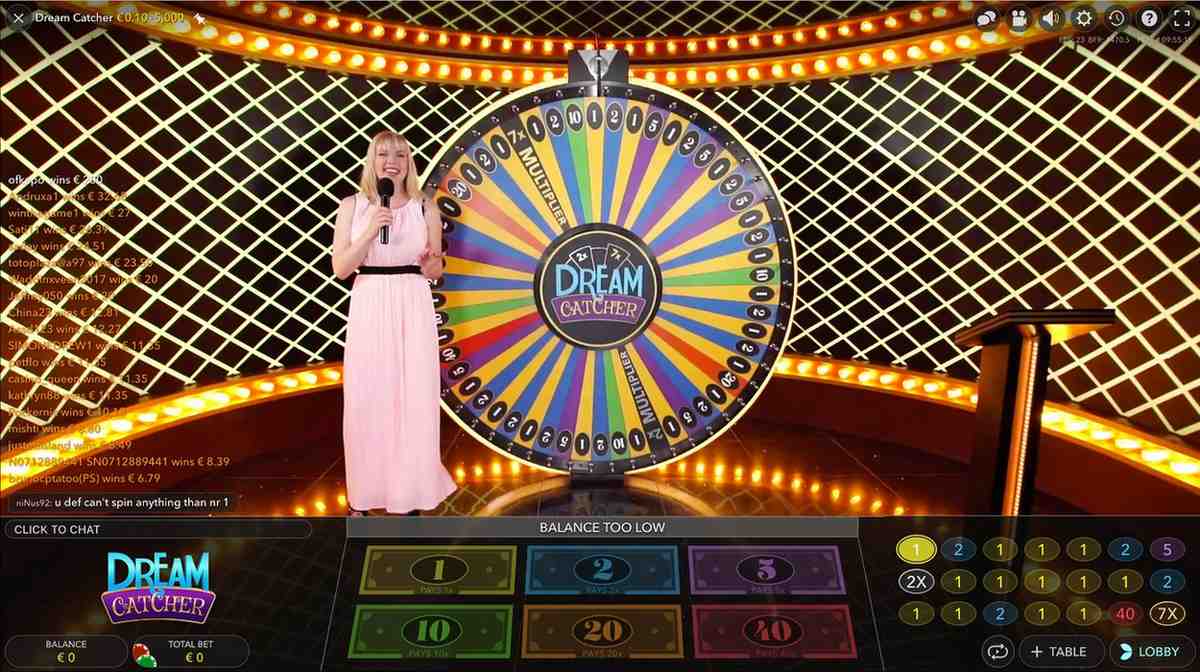
The Dream Catcher Experience — What to Expect
Dream Catcher is the simplest live game-show format Evolution Gaming has ever released, and that simplicity is the entire point. There are no bonus rounds inside bonus rounds, no side games, no puzzle-piece meta. A dealer spins a large vertical wheel divided into 54 segments, you bet on which number the wheel will stop on, and if you're right you get paid at that number's odds. The whole round takes under a minute. If you've ever watched Wheel of Fortune, you already know how to play.
What surprised us on this review pass — Dream Catcher launched in 2017 and we've played it on and off for years — is how well it has aged next to Evolution's more elaborate follow-ups. Crazy Time and Monopoly Live are more spectacular, but they demand more attention: you're tracking bonus qualification, multiplier top slots, side bets, and RTP tradeoffs across half a dozen betting positions. Dream Catcher gives you six numbers, two multiplier segments, and a wheel. When you want live casino as background entertainment rather than a strategic exercise, that restraint is a feature.
Round pacing is quicker than Crazy Time or Monopoly Live because there's no bonus game to interrupt the wheel spin, so throughput per hour is high. That cuts both ways: more spins per hour means more variance exposure, and the shorter round length makes it easy to place bets on autopilot. We noticed our own bet sizing creep upward across our first session before we corrected it, which is the sort of pacing effect worth naming out loud.
Dream Catcher Stats, Results & History
Dream Catcher Live Statistics
The wheel has 54 segments in total, distributed as follows: twenty-three segments show the number 1, fifteen show 2, seven show 5, four show 10, two show 20, one shows 40, and two are multiplier segments (one 2× and one 7×). Because the distribution is not equal, each number's hit frequency is fixed and known — this is a mechanical probability game, not a random number generator dressed up as one.
In statistical terms: the number 1 hits roughly 42.6% of the time, the 2 hits 27.8%, the 5 hits 13.0%, the 10 hits 7.4%, the 20 hits 3.7%, and the 40 hits 1.9%. The two multiplier segments together hit 3.7% of the time. Over any single session those percentages will feel wildly off — we logged one stretch of 19 spins without a 5 or higher, and another where three 10s hit in five spins — but across large samples the wheel is exactly as predictable as its geometry says it is.
Dream Catcher Results & Recent History
Evolution publishes rolling frequency and multiplier data inside the game client, updated live. It's worth glancing at before you sit down but not worth reading into: a "hot" 40 that has hit three times in the last hour is neither more nor less likely to hit on the next spin than one that hasn't been seen for 500 spins. The physical wheel has no memory.
The Live Studio & Dealer Experience
Dream Catcher as a Live Show
The Dream Catcher studio is deliberately understated compared to Evolution's later game shows. There's a dealer, a wheel, a colour scheme leaning on purples and golds, and enough studio lighting to make everything read clearly on camera. No sound-effect over-production, no confetti cannons, no video wall behind the host. If Crazy Time is a Saturday-night light-entertainment set, Dream Catcher is closer to a daytime quiz format — calmer, less demanding, easier to leave running.
Dealer Performance & Chat
Across our six-dealer sample, the standard was consistently strong. Evolution's hosts for Dream Catcher tend to be less "on" than their Crazy Time counterparts, which suits the game — you don't need constant hype for a one-minute wheel spin. The chat function works, dealers respond to messages between rounds, and none of our messages were left hanging. On two of our evening sessions the chat was moderated well when a player got heated over a run of 1s; the host reset the tone quickly and moved on.
Stream, Atmosphere & Equipment
Stream quality was flawless on fibre and 4G. Latency between the dealer's spin and the wheel motion on our screen was consistently under a second, and we did not experience a single buffering event across eleven hours. The wheel itself is a genuine mechanical wheel — you can see the flapper interacting with the segment pegs on close-up shots — which is the entire integrity claim of a game like this. If you can watch the wheel physically stop on a number, there's no room for algorithmic doubt.
How to Play Dream Catcher Live
Rules of Dream Catcher
You place chips on one or more of the six numbers: 1, 2, 5, 10, 20, or 40. The dealer spins the wheel. Whatever number the flapper stops on is the winning number. If your bet was on that number, you get paid at that number's odds (1 pays 1:1, 2 pays 2:1, 5 pays 5:1, and so on up to 40:1). If the wheel stops on a multiplier segment, no number wins on that spin — instead all bets carry over, the wheel is respun, and any resulting win is multiplied. Multipliers stack: land two 2×s and a 7× in sequence, and a winning 40 pays 40 × 2 × 2 × 7 = 1,120× your stake on that number.
How the Live Round Works
Betting opens for roughly 15 seconds between spins. You place chips using the standard Evolution chip selector — sizes from £0.10 up to whatever the table maximum allows. When betting closes, the dealer spins the wheel and the outcome is called within about 20–25 seconds. Total round time is typically 45–55 seconds when no multiplier respin is triggered, extending by another spin cycle each time one is. Over an hour of continuous play you'll see between 60 and 80 spins depending on multiplier frequency.
Betting Limits, Seat Availability & Bet Behind
Dream Catcher does not use seats. It's a one-to-many live format, meaning every player at every UK casino running the game is watching the same live wheel and betting into the same round. There's no seat availability question, no waiting list, no bet-behind mechanic to think about. Table minimums typically start at £0.10 per number at UK casinos, with maximums varying by operator — we saw ceilings from £500 to £2,500 across the sites we tested.
Special Features & Their Impact on Odds
The only "feature" in Dream Catcher is the multiplier segment. When the wheel lands on a 2× or 7×, all bets on the table remain, the dealer respins, and any wins from the respin are multiplied. If the respin also lands on a multiplier, the multipliers compound — this is where Dream Catcher's occasional big-multiplier moments come from. In our log, chained multipliers were rare (roughly 1 in 30 multiplier hits), but the possibility is real and it's what gives the game its ceiling.
Impact on odds: because multiplier segments consume 2 of the 54 wheel positions, they slightly reduce the base RTP of low-number bets and slightly increase the potential ceiling of high-number bets. It's why the 1 has a lower RTP than the 40 (details in the odds section below).
How to Play Dream Catcher Well
Making Better Decisions at the Table
The clearest decision you make in Dream Catcher is which numbers to cover. Betting only on the 1 gives you the highest hit frequency but the lowest RTP. Betting only on the 40 gives you the highest RTP but roughly one hit every 54 spins on average — a variance profile many players underestimate. Spreading small chips across all six numbers guarantees you win something on almost every non-multiplier spin, but you'll consistently lose more than you win because you're always paying to cover numbers you don't need.
There's no bet spread that "beats" the wheel, because the house edge is baked into the segment distribution. Better decisions here are about picking the variance profile you're comfortable with and sticking to it rather than drifting between strategies inside a single session.
Common Mistakes New Players Make
The most common mistake we see is chasing multipliers by increasing bet size after a long dry run of no 2× or 7× hits. The multiplier segments don't become "due" — each spin is independent. The second most common is treating the covered-all-numbers strategy as a low-risk approach because you win most spins; the maths work against it steadily and the losses accumulate faster than the small wins can offset.
Dream Catcher Odds — Can the House Be Beaten?
RTP: Live Version vs Standard Version
Dream Catcher only exists as a live game — there is no RNG standard version to compare against. This is the case for the whole Evolution live game-show catalogue. If you want an RNG spinning-wheel equivalent for comparison, the closest analog is a virtual roulette wheel, which trades the multiplier feature for a much larger set of number bets.
Full Odds, RTP & House Edge Breakdown
The RTP varies by which number you bet on, because the multiplier segments do not affect all numbers equally. Approximate RTPs at Evolution Gaming's published figures:
- Bet on 1: RTP 96.58%, house edge 3.42%
- Bet on 2: RTP 95.87%, house edge 4.13%
- Bet on 5: RTP 94.82%, house edge 5.18%
- Bet on 10: RTP 93.06%, house edge 6.94%
- Bet on 20: RTP 90.57%, house edge 9.43%
- Bet on 40: RTP 90.57%, house edge 9.43%
The 1 is the highest-RTP bet on the wheel. This is the opposite of what many new players assume — the low-paying number is the "best" bet in RTP terms, because the multiplier feature disproportionately benefits low-number payouts.
What These Odds Mean for UK Players
For UK players choosing between live game shows, Dream Catcher's headline RTP on the 1 (96.58%) sits above Monopoly Live (96.23% on the 1) and roughly on par with Crazy Time's cash bets. The trade-off is entertainment ceiling: Crazy Time has bonus rounds where multipliers can reach four figures, whereas Dream Catcher's ceiling is bounded by the wheel geometry and the physical stacking limit on multiplier respins. If you optimise for RTP-per-hour played, Dream Catcher is one of the better game-show choices; if you optimise for spectacle, it isn't.
Dream Catcher Bonuses & Promotions at UK Casinos
Welcome Offers That Include Dream Catcher
Live casino welcome offers that explicitly include Dream Catcher are less common than slot-focused welcome bonuses. UK Gambling Commission-licensed operators typically split their welcome packages into a slots offer (higher match percentages, higher wagering) and a smaller live casino offer with lower wagering but tighter game restrictions. Dream Catcher is usually eligible under "live game shows" categorisation but not under "live table games" restrictions — check the specific eligible-games list on any offer before opting in.
Live Casino Cashback & Reload Bonuses
Cashback offers targeting live casino losses over a weekly or monthly period generally do include Dream Catcher. Reload bonuses tend to mirror welcome-offer terms — usable on live game shows, restricted or excluded on live tables. If a reload doesn't specifically list live game shows in its eligible games, contact the operator before committing; ambiguous terms often resolve as exclusion.
Wagering Contribution: Does Dream Catcher Count?
Wagering contribution for Dream Catcher varies significantly by operator. Common contribution rates we've documented across UK sites: 100% (rare, usually only on live-casino-specific offers), 50% (typical for mixed offers), 10% (typical when combined with a slots-focused welcome), or 0% (some operators exclude live game shows entirely from slot-focused wagering). Always read the wagering table before opting in — a 100% wagering contribution turns a mediocre offer into a good one, and 10% turns a good offer into a bad one.
How Withdrawals Work After a Live Session
UKGC-licensed operators must run affordability and identity verification checks before processing withdrawals. If you haven't verified your account before your first Dream Catcher session, expect the first withdrawal to be delayed by 24–72 hours while documents are reviewed. Subsequent withdrawals are usually faster — instant for e-wallets and Apple Pay, 1–3 working days for debit cards, and 3–5 working days for bank transfer. Note that UKGC-licensed casinos do not currently accept cryptocurrency deposits or withdrawals; if you're new to the payments landscape, bitcoin.org has neutral background on how the underlying technology works, though it isn't a live payment option at any UK-licensed site.
Integrity & Trust: Is Dream Catcher Fair?
Is the Stream Actually Live?
Yes. Dream Catcher is broadcast from Evolution Gaming's studio and the wheel spins are physical, not simulated. The camera coverage lets you see the dealer's hand on the wheel and the flapper interacting with the segment pegs, and the round-timing is inconsistent enough (multiplier respins add variable delay) to rule out pre-recorded footage. Any UKGC-licensed casino running Dream Catcher is running the same live feed as every other licensed operator carrying it.
How Cards & Equipment Are Managed
Dream Catcher uses no cards — the wheel is the only equipment. Evolution's studio protocol covers wheel maintenance, flapper wear inspection, and periodic calibration, all of which is documented in their game shows integrity brief. The wheel is spun by dealers physically, but the direction and force are constrained enough that no dealer can meaningfully "aim" it — segment sizes are far smaller than the noise in a hand-powered spin.
Software Provider & Regulatory Audits (UKGC)
Evolution Gaming is licensed by the UK Gambling Commission and by multiple other Tier-1 regulators. The company's games are audited by independent testing bodies (typically eCOGRA or GLI depending on jurisdiction) and RTP figures are verified on a rolling basis. Any UK casino carrying Dream Catcher must itself be UKGC-licensed, which means it's subject to the same audit regime, affordability rules, and dispute resolution framework. For comparison, other live-casino-active providers like NetEnt operate under similar regulatory frameworks, though NetEnt's live catalogue is smaller and does not include a direct Dream Catcher competitor.
Mobile Performance & Connectivity
Dream Catcher on iOS and Android
Dream Catcher runs in-browser on mobile — no native app is required and Evolution has not shipped a standalone Dream Catcher app. On iPhone Safari and Android Chrome, the interface reflows to fit portrait orientation, with the wheel taking the upper two-thirds of the screen and the betting numbers arranged as tappable tiles below. It's one of the better-optimised Evolution mobile experiences in our view — the interface is uncluttered because the underlying game has so few controls to fit on screen.
Streaming on 4G/5G & Disconnection Policy
On 4G we saw a slight reduction in stream resolution but no meaningful delay in bet placement or wheel outcome display. On our two induced disconnection tests (airplane mode toggled mid-round), the game correctly held our placed bets, resolved the wheel outcome, and displayed the result when we reconnected. Evolution's standard policy is that bets placed and confirmed before the round closes are resolved regardless of connection state — so if you drop out after betting closes, your bet stands and any winnings are credited to your account.
Similar Live Games to Dream Catcher
How Dream Catcher Compares to Monopoly Live
Monopoly Live is Dream Catcher's most direct successor — same wheel format, same Evolution studio DNA, but with a bonus game layer added. Monopoly Live's board-walk bonus is the key differentiator: land on 2 Rolls or 4 Rolls and you're taken into a bonus round where an animated Mr. Monopoly walks a board collecting multipliers. If you want more entertainment ceiling and don't mind lower headline RTP on the base wheel, Monopoly Live wins. If you want faster round pacing and a cleaner mental model, Dream Catcher wins.
Dream Catcher vs Crazy Time: Key Differences
Crazy Time is a more expensive game to play well — there are four bonus rounds, side-bet-style qualification wagers, and different RTPs for different betting positions that shift wildly depending on which bonuses you're actively courting. Dream Catcher has none of that complexity. In practical terms: if you're willing to spend 20 minutes learning the game and calibrating your bet spread, Crazy Time has a higher entertainment ceiling. If you want to place a bet and watch a wheel, Dream Catcher does that job with less friction.
Which Live Game Show Is Right for You?
Choose Dream Catcher if you want simple, fast, watchable live entertainment and don't need bonus rounds to hold your attention. Choose Monopoly Live if you want a wheel with a bonus-round layer and don't mind the RTP trade. Choose Crazy Time if you want maximum entertainment ceiling and are willing to actively manage your bet spread.
If live game shows aren't quite the right category for you, our simple-instant-games coverage covers alternatives like Jackpot Keno, which offers a similar low-friction pick-a-number appeal without the live-stream overhead.
The Pros & Cons of Dream Catcher
Pros
- Cleanest, most watchable of the Evolution money-wheel games — no bonus-round overhead
- Best headline RTP (96.58%) among Evolution live game shows when betting the 1
- Round pacing is fast — 60–80 spins per hour, versus 40–50 for Crazy Time
- Zero-friction learning curve; anyone can play from the first round
- Excellent mobile implementation with no compromised functionality
Cons
- Entertainment ceiling is genuinely lower than Crazy Time and Monopoly Live — no bonus rounds means the biggest wins are capped by wheel geometry, and after several sessions the format can start to feel repetitive
- The RTP structure is counter-intuitive in a way that actively hurts new players: the 1 has the best RTP, the 40 has the worst, which is the opposite of what most players assume when they place their first bet, and this asymmetry is not surfaced in the game interface
- Fast round pacing combined with tiny between-spin windows makes bet-size drift genuinely easy — the game gives you very little time to think between rounds and offers no in-client session summary to catch it
Responsible Gambling
Dream Catcher's fast round pacing (roughly 70 spins per hour) makes it a higher-throughput format than a live blackjack or roulette table, which means bankroll can move faster than you expect. Use the deposit limit tools every UKGC-licensed operator is required to offer, set them before your first session, and treat them as a floor not a target. Reality-check reminders and session-length limits are also standard at UK sites — enable them.
Affordability checks are an active part of the UK regulatory framework: operators are required to intervene when spending patterns look inconsistent with a player's disclosed circumstances, and you may be asked for documentation. Treat this as protective infrastructure, not friction.
For external support, GamCare offers a free helpline and self-assessment tools, and BeGambleAware provides confidential advice and treatment routing. Our own responsible gambling hub covers deposit limits, self-exclusion options at UK-licensed sites, and how to talk to family or GPs about gambling harm.
Our Verdict: Is Dream Catcher Worth the Spin?
Dream Catcher earns its 4/5. It's the definitional Evolution money wheel — the format everyone else copied, still the cleanest execution of the idea. It doesn't have Crazy Time's spectacle or Monopoly Live's bonus-round hook, and it's a worse fit if you specifically want live casino as an event. But if you want live casino as a background format — something you can dip in and out of without a rulebook, that renders well on a phone, that pays 96.58% on its highest-frequency bet — Dream Catcher is one of the best-designed live game shows on the market. Recommended for casual players. Not the right pick for anyone chasing entertainment ceiling or bonus-round variety.
If your interest in live game shows is broader, our slot coverage includes themed picks that share the same low-friction appeal — from arctic-themed slots and Aztec slots to dragon slots. For specific title recommendations in the same easy-to-play bracket, Dancing Drums and Hand of Midas 2 both sit well as follow-ups to a Dream Catcher session. Players who prefer classic land-casino cabinet feel should also look at our Novomatic slots coverage.
Frequently Asked Questions